 Auto
Auto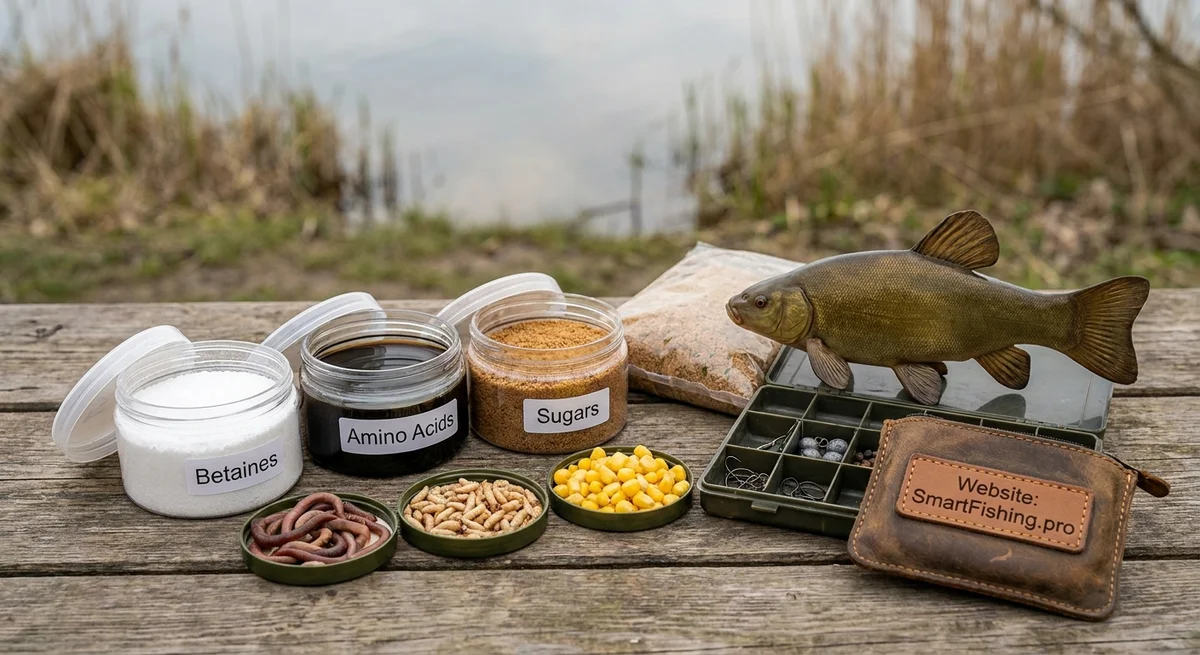
Introduction
Tench (a freshwater cyprinid fish) use their sense of smell and taste to find food. Chemoattractants are substances that fish can smell or taste, leading them to feed. Examples include betaine, amino acids, and certain sugars. These are small food nutrients that fish recognize in the water. Researchers have found that many fish (including carp and tench) respond strongly to free amino acids and betaines (edis.ifas.ufl.edu) (edis.ifas.ufl.edu). In this article, we review what lab and field studies show about using these attractants for tench, especially in summer waters, and give anglers practical advice on how to apply and test them.
Chemoattractants for Cyprinids
Amino acids and betaine are naturally found in the diets of tench and other carp-like fish. Free L-amino acids in prey (worms, crustaceans, plant matter) are readily detected by fish and trigger feeding. For example, key amino acids like alanine, glutamic acid, arginine, and glycine have been shown to cause strong feeding responses (edis.ifas.ufl.edu) (agris.fao.org). In one classic lab study, non-polar amino acids alanine, valine, and glycine given together produced very strong attraction in carp (agris.fao.org). Betaine (a small salt derived from choline found in shrimps and krill) is another powerful attractant. It stimulates taste receptors in many fish, making baits more effective (edis.ifas.ufl.edu). In fact, adding low levels of betaine (around 0.2%) to bland feeds significantly increased feeding activity in bass, suggesting tench would also respond to it (www.frontiersin.org). By contrast, sugars like sucrose seem to matter little. Fish do not taste carbohydrates strongly, so simple sugars alone are usually poor attractants (edis.ifas.ufl.edu). Instead, mixing sugars with other ingredients may help in some cases by affecting bait texture or release.
Evidence from Lab and Field Studies
Laboratory tests and field trials confirm that cyprinids are drawn to certain attractant molecules. In the lab, maze and feeding-ball assays let scientists give fish different odor cues and measure their response. For instance, grass carp strongly “bit” at balls soaked in solutions containing glycine, glutamic acid, and arginine (www.researchgate.net). A similar craving was seen in common carp, which preferred complexes of natural bait extracts full of amino acids (agris.fao.org) (www.frontiersin.org). In controlled ponds and lakes, anglers notice that putting amino acid or betaine bait near carp or tench leads to faster feeding and more bites. Such field observations match lab data: attractants often bring more fish into a feeding zone.
Interestingly, not every attractant works when isolated. In one study on crucian carp (a relative of tench), water extracts of commercial carp feed caused feeding behaviors, but an equal mix of just the feed’s amino acids did not (www.sciencedirect.com). This suggests that fish may need the full blend of natural bait compounds (peptides, nucleotides, oils, salts) to trigger a strong response. In practice, anglers often rely on natural bait extacts (like liver or krill glug) for this reason, since these contain many attractant chemicals together.
Effects of Warm Water (Summer Conditions)
Tench are active in warm summer water (around 20–25 °C). Warm water speeds up a fish’s metabolism and makes them feed eagerly. It also speeds up chemical diffusion, so attractants spread and dilute faster. In practical terms, this means an attractant spike might be intense but short-lived in hot water. Anglers should note that baits may lose their scent more quickly on a hot day or shallow warm lake. Using a slow-release carrier (see below) can help the attractant last longer. The high appetite of tench in summer is an advantage – they will bite readily if they smell food – but it also means one should keep renewing or refreshing attractants to maintain the scent cloud over time.
Dosage Ranges and Carriers
How much attractant? Studies suggest modest levels work best. In feeding trials with bass, attraction roughly doubled as betaine rose to 0.2% of bait weight, but fell off at higher doses (www.frontiersin.org). In other words, there is a “sweet spot” (often around 0.1–0.5% of the bait mix) where fish are most interested. Too little and they hardly notice; too much can actually repel fish or overwhelm their senses. A good starting point is about 0.2% (2 grams per kilogram of bait) for amino acids or betaine (www.frontiersin.org). For sugars, trials suggest even less effect – usually we treat sugar as a binder or flavor carrier rather than the main attractant.
Carrier Mediums: Attractants must be delivered in a way fish can encounter them. Common carriers include:
- Pellets or boilies: Mix attractants into ground bait or pellet dough. The bait soaks up the chemicals; fish bite into it releasing the scent.
- Liquid Glugs/Dips: Pre-mixed attractant syrups (often oil-based) can be poured or injected into baits, forming a sticky coating. Oils slow water uptake and prolong release.
- PVA bags or sticks: Spongy PVA (a dissolvable cloth) can be soaked in attractant solution and attached near the bait to create a scent “cloud.”
- Cotton baits or cloth: Some studies doused cotton and wrapped it around fine mesh with attractant, then submerged it. (This is mostly for lab trials (www.frontiersin.org).)
The goal is slow leaching: as the carrier absorbs water, it gradually releases the attractant compounds. Dense carriers (gelatin, agarose beads, groundbait with propylene glycol) can extend the scent. For summer fishing, consider adding extra binder so the attractant doesn’t all wash out instantly in the warm water.
Leaching Kinetics
Leaching means how fast the attractant dissolves into the water. In warm water, diffusion is faster. For example, an attractant powder on a bare hook could dissolve in minutes. Using a binder or gel slows this down by trapping the particles. Many boilies use egg or citrus oils to hold the soluble molecules. Liquid dips are usually made viscous or oily so they release slowly (some specialized “thick” dips are sold for hot conditions). In lab tests, carp took longer to find a bait if the attractant was trapped in a slow-leaching carrier. Sadly, precise leaching numbers are rare in published work, but anglers know the rule of thumb: warmer water = quicker leaching = shorter contact time. Check attractants at different temperatures if possible, and adjust amount accordingly.
Natural Sources vs. Synthetics
Natural sources like krill hydrolysate (an enzymatic extract of small shrimp) are rich in attractants: lots of free amino acids, small peptides, and high betaine content. Anglers prize krill ‘glug’ because it smells strong and is biologically tweaked to fish tastes. Indeed, krill has been shown to boost feeding and growth in cultured fish (edis.ifas.ufl.edu). Other natural attractors include squid meal, mussel or worm extracts, liver powders, and algae blends. The advantage is a broad spectrum of stimulants acting together (sometimes including nucleotides and micronutrients too (edis.ifas.ufl.edu)).
Synthetic attractants are pure chemicals: single amino acids (e.g. L-lysine, L-glycine), betaine (often as betaine HCl), or artificial flavors. They offer consistency (every bait gets exactly the same dose) and no spoilage. However, as the crucian carp study showed, a few synthetic amino acids by themselves did not equal the power of a natural feed extract (www.sciencedirect.com). Often blends of several synthetic attractants are needed to approximate natural baits. One tactic is to use a small amount of natural extract (like krill or meat juices) as a carrier for the synthetic boost.
In summary, natural gels like krill give a “whole bait” lure effect, while synthetics allow fine-tuning. Both can work well. For tench, combining them may be best: for example, add a synthetic amino acid or betaine powder to a krill-based bait for extra punch.
A Protocol for Testing Attractants
To figure out what works for a given lake or season, follow a simple trial method:
- Prepare test baits. Create at least three bait mixes: one control (no added attractant), and two or more test mixes with different attractants or dosages. For example: Control, +0.2% betaine, +0.2% glycine, and +0.5% of each. Keep all other ingredients the same (same pellet or boilie recipe, same moisture).
- Use the same carrier system. If you are using liquid dips, dip all baits (including control) in the same base (like empty oil) to cancel out the carrier effect. If using soaked pellets, soak all the same time but with different additives.
- Record conditions. Note date, time, water temperature, wind, and bait deployment time. Summer ≥20°C is our target.
- Set up trials. In the lab: you could use two aquarium sections, one with control bait and one with attractant bait, and count which one the fish swims to more often. In the field: on a boat or bank, prepare parallel rigs or spots. Cast bait with one treat, then another with the different treat. Alternate spots so each treatment gets similar conditions.
- Measure response. Ideally, count how many tench visit or take each bait. In a catch session, record numbers of bites or fish caught on each bait type. Note time taken to first bite as a speed measure.
- Repeat. Do multiple runs (e.g. 1–2 hours each) and swap bait positions to avoid bias from spot effects. More repetitions give more reliable data.
Data Sheet
Keep a simple log or spreadsheet. Columns might include:
- Date/Time – when the trial run occurred.
- Water Temp (°C) – measure near bait depth.
- Bait Type – description (e.g. “Base + 0.2% betaine”, “Base + krill soaking”).
- Carrier – how it was delivered (e.g. pellet, PVA bag, stick mix).
- Attractant Dosage – amount per kg or per bait (omit for control).
- Observation – count or notes (e.g. “10 fish on betaine bait, 4 on control”, “faster approach on krill mix”).
- Comments – color of cloud, bait integrity, any problem (e.g. bait disintegration).
Use a fresh row for each bait and each test. Over several trials you’ll see patterns (for example, bait with 0.2% betaine might consistently yield more bites). This systematic approach turns fishing into a mini-experiment – and gives you clear answers instead of guesswork.
Conclusion
Amino acids and betaine are proven attractants for tench and other carp-family fish (edis.ifas.ufl.edu) (edis.ifas.ufl.edu). Using them in summer baits can make a big difference, as fish are actively feeding and will home in on scent cues. Best results come from moderate dosages (roughly 0.1–0.5%) in a good carrier (pellet, gel, or liquid dip) (www.frontiersin.org) (edis.ifas.ufl.edu). Natural sources like krill hydrolysate supply a broad spectrum of attractants and should be part of your toolkit (edis.ifas.ufl.edu). Synthetic compounds let you fine-tune the mix and maintain consistency. Because warm water speeds leaching, aim for slow-release baits (thick coatings or PVA sticks) to keep fish interested longer.
Finally, test methodically. Use the protocol above to compare baits side by side. Write down your data (how many fish, time to bite, etc.) and you’ll learn exactly which attractant and dose works best on your water. With practice, you can design baits that tench can’t resist – harnessing science to catch more fish and make each summer session more successful.