 Auto
Auto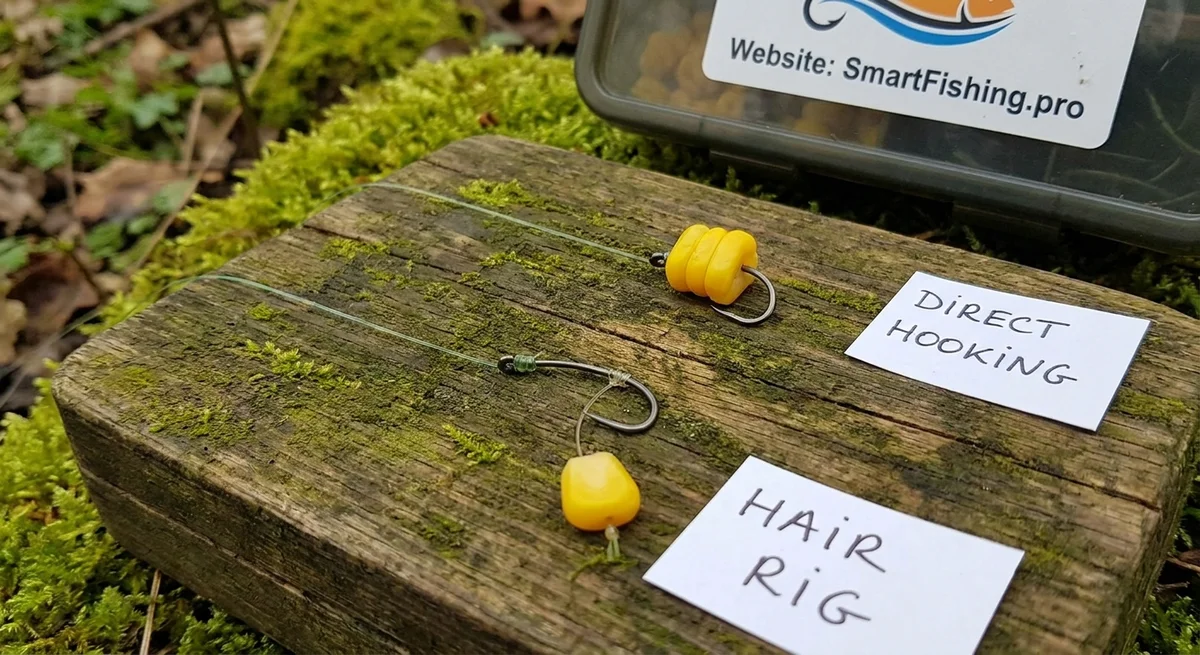
Hair Rigs vs Direct Hooking: When Subtlety Beats Separation in Tench Fishing
The best tench rig is not always the most advanced one.
A hair rig keeps the bait away from the hook. This can improve hooking and stop the hook point from being covered. But it also adds a hair, a stop, and sometimes a clip. On a clear, busy, heavily fished lake, that extra separation may be less important than making the whole offering look and move naturally.
A direct-hooked bait is simpler. A single grain of corn or a short worm section sits close to the hook and creates a small, compact package. This can be a major advantage when tench are inspecting every bait before they eat it.
The practical answer is simple:
- Use direct hooking when tench are cautious, the bait is small, and the bottom is clean.
- Use a short hair when the bait is being taken but the hook is not finding hold.
- Use a maggot clip when you need bait movement, bait security, or a hook point that stays completely clear.
- Let missed bites, bait damage, and debris tell you when to change.
There is no single “best” tench rig. The Tenchfishers’ rig guide makes the same point: bottom type, weed, range, bait, and fish size should all affect rig choice. (tenchfishers.com)
How Tench Feed and Reject Baits
Tench are mainly bottom-feeding fish. Their diet includes aquatic insect larvae, small crustaceans, worms, mollusks, plant matter, and other small items found around mud, silt, and weed. They often feed in shallow, still water with vegetation and soft bottom. (nas.er.usgs.gov)
The first stage: suction
Like other cyprinids, tench are expected to take many baits by creating suction. Water and the food item are drawn into the mouth together.
Laboratory work on common carp shows a fast intake phase followed by slower food handling. Water then moves back and forth inside the mouth as the fish tests, sorts, and positions the food. (vliz.be)
This matters because a tench does not always swallow a bait immediately. It may:
- Draw in the bait.
- Hold it briefly.
- Test its taste and texture.
- Move it around the mouth.
- Swallow it or blow it back out.
Cyprinid research shows that food kept in the mouth for longer is more likely to be swallowed, while rejected items are often released quickly. (journals.rcsi.science)
The second stage: rejection
A direct-hooked bait makes the hook and bait enter as one object. A hair rig allows the bait to move separately from the hook.
That difference is small in the angler’s hand, but important inside the fish’s mouth. A direct hook may be felt sooner. A hair may allow the bait to enter first, leaving the hook point free to catch as the fish moves away or blows the bait out.
However, a hair rig is not magic. It still needs a sharp, exposed hook, a sensible hair length, and enough resistance from the feeder, lead, or angler for the hook to turn and find hold.
High angling pressure can make this more important. Research on common carp has shown that fish can learn to avoid angling rigs after being hooked. They may also learn from seeing another fish caught. The evidence is on carp, not tench, but it gives a useful warning for heavily fished tench waters: a fish may reject a bait because of how it feels, not because it dislikes the bait itself. (academic.oup.com)
Direct Hooking: The Subtle Option
Direct hooking means the bait is pierced by the hook rather than mounted on a hair.
It is especially useful with:
- A single grain of corn
- One or two maggots
- A short piece of worm
- Small casters
- Very delicate marginal fishing
The main advantage is simplicity. There is no extra clip and very little separation between hook and bait.
Direct-hooked single grains
A single grain of corn on a small, strong hook gives a compact bait with a low profile. The grain and hook move together, so there is little loose line or extra hardware for a cautious fish to inspect.
This can work well when:
- The water is clear.
- The lake is heavily fished.
- Tench are feeding slowly.
- Free offerings are small.
- The bottom is clean gravel, clay, or firm silt.
- You are float fishing and can strike quickly.
The main weakness is that the grain can cover the hook point or reduce the hook’s gape. The hook point must remain completely clear. If the grain splits, slides down the shank, or becomes soft, replace it.
A direct-hooked grain is also less free-moving than a hair-mounted bait. That is not always a disadvantage. On a pressured lake, a small bait that behaves simply may look more believable than a bait swinging below a visible hair.
Direct-hooked worm sections
A short worm section offers more movement and scent than a grain of corn. It can be very effective when tench are feeding on natural worms or other soft-bodied prey.
Use a short section, rather than a long worm that can wrap around the hooklink. Pierce it near one end or through the stronger part of the worm, and leave the hook point and gape clear.
Direct-hooked worm sections are best when:
- Tench are moving confidently.
- The water is coloured.
- Worm is part of the loose feed.
- You are fishing close to weed edges or margins.
- The bottom is clean enough to stop the worm being buried.
The main failure is bait movement in the wrong direction. A long worm can twist, mask the hook, or slide off after a missed bite. Practical tench guidance often uses a short hair and a small fixing point to stop worms escaping or wrapping. (anglingtimes.co.uk)
Short Hair Rigs: The Middle Ground
A short hair gives you some of the benefits of separation without making the bait look too far away from the hook.
The bait should sit only a few millimeters below the bend of the hook. As a starting point, the nearest part of the bait can sit roughly 3–6 millimeters below the hook bend, then be adjusted according to the bait and the fish.
A short hair is often the best first change when direct hooking produces signs of feeding but poor hook-ups.
What happens during the take?
When a tench inhales the bait, the bait can enter the mouth without the hook being buried inside it. The hook point remains open.
If the tench moves forward, turns, or blows the bait back out, the hair can allow the hook to rotate and catch in the lip. This is the basic reason hair rigs are so widely used for carp and tench. (americancarpsociety.com)
The hair also allows the bait to wobble or waft slightly. This can make a worm, caster, or balanced maggot bait look more natural.
When a short hair is better than direct hooking
Choose a short hair when:
- Direct bait is being crushed or stripped.
- The hook point is being covered.
- Fish are taking the bait but not hooking.
- You need a soft bait to stay attached.
- You are using a small balanced bait.
- You are fishing a clean or lightly weedy bottom.
A short hair is also useful when using a worm section. A small rubber caster or bait stop can prevent the worm from sliding down the hooklink, while the short hair keeps the hook close to the bait. (anglingtimes.co.uk)
When a short hair is too much
A hair can work against you when it is too long.
A long hair may allow a cautious tench to pick up and eject the bait without bringing the hook far enough into its mouth. It can also tangle in weed, leaf litter, or soft debris.
If the bait comes back untouched after several clear indications, shorten the hair. If it is already very short, try the same bait directly on the hook.
Maggot Clips: Movement, Security, and a Clear Hook Point
A maggot clip places a small group of maggots away from the hook. The clip keeps the hook point exposed while the live maggots provide movement.
A small clip loaded with a few real maggots and one or two buoyant artificial maggots can be made almost neutrally buoyant. This allows the bait to sink slowly and remain easy for a feeding fish to suck in. The real maggots also wriggle and move on the bottom. (total-fishing.com)
Why maggot clips work
Maggot clips are useful when:
- Maggots are the main loose feed.
- Small fish keep stripping bait from the hook.
- Live maggots cover the hook point.
- You need a larger, more visible bait.
- The bottom contains light silt or leaf litter.
- You want to use a balanced bait.
Directly hooking a bunch of maggots can create problems. The maggots may mask the point, push apart, or make the bait spin. A clip solves some of these problems by keeping the hook separate and clear. (total-fishing.com)
The weakness of the maggot clip
A clip adds hardware. It can also add weight.
On a very clear, pressured lake, a tench may notice the extra movement or the unnatural weight of the bait. If the clip is too heavy, the whole bait may drop into silt instead of settling lightly on top.
Always test it in the edge before casting. The ideal presentation should:
- Sink slowly.
- Sit naturally on the bottom.
- Keep the hook point clear.
- Avoid spinning.
- Avoid burying the clip in silt.
- Remain balanced after the real maggots are added.
A maggot clip is not automatically better than direct hooking. It is better when bait movement and hook-point clearance matter more than absolute simplicity.
Direct Hooking vs Hair Rigs: A Practical Comparison
| Presentation | Bait movement | Hooking strength | Main advantage | Main weakness |
|---|---|---|---|---|
| Single grain directly on hook | Low and compact | Immediate contact | Very subtle | Grain can cover the hook point |
| Worm section directly on hook | High and natural | Immediate contact | Scent and movement | Can slide, wrap, or mask the point |
| Short hair | Moderate and independent | Good if hair is short | Open hook point with limited separation | Can fail if too long or tangled |
| Maggot clip | High, with live movement | Very clear hook point | Durable, visible, balanced bait | More hardware and possible fouling |
When Subtlety Beats Separation
Direct hooking usually wins when the fish are close, cautious, and selective.
Think of a pressured margin swim where tench are feeding on small individual items. A single grain of corn or short worm section may be more believable than a bait hanging from a clip or a long hair.
A short hair usually wins when the fish are taking the bait but not the hook.
This often happens when:
- The direct bait is masking the point.
- A worm is being crushed but not hooked.
- Maggots are covering the hook.
- The fish is feeding quickly and moving away.
- The hook is too deeply buried in the bait.
A maggot clip wins when the fish are feeding on groups of maggots, especially when you need the bait to move, remain visible, or survive nuisance fish.
The key question is not:
“Which rig is most modern?”
It is:
“What is failing: attraction, presentation, or hooking?”
Rig-Switching Rules Based on What You See
The following rules are practical starting points. They are not fixed scientific limits. Tench waters differ, so change one part of the rig at a time and keep notes.
Rule 1: Two or three missed bites with the bait untouched
If the bait comes back looking perfect, the tench may be testing and rejecting it before the hook engages.
- If using a long hair: shorten it.
- If using a short hair: try the bait directly on the hook.
- If using a maggot clip: reduce the clip size or switch to one or two direct-hooked maggots.
- Also check whether the hooklink is too stiff or the bait is too large.
This is the clearest situation where subtlety may beat separation.
Rule 2: The bait is damaged, but the hook is clean
This suggests the fish is eating or crushing the bait without allowing the hook to find hold.
- Change from direct hooking to a short hair.
- Keep the hook point fully exposed.
- If maggots are being stripped, use a small maggot clip.
- If a worm is being torn apart, use a shorter and tougher section.
The aim is to let the fish take the bait while keeping the hook free to turn.
Rule 3: The hook point comes back covered
This is a rig problem, not necessarily a bait problem.
- Direct-hooked maggots should be reduced in number.
- A worm section should be shortened.
- Move to a short hair.
- If using a maggot clip, reduce the number of real maggots or use a smaller clip.
- Replace any bait that has slid over the point.
A hook that cannot reach the fish cannot hook it, no matter how attractive the bait is.
Rule 4: The bait is missing but there is no proper bite
This often means small fish are stripping the bait, although it can also be caused by weed or debris.
- Use a tougher bait.
- Switch from direct-hooked maggots to a clip.
- Add artificial maggots or casters to protect the hookbait.
- Recast more often until you know what is happening.
A maggot clip is especially useful when small fish repeatedly destroy directly hooked maggots.
Rule 5: The bait is buried, but the hook is clean
This is a presentation problem.
- Use a critically balanced short-hair bait.
- Add one buoyant artificial maggot or caster.
- Use a small maggot clip with enough buoyancy to slow the descent.
- Reduce the size of the hookbait.
- Try a firmer patch of bottom.
A bait that is hidden in silt or leaf litter cannot be found easily, even if the rig hooks well.
Rule 6: The hook is fouled with weed or leaves
This is different from a buried bait.
- Shorten the hair.
- Use a stiffer hooklink to reduce wrapping.
- Try a compact direct-hooked grain.
- Reduce the number of maggots.
- Check the hooklink after every missed bite.
Some maggot presentations can collect weed, especially when the bait and hook move freely through soft debris. (gardnertackle.co.uk)
Rule 7: Both the bait and hook are fouled
Do not keep changing rigs forever.
If both bait and hook are covered on several casts, the spot may be unsuitable. Tench fishing guidance rightly places strong emphasis on bottom type and weed when choosing a rig. (tenchfishers.com)
In heavy debris, first try moving a short distance, clearing a small area, or finding a cleaner edge. A perfect rig cannot overcome a bait that lands in a pile of weed.
A Simple Decision Guide
Clean bottom, high pressure, small natural bait
Start with:
- Single grain directly on the hook
- Short worm section directly on the hook
- Small hook with a clear point
- Light, unobtrusive terminal tackle
Switch to a short hair only after bait damage or poor hook-ups show that direct hooking is failing.
Clean bottom, moderate pressure, fish feeding well
Start with:
- Short hair
- Bait just below the hook bend
- Corn, caster, worm section, or small balanced bait
- Hook point fully exposed
This gives you a good balance between natural movement and reliable hooking.
Maggot feeder, maggots in the feed
Start with:
- Small maggot clip
- A few real maggots
- One or two buoyant artificial maggots
- Slow-sinking or neutral presentation
This keeps the hook clear and allows the hookbait to match the free offerings.
Light weed, silt, or leaf litter
Start with:
- Short hair rather than a long hair
- Balanced bait
- Short or medium hooklink
- Regular checks for fouling
If the bait is buried, add buoyancy. If the hook is fouled, simplify the rig.
Heavy weed or dense debris
First decide what is fouling:
- Bait buried: use a buoyant, balanced short-hair or maggot presentation.
- Hook fouled: shorten the hair or use a compact direct bait.
- Both fouled: move or improve the spot.
A Useful Two-Rod Test
If the rules allow two rods, fish the same area with two different presentations:
- Rod one: single grain or worm section directly on the hook.
- Rod two: short hair or small maggot clip.
Record:
- Number of clear indications
- Number of missed bites
- Bait damage
- Hook fouling
- Hook-ups
- Fish lost
After three to five genuine takes, you should have a better idea of what the tench are accepting. Do not change bait, hook, feeder, hair length, and swim all at once. You will learn nothing from the result.
Final Safety Checks
Whatever rig you choose, make sure it is fish-safe.
The hooklink must be able to separate from the feeder or lead if the main line breaks. Avoid any arrangement that could leave a tench towing a feeder, lead, or long length of line. The Tenchfishers specifically recommends testing rigs for release and ensuring that tackle is strong enough for the expected fish and casting weight. (tenchfishers.com)
Before casting, check:
- The hook point is sharp and clear.
- The bait cannot slide over the point.
- The hair is not tangled.
- The clip is fully closed.
- The bait sinks or balances as intended.
- The feeder or lead can release safely.
- The rig lands cleanly on the chosen spot.
Conclusion
Direct hooking is the subtle tool. It is best when tench are cautious, the bait is small, and the bottom is clean. A single grain or short worm section can look more natural because there is less separation and less tackle around the bait.
A short hair is the compromise. It keeps the bait close while leaving the hook point free. Use it when direct bait is being damaged, masked, or taken without a hook-up.
A maggot clip is the movement and security tool. It is strongest when maggots are the main feed, small fish are a problem, or the bait needs to remain balanced above light debris.
The most reliable switching rule is this:
If the fish reject the offering, simplify it. If they take the bait but avoid the hook, separate it. If debris ruins the presentation, balance or reposition it.
That approach is more useful than following any fixed rig fashion.