 Auto
Auto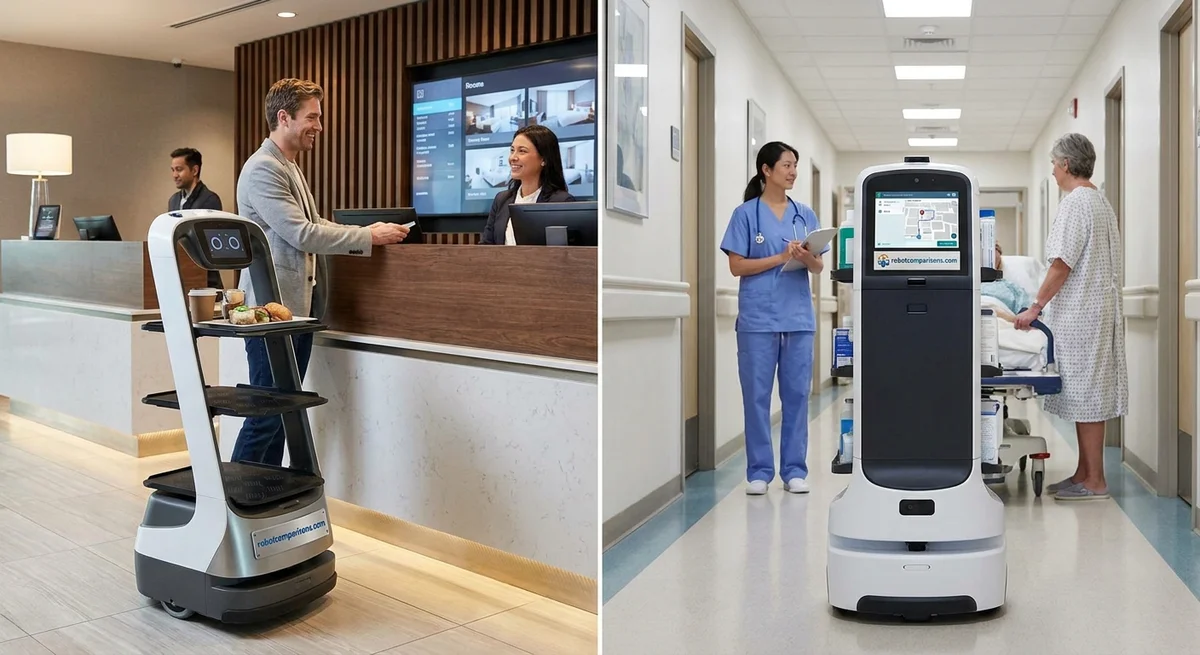
Service Robots in the Real World: Healthcare and Hospitality
Performance, hygiene, navigation, safety, and lessons from real-world pilots — current as of July 24, 2026
Service robots are no longer limited to trade shows and research labs. Hotels use them to deliver towels, food, and toiletries. Hospitals use them to move medicines, lab samples, linens, and supplies. Cleaning robots scrub floors, while newer systems are beginning to assist with patient transport.
But the reality is more specific than the marketing.
Today’s best service robots are specialists, not general-purpose workers. They perform well when the task is clear, the building is mapped, and the robot can safely stop when something unexpected happens. They perform less well when they must handle people, messy spaces, urgent decisions, or unclear instructions.
Quick comparison
| Task | Best current robot types | Real-world result | Main limitation |
|---|---|---|---|
| Hotel room delivery | Relay, Pudu FlashBot, Aethon Zena | Strong for towels, food, toiletries, and packages | Elevators, room access, and guest handoff still need careful setup |
| Hospital supply delivery | Moxi, Aethon TUG, Panasonic HOSPI, Relay | Strong for routine, non-urgent logistics | Robots may struggle with changing routes, blocked doors, or poor Wi-Fi |
| Patient transport assistance | Rovex Rovi; research systems | Emerging and limited to low-acuity or supervised use | Most commercial delivery robots do not move patients |
| Basic sanitation | Avidbots Neo, Pudu CC1, UVD-style UV robots | Strong for floors and supplemental disinfection | They do not replace manual cleaning of high-touch areas |
| Crowded-space navigation | Relay, Moxi, TUG, Pudu robots | Usually good in mapped indoor areas | Crowds, elevators, spills, and blocked charging docks can still cause failures |
| Healthcare hygiene readiness | Aethon TUG has the clearest public cleaning guidance | Can be included in a hospital cleaning program | Many vendors do not publicly list IP ratings or chemical compatibility |
These are qualitative judgments, not results from one common test. Most public data come from vendor reports, field pilots, published interviews, and research studies rather than independent head-to-head trials.
What service robots can really do today
Room delivery in hotels
Room delivery is one of the strongest commercial uses for service robots.
Relay, formerly associated with Savioke, is designed for hotels and hospitals. Its robot can carry room-service items, guest amenities, medicines, lab samples, and supplies. It can call elevators, ride between floors, return to its charging dock, and use secure compartments for sensitive deliveries. Relay says its fleet has completed more than one million deliveries and reports a 99.8% successful-delivery rate. Those figures are company-reported, not an independent industry benchmark. (relayrobotics.com)
The older Savioke hotel pilots showed why the task works. In one six-month hotel trial, the robot completed more than 1,000 deliveries. In another reported hotel deployment, Relay robots moved through a crowded lobby during a major technology event while guests walked around them. (spectrum.ieee.org)
Pudu competes with Relay through products such as FlashBot, which is built for hotel room service and can work in semi-open areas such as gardens, fitness zones, and poolside routes. Pudu also sells BellaBot and other robots for restaurant delivery. Its robots use combinations of laser mapping, visual mapping, cameras, and three-dimensional sensors. (pudurobotics.com)
The main lesson for hotel owners is simple: the robot does not remove the entire delivery process. A staff member must still:
- Receive the order.
- Prepare and load the items.
- Enter the correct room or destination.
- Handle special requests.
- Help if the guest is not available.
- Clean the delivery compartment and trays.
The robot removes the walking and carrying. It does not remove the need for a well-designed service process.
Hospital supply delivery
Hospitals are a more difficult environment than hotels. Corridors are busier, doors may require badges, elevators may be shared with patients, and deliveries can involve medicines or samples that need a clear chain of custody.
Moxi, from Diligent Robotics, focuses on non-patient-facing work. It delivers medicines, lab samples, PPE, linens, and supplies. It can open doors, use elevators, carry items in locking compartments, and use a robotic arm to grab or place selected objects. Diligent describes Moxi as a robot that learns from human guidance and adapts to different hospital workflows. (diligentrobots.com)
Aethon TUG is a more traditional hospital logistics robot. It can move food, linens, medicine, specimens, and carts. At UCSF, a fleet of TUG robots was reported to move food, linens, lab specimens, and medications through the hospital. TUG is built more like an automated porter than a social robot. (aethon.com)
Panasonic HOSPI is another hospital-focused competitor. At Changi General Hospital in Singapore, four HOSPI robots delivered medicine, medical specimens, and patient case notes. The robots used elevators, avoided wheelchairs and visitors, communicated with a control center, and used ID-card access to protect the contents. The model described in the case study carried up to 20 kilograms. (ap.connect.panasonic.com)
For hospital owners, the choice is often:
- Moxi for flexible workflows and light manipulation.
- TUG or HOSPI for secure, repeatable transport.
- Relay for compact, room-to-room delivery.
- A cart-towing robot for heavier loads.
No single machine is best at every hospital task.
Patient transport: the biggest gap
“Patient transport assistance” can mean several different things:
- Showing a patient the way.
- Walking beside a patient.
- Pushing a wheelchair.
- Pulling or pushing a stretcher.
- Moving a hospital bed.
- Helping transfer a person from a bed to a chair.
These tasks have very different safety requirements.
Most hospital delivery robots do not move patients. Moxi is specifically marketed for non-patient-facing logistics. TUG and HOSPI move goods, not people. This is an important boundary: a robot that can avoid a wheelchair is not automatically safe enough to push one. (diligentrobots.com)
Rovi: an important new pilot
Rovex’s Rovi is one of the clearest examples of a robot aimed directly at patient transport. It attaches to a stretcher and is designed to move low-acuity patients through a hospital. The company says it can navigate doors and elevators, detect obstacles in all directions, and keep patients informed about their destination. Rovi is being piloted with BayCare at Morton Plant Hospital. (gorovex.com)
Rovi is not presented as a robot for emergency patients or complex intensive-care transport. The company says it is designed for low-acuity patients and moves at walking speed. That limited scope is a strength, not a weakness. Safe automation usually begins with a narrow task.
Research shows why patient transport is difficult
Research systems demonstrate the technical challenge.
The HoLLiE care robot was tested at a hospital for wheelchair pushing and patient escort. The robot could grasp and steer a wheelchair, but pushing a real person did not work. The forces created by a loaded wheelchair were too high for the robot’s arms and hardware. The project concluded that a more specialized and compliant robot would be needed. (frontiersin.org)
Another system, called ARNA, studied whether nurses would accept a robot that helped patients walk. The results were encouraging, but the trial took place in a simulated hospital environment with nursing students acting as staff. It was not a broad commercial hospital deployment. (pmc.ncbi.nlm.nih.gov)
Bottom line: hospitals can safely explore patient transport, but only with low-acuity patients, clear clinical approval, physical safety checks, human override, and a manual backup.
Basic sanitation support
Sanitation robots fall into three different groups:
- Floor-cleaning robots
- UV-C disinfection robots
- Delivery robots that can be cleaned and disinfected
These groups should not be confused.
Floor-cleaning robots
Pudu’s CC1 can sweep, vacuum, scrub, and mop. It has clean- and waste-water tanks, automatic water handling options, mapping, automatic charging, and a reported cleaning speed of 700 to 1,000 square meters per hour. It is sold for healthcare, hospitality, offices, retail, and public buildings. (pudurobotics.com)
Avidbots’ Neo is a larger autonomous floor scrubber used in healthcare and other commercial facilities. Its system uses mapping, cameras, sensors, and AI-based route planning to adjust around obstacles and changing traffic. A healthcare services company, HHS, tested Neo for eight months before expanding its use in medical facilities. (avidbots.com)
These robots are useful for:
- Large lobby floors.
- Hospital corridors.
- Hotel ballrooms.
- Airport-style public spaces.
- Dining areas.
- Open areas with repeatable cleaning routes.
They are less useful for:
- Bed rails.
- Door handles.
- Elevator buttons.
- Tight corners.
- Cluttered patient rooms.
- Spills that need immediate human attention.
- Surfaces that require manual wiping.
A floor robot can make floors cleaner and reduce worker fatigue. It is not a complete environmental-cleaning program.
UV-C disinfection robots
UV-C robots are designed to add another layer of disinfection after normal cleaning. A field study of a UVD robot used it after routine cleaning in hospital outpatient areas. The robot worked at a set distance and exposure time. The researchers described the technology as an add-on to standard cleaning, not a replacement for it. (pmc.ncbi.nlm.nih.gov)
The European Commission also described UV-C disinfection robots being used in hospitals. Operators started the machines from outside rooms so staff would not be exposed to UV-C during the cycle. (digital-strategy.ec.europa.eu)
UV-C has important limits:
- People normally cannot remain in the room during operation.
- Light must reach the surface.
- Shadows can block disinfection.
- It does not remove dirt or body fluids.
- It does not replace wiping and cleaning.
- The facility must verify exposure time and room coverage.
Hygiene design and cleanability
What makes a robot easy to clean?
A healthcare-ready robot should have:
- Smooth, sealed surfaces
- Few deep gaps and exposed screws
- Removable bins or trays
- Clear separation between clean and dirty loads
- Materials that tolerate approved disinfectants
- A documented wipe-down procedure
- Sensors protected from liquid damage
- An emergency stop that remains accessible
- A clear record of when cleaning occurred
A robot that looks smooth is not necessarily easy to disinfect. The buyer needs written information about materials, chemicals, contact time, drying time, and areas that must not get wet.
Publicly available hygiene information
Aethon TUG
Aethon provides the clearest public cleaning instructions among the delivery robots reviewed here. It tells hospitals to treat TUG as frequently touched medical equipment, use existing hospital cleaning solutions, and wipe both plastic and stainless-steel surfaces. It specifically calls out buttons, touch screens, drawers, doors, and other high-touch areas. The company also warns staff to avoid wiping directly over certain sensors. (aethon.com)
This does not mean TUG is sterile. It means the manufacturer provides a practical method for including the robot in a hospital cleaning program.
Pudu BellaBot
Pudu lists BellaBot’s materials as ABS plastic and aircraft-grade aluminum. Pudu’s product documentation also lists an IP20 rating. IP20 protects against certain solid objects but provides no water protection. It is an indoor electrical rating, not a spray-down or wash-down rating. (pudurobotics.com)
That creates an important operating rule: BellaBot should not be treated like a machine that can be hosed down or sprayed heavily. Food trays and high-touch surfaces still need a manual cleaning procedure.
Relay
Relay has enclosed delivery bins, and its hospital version supports authentication and delivery tracking. However, the public product information reviewed for this article does not clearly list a robot-body IP rating or a full chemical-compatibility chart. Hospitals should request those documents before approving Relay for clinical areas. (relayrobotics.com)
Moxi
Moxi has locking compartments and carries medical supplies, lab samples, medicines, and PPE. Its public product pages focus on autonomy and workflow support, but do not clearly publish an IP rating or complete disinfectant-compatibility list. Hospitals should require facility-specific cleaning instructions during procurement. (diligentrobots.com)
Cleaning robots
CC1 and Neo are designed to work around water, cleaning fluids, and floor-care equipment. That does not automatically mean every part of the robot is safe for high-pressure spray or harsh disinfectants. The robot body, charging dock, sensors, batteries, and water system should be evaluated separately. (pudurobotics.com)
Healthcare protocol matters more than marketing
The CDC recommends using EPA-registered hospital disinfectants according to their labels, including proper concentration, contact time, and material-compatibility instructions. Healthcare equipment should be cleaned regularly, when visibly dirty, and between uses when the risk requires it. (cdc.gov)
A hospital should therefore approve a robot through its:
- Infection prevention team
- Environmental services department
- Pharmacy
- Laboratory
- Nursing leadership
- Patient transport team
- Information technology department
- Facilities and elevator teams
- Risk management office
The robot itself is only one part of compliance.
Navigation in crowded public spaces
How the robots see the world
Most modern indoor service robots combine several tools:
- LiDAR, which measures distance with laser light
- Cameras and depth cameras
- Visual mapping
- Wheel and movement sensors
- Obstacle-detection software
- A building map
- Elevator and door connections
Relay says its sensors build a changing map of people and objects. It is designed to stop or change course when a person suddenly enters its path. (relayrobotics.com)
BellaBot combines LiDAR, visual mapping, RGB-D cameras, and other sensors. Pudu says the robot can stop when it detects an obstacle and lists a response time as short as 0.5 seconds. (pudurobotics.com)
HOSPI uses hospital map data and sensors to avoid wheelchairs, visitors, and other obstacles. It reports its position and operation history to a control center. (ap.connect.panasonic.com)
Moxi uses sensors to detect people and objects. If blocked, it can stop, wait, or find another route. It can also use doors and elevators that have been connected to the hospital’s systems. (diligentrobots.com)
Etiquette matters
A safe robot is not automatically a polite robot.
Good public behavior includes:
- Moving at a walking speed
- Giving people the right of way
- Avoiding sudden turns
- Using lights or sounds to show intent
- Stopping far enough away from a person
- Not blocking elevators or doorways
- Making it clear whether it is waiting or broken
- Allowing a person to pass without touching it
Aethon’s TUG has been described as giving people the right of way and using spoken phrases to communicate. BellaBot uses lights, sounds, screen messages, and playful expressions. Relay uses guest notifications and hotel-room calls. (aethon.com)
The social design can help acceptance. People often treat a friendly-looking robot better than a plain machine. But too much personality can also become annoying, especially in a hospital or during a busy restaurant shift.
Fail-safe behavior: where pilots reveal the truth
The most important question is not, “Can the robot complete the task?”
It is:
“What happens when the robot cannot complete the task?”
A good fail-safe response is:
- Slow down.
- Stop safely.
- Try a new route.
- Ask for help if necessary.
- Keep the contents secure.
- Notify staff.
- Return to a safe location or charging dock.
- Leave a clear record of the failure.
Real pilots show that this does not always work perfectly.
A 2026 report about a MultiCare hospital pilot described Moxi losing its way, struggling with elevators, and needing a human handler. Nurses became concerned that a blood sample might arrive too late for use. The hospital eventually stopped using the robots at some sites. This is one hospital system’s experience, not proof that every Moxi deployment fails. But it is a strong reminder that a robot may become an extra task for staff if its routes and support systems are not reliable. (proofnews.org)
The lesson is especially important for urgent hospital work. A robot may be acceptable for routine supplies but unsuitable for:
- Time-sensitive blood samples
- Emergency medications
- Critical equipment
- Isolation-room work without a validated protocol
- Any delivery where a missed deadline could harm a patient
What workers and managers say
No new interviews were conducted for this article. Instead, this section summarizes published interviews and pilot studies involving nurses, hotel workers, restaurant workers, and managers.
Hospital staff: time back is the biggest benefit
A published nursing case study described Moxi trials that included delivery of admission kits, clean linens, essential supplies, PPE, and the collection of soiled linen bags. The goal was to reduce time spent walking and carrying supplies. (anaprodsite2.nursingworld.org)
Reports from hospital staff often describe three benefits:
- More time near patients
- Less physical walking
- Less interruption during clinical work
Diligent also reports that hospitals have used Moxi for medicines, labs, supplies, and other routine deliveries. These are useful tasks because they are repetitive and do not require the robot to make clinical decisions. (diligentrobots.com)
Hospital staff: reliability comes first
The MultiCare experience shows the opposite side. If the robot gets lost or needs a person to guide it, staff may see it as another responsibility rather than a helper. The value of a delivery robot disappears when a nurse must follow it, restart it, or repeat its delivery manually. (proofnews.org)
Hospitals also need careful supply control. Robots do not understand every clinical detail. A robot may carry the wrong item, fail to recognize an expired product, or deliver an item to the wrong location unless the hospital’s software and staff checks prevent the mistake.
Hotel employees: task fit is more important than novelty
A 2025 study of Hotel Hanaholmen in Finland used 22 employee interviews to examine a room-service robot named Kalle. Employees generally saw room-service delivery as a good task for a robot. But low use and occasional errors increased mental workload for some workers. Acceptance depended on whether the robot fit the task and whether it created extra work. (aaltodoc.aalto.fi)
This is an important finding for hotel owners. A robot that makes only a few deliveries each day may not save enough time to justify the setup, charging, maintenance, and staff training.
Restaurant workers: less strain, but more frustration when systems fail
A NIOSH-supported qualitative study interviewed 42 restaurant and foodservice workers. Workers said robots could reduce physical strain from carrying heavy trays and could entertain customers. At the same time, failures, Wi-Fi problems, training gaps, and pressure to use the robot caused frustration. Some workers also felt that the robot competed with them for control of the service experience. (stacks.cdc.gov)
Hotel research has found similar barriers. Interviews with hotel professionals identified poor design, low working efficiency, and technology-related stress as reasons for dissatisfaction with service robots. (aisel.aisnet.org)
Acceptance is not just about customers
A robot may be popular with guests and disliked by staff. Or staff may love it while guests find it slow or confusing.
Successful deployments give workers control over:
- When the robot is used
- Which tasks it receives
- How customers are informed
- What happens during a failure
- Whether human service can override the robot
- How the robot’s performance is measured
The best model is usually robot plus human, not robot instead of human.
Competitor comparison
Relay
Best for: Secure hotel and hospital room delivery.
Strengths:
- Enclosed delivery area
- Elevator integration
- Hospital authentication options
- Hotel and healthcare deployments
- Compact indoor design
Weaknesses:
- Limited payload compared with cart-towing systems
- Requires building integration
- Public hygiene and IP details need closer review
Moxi
Best for: Flexible hospital logistics.
Strengths:
- Robotic arm and gripper
- Can open doors and interact with hospital infrastructure
- Learns from staff guidance
- Supports many hospital workflows
- Locking compartments
Weaknesses:
- More complex than a simple delivery robot
- May require workflow customization
- Public pilot results are mixed
- Not designed for direct patient care
Aethon TUG and Zena
Best for: Hospital and hospitality transport with repeatable routes.
Strengths:
- Strong history in hospital logistics
- Can move carts and heavier loads
- Clear public TUG cleaning guidance
- Suitable for porter-style work
Weaknesses:
- Less focused on friendly guest interaction
- Requires careful route and door planning
- Cleaning and safety procedures vary by model
Panasonic HOSPI
Best for: Secure hospital deliveries.
Strengths:
- Medication and specimen delivery
- ID-card access
- Control-center monitoring
- Hospital-specific mapping
- Elevator and multi-building operation
Weaknesses:
- More specialized
- Public availability varies by market
- Not designed for patient transport
Pudu Robotics
Best for: Hospitality, restaurants, room delivery, and cleaning fleets.
Strengths:
- Large product family
- Delivery, food service, hotel, and cleaning models
- Strong customer interaction design
- Visual and laser navigation
- Global deployments
Weaknesses:
- BellaBot’s published IP20 rating means no water protection
- Open trays require manual handling and cleaning
- Food-service robots should not be assumed to be healthcare-grade
- Many claims are vendor-reported
Pudu announced a June 1, 2026 agreement for a full-scenario robot-served hotel in China, covering reception, room delivery, cleaning, food service, and guest support. This is an important future direction, but an announced project is not the same as proof of wide deployment. (pudurobotics.com)
Avidbots Neo and Pudu CC1
Best for: Large-area floor cleaning.
These robots should be compared with commercial floor-care machines, not hotel delivery robots. They can reduce repetitive cleaning work, but human workers are still needed for edges, high-touch surfaces, spills, rooms, and quality checks. (pudurobotics.com)
Rovex Rovi
Best for: Emerging low-acuity stretcher transport.
Rovi is the most direct competitor in the patient transport category reviewed here. Its current position is closer to a hospital transport pilot than a mature, widely deployed product. Its planned expansion to beds and wheelchairs will require additional safety testing. (gorovex.com)
How AI is used
In these robots, AI usually means more than a chatbot.
It may include:
- Recognizing people and objects
- Building and updating maps
- Choosing a safe path
- Predicting where a person may move
- Understanding voice commands
- Learning door and elevator behavior
- Adapting a cleaning route
- Detecting missed stains
- Predicting when supplies are needed
Moxi uses human-guided learning and mobile manipulation. BellaBot Pro adds dish recognition and new interaction features. Avidbots uses AI-based route planning to adjust around traffic and obstacles. Rovi describes virtual simulation and transport data analysis before and during hospital operation. (diligentrobots.com)
Still, “autonomous” does not mean “independent in every situation.”
A robot usually depends on:
- A prepared map
- Reliable Wi-Fi
- Connected doors and elevators
- Staff who load the correct items
- A safe charging area
- Human support for unusual events
- Regular cleaning and maintenance
Practical advice for buyers
For a hotel
Start with:
- Late-night toiletries
- Towels and bottled water
- Small room-service orders
- Package delivery
- Routes with reliable elevators
Measure:
- Delivery time
- Failed deliveries
- Guest satisfaction
- Staff time saved
- Number of human interventions
- Battery and charging performance
- Cleaning time between deliveries
Do not begin with high-value food, fragile items, or complicated guest requests until the robot has proven reliable.
For a hospital
Start with non-urgent work:
- PPE
- Linens
- Routine supplies
- Admission kits
- Equipment
- Scheduled pharmacy deliveries
Before moving lab samples or medicines, test:
- Delivery time limits
- Chain of custody
- Secure compartments
- Wrong-destination prevention
- Temperature requirements
- Elevator delays
- Manual fallback procedures
Use separate containers and routes for clean and dirty materials. A robot that carries clean linens in the morning and soiled bags later needs a clear decontamination process.
For sanitation
Use floor robots in open spaces first. Keep manual cleaners responsible for:
- High-touch surfaces
- Patient rooms
- Blood and body-fluid spills
- Corners and edges
- Door handles
- Bed rails
- Equipment surfaces
Use UV-C robots only as part of an approved room-disinfection process, with people removed from the room and coverage verified.
For patient transport
Treat this as a clinical safety project, not a normal automation purchase.
Require:
- Low-acuity limits
- Patient consent
- Trained staff
- Physical emergency stop
- Human override
- Manual transport backup
- Stretcher compatibility testing
- Safe behavior during elevator or door failure
- Clear communication with the patient
Near-future outlook
The next stage of service robotics will probably not be a single humanoid robot doing every job. It will be fleets of narrow-purpose robots:
- One robot for room delivery
- One for hospital logistics
- One for floor cleaning
- One for patient transport
- Software that coordinates them
That trend is already visible. Pudu is developing full-scenario hotel automation. Rovex is expanding from stretcher transport toward beds and wheelchairs. Diligent Robotics has joined Serve Robotics, linking hospital robotics with a company known for autonomous sidewalk delivery. (pudurobotics.com)
The most important improvements will not be flashy robot faces. They will be:
- Better handling of blocked routes
- Safer elevator behavior
- Stronger cleaning documentation
- Better staff controls
- Improved failure alerts
- More reliable software integration
- Clearer health and safety certification
- Better support for disabled users and patients
Conclusion
Service robots are already useful in healthcare and hospitality, but only when their job is carefully defined.
For hotel room delivery, Relay and Pudu-style robots are mature and practical. For hospital logistics, Moxi, TUG, HOSPI, and Relay can reduce walking and carrying. For floor sanitation, Neo and CC1 can cover large areas, while UV-C robots can add another layer after normal cleaning.
The hardest task is moving patients. Rovi is an important early example, but most patient transport automation remains limited, supervised, or experimental.
The best buying decision is not based on the most advanced demonstration. It is based on a simple question:
Can this robot complete one useful task safely, cleanly, and reliably without creating more work for the people it is supposed to help?
When the answer is yes, service robots can give time back to nurses, reduce physical strain for hospitality workers, improve overnight service, and make large buildings easier to operate. When the answer is no, the robot may simply become another coworker who needs constant assistance.