 Auto
Auto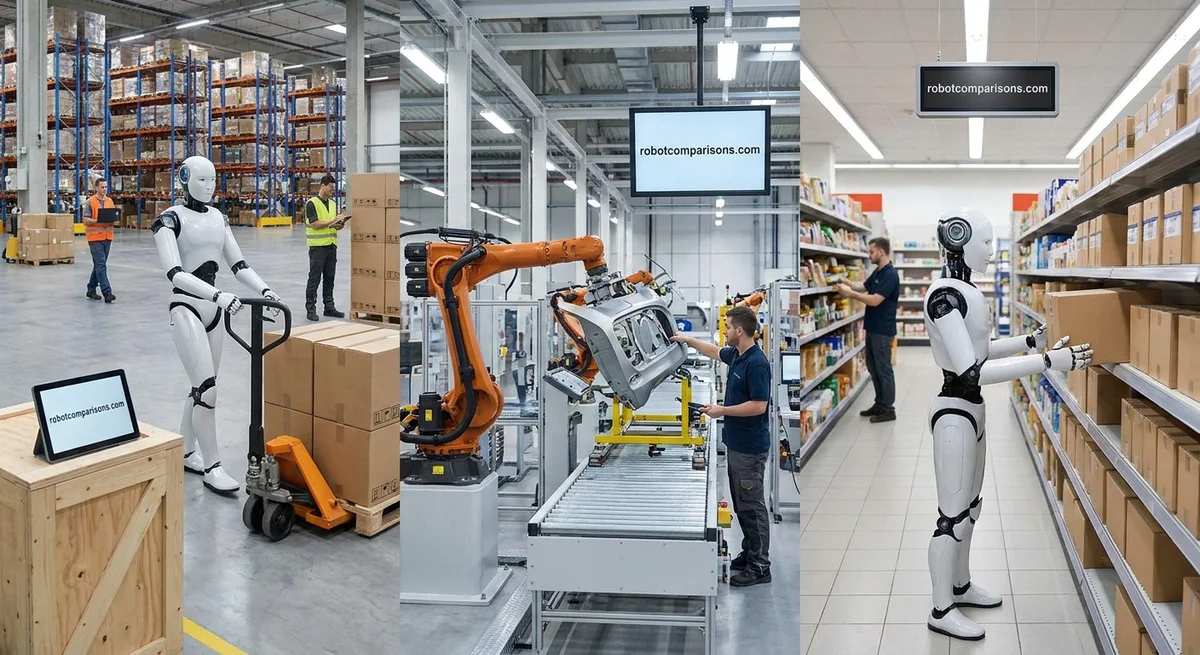
Introduction
Humanoid robots – machines with arms, legs, and human-like form – are moving out of the lab and onto factory and store floors. By 2026, companies like Agility Robotics, Figure, and Boston Dynamics are showing real prototypes doing work previously done by people (getproductiv.com) (therobotshq.com). For example, Agility’s Digit is already moving totes in warehouses (therobotshq.com), and startups are piloting shelf-restocking robots in grocery stores (www.strongpoint.com). These robots use advanced AI vision and cloud software to see and decide tasks (www.figure.ai) (prtimes.jp).
This article maps important tasks in manufacturing, logistics, and retail to the strengths and limits of humanoid robots in 2026. We look at each task – like stocking shelves or kitting parts – and describe how much dexterity, mobility, perception, and safety are needed. We also note real-world constraints (narrow aisles, stairs, wet floors, crowds, etc.) that may help or hinder a humanoid. Finally, we suggest simple criteria and a scoring model to decide which workflows are best suited for robots. The goal is to give business leaders and even everyday readers an easy guide to where humanoid robots might fit tomorrow’s workplace.
Key capabilities of humanoids: These robots have two arms with grippers or hands (often with an industrial gripper or simple claws), cameras for vision, and legs or wheels to move. Their dexterity (fine motion control) lets them pick and handle objects. Mobility (walking or rolling) lets them reach different places. Perception means using cameras and AI to identify objects and obstacles. And they are built with safety features (like force-limited joints and sensors) so they can work near people. Each task has its own requirements for these four factors, which we detail below.
Key Use-Cases and Workflows
Below are six high-value use cases for humanoid robots across manufacturing, logistics, and retail. For each we describe what the job involves, how demanding it is on dexterity, mobility, perception, and safety, and what environment challenges exist.
Line-Side Replenishment (Manufacturing)
What it is: Stocking parts or tools at an assembly line so that workers or machines never run out. Instead of a person pushing a cart of boxes along the line, a robot would carry bins of parts (screws, brackets, etc.) and place them where needed.
- Dexterity: Medium. The robot must pick up bins or trays and set them on racks or conveyors. Parts can come in boxes or trays, sometimes with lids. A humanoid needs a gripper or hand strong enough to lift a box (maybe 5–10 kg) and set it down carefully. It may also hold tools or smaller parts. Fine finger-tip precision is less crucial than strength and stable grip.
- Mobility: High. This task requires moving along the production line, sometimes pushing a cart or carrying totes between supply area and workstations. A robot should walk or roll steadily on flat factory floors, possibly navigate around other machines. Speed need not be very high, but it should keep pace with the line’s needs.
- Perception: Moderate. The robot must recognize which part bin or tool is needed (often labeled or logically placed). It should scan barcodes or read labels (so a camera or scanner is useful). It also needs to align boxes with correct shelves. Some simple vision (identifying tall trays vs. open bins) is needed, and knowledge of where the line racks are.
- Safety: High. The robot will work near assembly stations, often alongside human workers or heavy machinery. It must be gentle around people, stopping if someone or another machine is too close. Many manufacturing areas require safety fencing or sensors. The robot’s design should be collaborative – e.g. force-limited joints – in case it bumps something.
Environmental constraints: Factory lines often have clear pathways for transport, so narrow aisles are usually not a problem. However, there may be forklifts or pallet movers around, requiring robust sensors. Stairs are typically not in a production hall, but if the line is on multiple levels the robot could be limited to one floor. Floors should be dry, but factories sometimes have oil or small spills – humanoids may need special non-slip feet. Crowding is moderate: workers do move around, but schedules can be arranged so the robot has space (for example, working when no humans are at a station).
Machine Tending (Manufacturing)
What it is: Loading and unloading parts to/from machines (like CNC mills, injection molders, or 3D printers). The robot would take raw material from a bin, put it into the machine, then take the finished part out and place it on a tray or conveyor.
- Dexterity: High. Machine tending often requires very precise motion. The robot may have to insert a part into a chuck or tight fixture. It needs steady grip and possibly fine alignment (millimeters of accuracy) to avoid jamming. If the parts are small, finger-level manipulation is needed. A relatively human-like hand or a smart gripper helps.
- Mobility: Low to Moderate. Some machine-tending robots stand in one spot (like a robot arm fixed by a machine) or on a small cart that moves short distances. A humanoid might be semi-mobile: for example, it could kneel or pivot around one machine, or wheel between two machines. It doesn’t usually have to walk long distances continuously.
- Perception: High. The robot must recognize the parts and understand how to align them with the machine’s tooling. This often means using cameras and force sensors. For example, seeing the shape of a part and orienting the gripper correctly, or detecting the machine’s opening. It may also need to read controls or indicators on the machine.
- Safety: Very High. CNC machines or presses are hazardous. Humans normally work behind guards while machines run. If a humanoid is tending an active machine, the area may need to be fully fenced off, or the robot must work in sync with the machine cycle. The robot should have emergency stop features. It also must handle hot or sharp parts safely (maybe wearing special gripper covers).
Environmental constraints: Machine cells are usually fenced or limited access, reducing crowding issues. Floors are even and typically clean around machines. Stairs are not an issue (machines and lines are on single floors). The main constraint is the precise, confined space inside the machine area; the humanoid must fit through openings or doorways. If machines are in a row, the robot might need to travel a bit between them – so enough aisle width is required but this is usually designed for human operators and forklift, which humanoids can also handle in similar fashion.
Shelf Restocking (Retail & Warehousing)
What it is: Picking items from pallets or back-room shelves and placing them on store shelves. For example, filling grocery shelves with canned goods or putting new inventory on retail shelves overnight.
- Dexterity: High. Store items come in many sizes and shapes (boxes, cans, bottles). The robot needs adaptable grasping. It should handle heavy cases (up to 20–30 kg) as well as light products. Two-handed or even bimanual action may be useful (e.g. holding one case steady while grabbing another). Fine dexterity is needed to place goods neatly and avoid dropping anything. Robots may need adjustable grips or suction for different objects. (www.strongpoint.com).
- Mobility: High. Humanoids must navigate narrow aisles of a store. Grocery aisles can be only a meter wide, often cluttered with displays. They should move slowly and precisely, possibly with omni-directional wheels or very steady walking. The robot should also be able to scale different shelf heights – in practice, tasks might be limited to waist-high shelves unless the robot can safely reach up. Some suggestions (like StrongPoint’s reshelving robot) assume the robot works after-hours to avoid crowds (www.strongpoint.com).
- Perception: Very High. The robot must identify the correct product among many similar packages and ensure it places items in the right spot. It often uses 3D cameras or vision AI to recognize product shapes and label positions. It needs to scan shelves and detect empty spots. Advanced AI models (like Figure’s “Helix” system) train robots to quickly learn new product shapes and orientations (www.figure.ai).
- Safety: Very High. In a store, customers and staff may be present. Even after hours, maintenance staff could be around. The robot must have collision avoidance (LIDAR, depth cameras, bump sensors). It should move slowly in tight spaces to avoid knocking things over. Many projects plan these robots to work when the store is closed to reduce human contact (www.strongpoint.com) (www.strongpoint.com).
Environmental constraints: The biggest challenge is tight aisles and confined spaces. A humanoid must be slim enough to fit down typical retail aisles and should not accidentally knock over shelving. Also, floors in stores can be slippery (especially after cleaning), making balance a concern. Carrying heavy loads on polished tile is harder than on grippy concrete. Another issue is crowding: even after hours, occasional staff or late shoppers can appear, so the robot needs to stop or wait. Obstacle changes (like a pallet unexpectedly in the aisle) require good obstacle detection. Unlike warehouses, retail floors are mixed environments; a task for robots may be best scheduled for night shifts.
Real-world example: Grocery chain StrongPoint estimates that restocking shelves is about 30% of all labor hours in a store (www.strongpoint.com). It is a repetitive, high-volume task, which is why startups are targeting it with robots. For instance, Theseus Robotics advertises an “autonomous shelf-restocking robot” that works overnight to free up staff (www.theseusrobotics.ch).
Kitting (Manufacturing and Distribution)
What it is: Gathering a set of parts or products into a “kit” for assembly or shipment. In manufacturing, kitting might mean assembling sets of hardware (screws, bolts, brackets) needed for a sub-assembly. In e-commerce, it might mean picking items into an order box.
- Dexterity: High. Kitting involves picking many different objects and placing them together. These items can be small electronic parts or fragile items like glass. The robot arms need to be steady and precise. Often kitting requires reorienting parts (e.g., a bolt must be placed head-up), so the robot needs good wrist and finger control. It’s similar to light assembly. Early humanoids like Agility’s Digit are being tested on kitting tasks that require “fine motor skills” and human-level dexterity (getproductiv.com).
- Mobility: Moderate. Kitting stations are usually in one area of a factory or warehouse. A humanoid might need to move between shelf locations and the packing station. This might involve short trips on a flat floor. Unlike heavy material handling, kitting areas are usually not huge, so a robot does not need long walking range. However, flexibility to navigate around carts and other workers is useful.
- Perception: High. The robot must correctly identify each part or product (sizes, shapes, barcodes) to make accurate kits. Good vision systems are needed to distinguish similar parts. Some kits are built by following a list of components, so the robot needs to verify it picked the right item. AI vision (trained on the parts) is very helpful for speed and reducing mistakes.
- Safety: Moderate. Kitting is often done in assembly areas with others around, but not near dangerous machinery. The robot should be careful not to collide with shelves or humans, but high impacts are less of a risk. Still, it must lift awkward pallets without tipping them. Robots need compliance (soft stops) in case of collision, and sensors to sense humans (like a worker walking behind it).
Environmental constraints: Kitting stations usually have enough space for a few people and a few bins, but some areas can be crowded with parts bins and conveyors. The key constraint is variety of items: bins may contain very small items at floor level or heavy boxes above. A humanoid might struggle with heavy lifting (kits can be tens of kg), so it may collaborate with a fixed hoist or use a small powered cart. Uneven floors or level changes (like low ramps) can be tricky for walking. Also, lighting can vary (bright indoor shop floor or dim corners), so robots need good low-light vision.
Tote Transfer (Logistics and Warehousing)
What it is: Moving containers (totes, bins, or boxes) from one location to another, such as taking filled totes from a conveyor and placing them on shelves, or carrying totes across the facility. For instance, an Amazon or DHL warehouse might have robots that pick up plastic totes of products and move them from shelves to a conveyor.
- Dexterity: Low to Moderate. A tote typically has handles or a clear shape, so the robot doesn’t need finger dexterity. It needs enough grip and arm strength to lift the tote (which can be 10–20 kg when full). The hands may be simple 2-finger grippers. Precise orientation is less critical, but the robot must place the tote on a conveyor or shelf without dropping it.
- Mobility: High. This task can cover long distances in a warehouse. The robot needs to walk stably with a heavy box, turn in aisles, and possibly handle uneven surfaces (ramps, small bumps). Some robots like Digit have demonstrated carrying up to 15-20 kg sets. It may also need to climb (some warehouses use mezzanine levels or ramps), but most will limit robots to flat ground.
- Perception: Moderate. The robot should detect where the tote is and where to put it. For example, it needs to see the correct conveyor inlet or the shelf number. It must also detect obstacles (like humans or other bots). In simpler setups, the path is pre-mapped, so perception needs mainly include aligning with fixed drop-off points.
- Safety: High. Warehouses are busy. The robot will likely walk through areas with forklifts, pallet jacks, and people. It must have strong collision avoidance and possibly the ability to sense impact. Being made to share floor space, it may use safety-rated sensors (like a 360° laser scanner). If the tote is heavy, the robot’s momentum is high, so advanced braking and motion planning are needed to avoid accidents.
Environmental constraints: Warehouse floors are usually flat and wide, which suits robots. However, aisle width can still be an issue if the robot plus tote width approaches human width. Also, floors may be slippery (e.g., water spills) – humanoid robots must be cautious on wet surfaces. Confirming with actual examples: in 2026 Agility’s Digit is said to work in Amazon warehouses “moving totes between conveyors and shelves” (therobotshq.com). This validates that this is a real use case. Some facilities may require that robots operate on marked paths or have overhead navigation to avoid narrow corners. If the warehouse has elevated shelving (multi-level), a humanoid would rely on lifts or not use stairs. Crowd issues are similar: tours or maintenance staff may appear, so the robot should yield or pause for humans.
Back-of-House Operations (Retail & Hospitality)
What it is: Support tasks behind the scenes, such as moving carts of laundry in a hotel, sorting returned goods, or bringing prepared orders from a storage area to a pickup point. In retail, this often means handling inventory in the stockroom or loading/unloading delivery trucks.
- Dexterity: Variable. Back-of-house tasks range widely. For stockrooms, the robot might just move bins (like tote transfer above). For handling loose items (like sorting returned clothes), more dexterity is needed. In a restaurant kitchen, tasks like carrying tray of dishes require sturdy arms and balance. So robots need basic grasp and carrying abilities, but not always fine finger motion.
- Mobility: High. These tasks often cover entire back-of-house areas or between dock and storage. The robot needs good navigation in potentially cluttered backrooms or kitchens. It may need to follow elevators or carts, so turning and maneuvering are important. If it’s a hotel, it may have to navigate corridors. Such environments can be very dynamic with people moving around.
- Perception: Moderate to High. The robot must distinguish people (so as not to bump them) and find target areas (like which shelf or bin to deliver to). It may use location beacons or simple maps. If doing tasks like sorting items, it needs to recognize labels or shapes. For some tasks, language or voice commands might be used (e.g., a chef telling the robot to fetch utensils).
- Safety: Very High. Back-of-house in hospitality or retail often has customers or staff nearby. A robot delivering dishes in a restaurant must avoid servers and diners. These environments are often wet (kitchen spills) or hot (ovens), posing slip or burn hazards. Robots should have protective gripper covers if carrying hot items. They must also not obstruct emergency exits or workflows.
Environmental constraints: These areas can be the most unpredictable. Narrow hallways, stairs, or elevators (in multi-floor stores/hotels), carts, and random obstacles (like a knocked-over box) are common. Humanoids must map and adapt continuously. Slippery floors (spills) are a major concern for balance. If stairs are present, most current humanoids cannot climb them, so tasks must be planned on flat runs – perhaps by using lifts or ignoring upper floors. In summary, robots can help here only if the environment is made robot-friendly (leveled, clear paths) or if the robot is robust enough to handle chaos – which is still tough.
Environmental Constraints
Humanoid robots are designed for human environments, but still face physical limits. Below are some general factors affecting feasibility:
- Narrow aisles: Most humanoids are built shoulder-width or slightly slimmer. Aisles under ~1 meter may restrict them. In tight aisles, robots must either move slowly or operate one-way. If a robot is too large, it could block traffic. Narrow spaces also limit a robot’s turning radius.
- Stairs and Levels: Climbing stairs is very hard for current robots. Some agile robots can go down a step gently, but going up is rare. Thus, any workflow involving stairs (e.g. stockrooms on different floors) is usually not yet possible for humanoids. Elevators or lifts are needed instead, but that adds complexity and time. Most practical deployments keep robots on one floor.
- Wet or Slippery Floors: A wet floor can cause a robot to slip or even fall. Unlike wheeled robots, bipedal robots risk losing balance. Safety features help (like feet grip or squat-and-recover routines (www.agilityrobotics.com)), but generally robots avoid very wet areas or carry out tasks only when floors are dry.
- Human Crowding: In highly crowded places (busy store aisles, packed warehouses), humanoids must be very cautious. They often use 360-degree sensors and purposely slow down. Some companies plan to use robots only when fewer humans are around (e.g. night shifts) to avoid accidents (www.strongpoint.com). Any permanent integration in human-occupied spaces demands very robust collision detection.
In short, tasks in wide-open, flat, and consistently lit environments are easiest. Places with fixed obstacles, steps, or crowds require careful planning or are lower priority until robots improve.
Selecting and Prioritizing Robot Workflows
Given many possible tasks, how do we choose which to automate with humanoids first? We suggest the following selection criteria:
- Labor Intensity / Value: Tasks where humans spend many hours doing rote work score high. For example, if shelf restocking or kitting accounts for dozens of man-hours daily, automating it has big payoff (www.strongpoint.com) (getproductiv.com). High-frequency, repetitive tasks give more savings.
- Task Complexity: Tasks that are too complex for today’s robots (ultra-fine assembly, heavy lifting) are lower priority. Medium-complexity tasks (handling boxes, standard parts) are more realistic. Also consider how structured the task is: a set routine is easier for a robot than an ever-changing pile.
- Environmental Fit: Tasks in human-designed spaces score better. For example, picking items from shelves (designed for humans) or moving totes on open floors suits humanoids. Contrast a task like painting freshness on a wet-floor corridor – less feasible. We prefer tasks with flat ground, clear navigation, and stable lighting.
- Safety and Social Impact: Tasks that improve safety (moving heavy loads, handling hazardous goods) are high priority. But if a task has high risk of harming people (like working on busy forklift aisles), it may be lower priority or require strict safeguards. Also, consider disruption: tasks done after hours (when humans aren’t around) avoid safety issues.
- Technology Readiness: Only pick tasks where a robot for the job is (or will soon be) available. For example, if Digit or Figure 03 can carry totes and turn them, then tote moving is ready for pilot (therobotshq.com). But tasks that need a next-generation robot should wait. Look at what companies and prototypes exist for similar tasks.
A simple prioritization model can help. For each candidate workflow (like “shelf restocking after midnight” or “parts delivery to machine”), assign scores 1–5 in each category: Frequency, Complexity, Environment, Safety, ROI. Add up or weight them as desired. For example:
- Nighttime Shelf Restocking: Frequency (5), Complexity (3), Environment (3), Safety (4), ROI (5) = 20/25.
- Daytime Storefront Stocking: Frequency (5), Complexity (3), Environment (2 – crowded), Safety (2 – many people), ROI (3) = 15/25.
- Machine Tending (simple press): Freq (4), Comp (4 – precision needed), Env (4 – open area), Safety (5 clearance), ROI (4) = 21/25.
- Unloading Delivery Truck (many steps): Freq (3), Comp (3), Env (2 – varied), Safety (3), ROI (3) = 14/25.
In this toy example, machine tending and shelf restocking (after hours) rank highest. This kind of table can be customized per site.
The key insight: prioritize tasks that are important to current operations but not easily done by existing machines, and match them to robots’ strengths. As one logistics provider noted, tasks requiring human-like adaptability (kitting, picking, etc.) are exactly where humanoids are headed (getproductiv.com) (www.figure.ai).
Conclusion
Humanoid robots in 2026 will still be new and not everywhere – but the first real deployments are coming. In warehousing, highlighted tasks include tote and box moving (Digit’s first applications (therobotshq.com)) and picking/packing tasks in densified facilities (getproductiv.com). In manufacturing, we see demos of machine-naked tasks (like inserting parts) and line replenishment. In retail, early targets are shelf restocking and overnight inventory work (www.strongpoint.com) (www.theseusrobotics.ch). All of these leverage the humanoid’s ability to use existing spaces and reach things off the ground – something wheels or arms alone can’t always do easily.
These robots use advanced AI brains. For example, Figure’s Helix model uses vision and language understanding so robots can sort packages at human speed (www.figure.ai). In practice, robots combine on-board GPUs (like NVIDIA Jetson chips) with cloud systems (Microsoft Azure) to process images and control their arms in real-time (prtimes.jp) (www.figure.ai). As AI models improve, humanoids will get better at adapting to new products and layouts – a big advantage in a changing environment.
Looking ahead, humanoids are not a drop-in replacement today, but they are evolving fast. For consumers, this means stores and factories will slowly start using robot helpers for routine work. For business owners, it means considering where these machines fit: edges of the day, repetitive lifts, or places where worker safety is a concern. Using the selection guide above, companies can score and rank tasks to pilot first.
By matching robot abilities to job requirements, businesses can find “low-hanging fruit” – the high-value workflows where a humanoid can add immediate benefit. Over time, as costs fall (Morgan Stanley projects huge markets) and dexterity improves, more complex tasks will become feasible (www.worleywarehousing.com) (interactanalysis.com). But in the near term, focusing on safe, repetitive work in human-friendly environments will give the best returns. The next-wave of automation is on the way – and simpler, accessible planning today will make those robots part of our everyday work – not just science fiction, but real tools we share the floor with.
**`