 Auto
Auto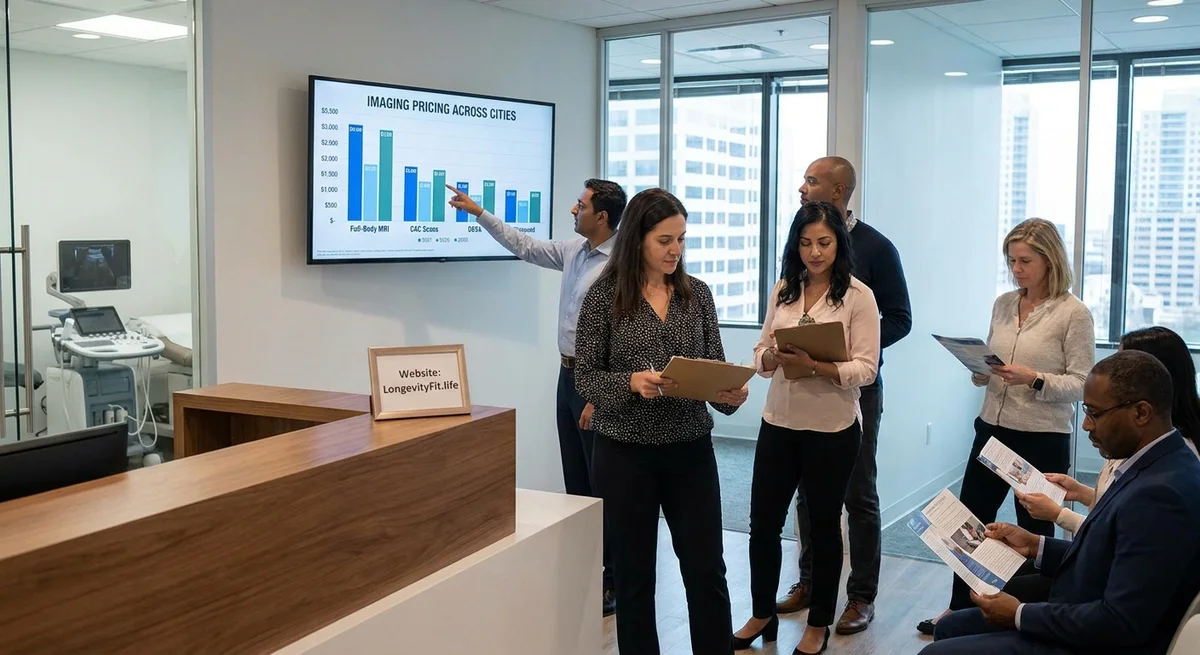
Introduction
Many people interested in longevity (living longer and healthier) turn to advanced imaging. Scans like full-body MRI, coronary calcium CT, DEXA bone scans, and targeted ultrasounds promise early disease warnings. These can spot problems years before symptoms. But they cost time and money, and they can also find harmless “incidental” findings. In this article, we explain how these scans are used, what evidence and guidelines say, and how much they cost in cities around the world. We also note how to schedule them, how fast you get results, and what doctor visits cost afterward.
Full-Body MRI Scans
A full-body MRI uses a machine with magnets (no X-ray) to take pictures of many organs at once. Clinics market whole-body MRI as a way to find hidden cancers or issues early. In fact, preventive screening MRI centers have opened in Canada, Germany, Japan, the UK and elsewhere (pmc.ncbi.nlm.nih.gov). However, some places (like the Netherlands) have banned this scan by law, because it is not clear if the benefits outweigh the harms (pmc.ncbi.nlm.nih.gov).
What it finds and risks. Studies show a whole-body MRI often finds many abnormalities in healthy people. In one review of 5,300 people without symptoms, about 32% had at least one “incidental” finding (pmc.ncbi.nlm.nih.gov). Many of those turned out to be benign or unclear. In that review, about 16% of people had results that looked worrisome but later proved to be false alarms (pmc.ncbi.nlm.nih.gov). Only about 1–2% of people actually had a cancer discovered (pmc.ncbi.nlm.nih.gov). This means lots of extra tests and anxiety for things that might not harm you. For example, minor kidney cysts, small lung nodules, or benign bone lesions are common incidental finds, yet they can lead to more scans or biopsies.
Because of this, major medical bodies currently do not recommend whole-body MRI for healthy people. The U.S. Preventive Services Task Force (USPSTF) and experts note there is no proof it extends life, and it carries a risk of overdiagnosis and anxiety (pmc.ncbi.nlm.nih.gov). In other words, it may find “something,” but we don’t know if fixing that actually helps.
Pricing and availability (global). Full-body MRI is expensive and varies by location. In the U.S., standalone clinics often charge $1,000–$5,000, while hospital billing can reach $5,000–$12,000+ per scan (mriscancost.com). For example, a U.S. provider advertises $999 for a basic whole-body MRI (mriscancost.com). In London, a private center offers scan packages starting around £765 (about $1,000) (mriscancost.com). In Tokyo or Singapore, advanced MRI health packages (with extra tests) tend to be in the ¥130,000–¥170,000 range (about $1,000–$1,300) (www.medicalscanning.net).
In Seoul, South Korea, even hospital prices for full-body MRI range roughly ₩640,000–₩1,350,000 (~$550–$1,150) (price.hospitalk.net). Affordable medical centers in India or Thailand may offer similar scans for only a few hundred dollars as part of health tourism packages. These prices are for the scan alone; be aware that additional fees often apply (see below).
Logistics and protocol. These scans usually take 1–1.5 hours, and you lie still in the MRI machine. You may need to remove metal (jewelry, watches, etc.) and change into a gown. No special fasting or prep is typically needed, though some centers might ask you not to apply lotions or makeup. After the scan, images are reviewed by a radiologist (a specialist doctor for scans). The results (a report) often come back in a day or two. For example, one Toronto MRI clinic advertises that patients are scanned within about a week of referral, with full reports within 24–48 hours (simplymri.com) (simplymri.com). Turnaround time can vary by clinic and country; hospitals sometimes take longer than private centers.
Follow-up costs. Remember that the scan fee usually covers only the imaging itself, not the doctor visit to explain it. If something is found, you would see a physician to discuss results. For example, a London clinic charges about £200 ($250) for an initial GP consultation and £180 for a follow-up (harleystreetphysicians.co.uk). Many U.S. and global clinics have similar fees – perhaps $100–$300 for a specialist consult. Always ask in advance: some scans are sold as an “all-in-one” health check, while others charge separately for the doctor’s report or follow-up.
Coronary CT Calcium (CAC) Scans
A CAC scan is a quick CT X-ray of the heart to measure calcium in the coronary arteries. Calcium in these arteries can indicate atherosclerosis (blockages) that may lead to heart attacks. The scan is very fast (a single breath-hold) and uses no special dye – just radiation. It gives you a “calcium score”. A score of 0 means no calcified plaque detected (low risk), while higher scores show more plaque. Doctors use CAC scoring to help assess heart attack risk, especially in people at borderline risk.
Evidence and guidelines. Research shows CAC scoring is a strong predictor of future heart risk. Current heart guidelines (American College of Cardiology/AHA) say that if your risk is unclear, a CAC scan can be used to guide treatment decisions for people age 40+ (www.jacc.org). In one guideline, physicians recommend considering CAC if you are uncertain about starting a statin for cholesterol control (www.jacc.org).
However, U.S. government guidelines (USPSTF) say there is insufficient evidence to recommend CAC screening for all asymptomatic adults (www.uspreventiveservicestaskforce.org). They found it is not proven that CAC testing reduces heart attacks more than standard risk scores. In short, many heart specialists use the scan as an extra risk tool, but official screening agencies have not given it a “go-ahead” for everyone.
Pricing and availability. CAC scans are much cheaper than full-body MRI. In the U.S., many imaging centers advertise these for around $50–$150 out-of-pocket. For example, average cash prices in New York are about $119 (cost.sidecarhealth.com). In London, a private clinic lists a heart CT calcium score at about £580 (~$700) (harleystreetphysicians.co.uk). Ultrasound-based clinics or labs in other countries often charge less (the cost of a CT machine and scan time is moderate). Many health check centers include it in a heart screening package. In India or Mexico, such scans can be under $50 or bundled in exams.
False positives and considerations. A CAC scan itself has few false positives, since it either finds calcium or not. The catch is more about interpretation. A zero score can sometimes falsely reassure if you have non-calcified plaque (which the scan cannot see). A high score often leads to more tests (like stress tests or angiograms) and sometimes aggressive treatment. Also, because the scan images the chest, very small lung nodules or other incidental findings in the chest can show up, leading to extra follow-up.
Scheduling and follow-up. This test is quick (a few minutes) and often has short wait times. Many doctor’s offices can directly order it. You typically lie on the CT table, hold your breath, and scans take seconds. The report may be ready the same day or next day. You should plan a follow-up appointment with a cardiologist or your regular doctor to interpret the score and plan action. Note: Some imaging centers include a brief doctor consult. If not, a cardiology consult in the U.S. might run $100–$200; in the UK similar exams often include initial consult fees (for example, the London clinic above notes “GP consultation £200” (harleystreetphysicians.co.uk)).
DEXA Bone Density Scans
A DEXA scan (dual-energy X-ray absorptiometry) measures bone density in the spine and hip, and is the standard test for osteoporosis. It can also measure body fat percentage if done as a full-body scan. For longevity, DEXA is mainly used to detect early bone loss so treatment can prevent fractures. Some wellness packages also use DEXA to measure body fat vs muscle.
Guidelines and evidence. Health agencies do recommend DEXA for certain groups: In the US, the USPSTF says all women 65 and older should have a DEXA scan to prevent fractures (www.uspreventiveservicestaskforce.org). Younger post-menopausal women with extra risk factors (like family history, smoking) are also advised to get screened (www.uspreventiveservicestaskforce.org). For men, the USPSTF concluded there is not enough evidence to recommend routine bone scans (www.uspreventiveservicestaskforce.org). In practice, doctors may screen men over 70 or those with certain risks (low weight, steroid use, etc).
Pricing. DEXA is relatively cheap. In the U.S., an uninsured patient can often pay around $100 for a whole-body DEXA (www.mdsave.com). The MDsave website reports Phoenix (AZ) prices of $91–$135 (www.mdsave.com), far below many imaging studies. In the UK, the same London clinic lists DEXA at about £310 ($380) (harleystreetphysicians.co.uk). Many health systems (like the NHS) freely provide DEXA for eligible patients (over 65 women, etc). In Asia, costs might be lower (perhaps $50–$150) in health check centers.
Results and protocol. The test is quick (often under 30 minutes) and is painless. You lie on a table while a low-dose X-ray arm scans your hips and spine. No special fasting is needed; you just remove jewelry or metal from waist down. A trained radiographer does the scan, and a radiologist or specialized doctor reports it. In most cases, your doctor or the imaging center will give you a short report with your bone density numbers and a T-score. If bones are thin (osteopenia or osteoporosis), your doctor will give advice on diet, exercise, calcium/vitamin D, or possibly medications. A follow-up consult might be included or extra. For example, if a UK clinic includes the DEXA in a “bone health check,” it might bundle a doctor review; otherwise, asking a primary care doctor to interpret a DEXA report usually does not cost extra if covered by insurance.
Ultrasound Screening
Ultrasound uses sound waves to image organs. In longevity programs, common scans include: abdominal/pelvic ultrasound (to look at liver, kidneys, etc.); carotid artery ultrasound (neck vessels, to screen for stroke risk); abdominal aorta ultrasound (to screen for aneurysm); and specific organ scans (thyroid, prostate, etc.). Unlike MRI/CT, ultrasound has no radiation and usually costs less.
-
Abdominal/Pelvic Ultrasound: This examines liver, kidneys, spleen, pancreas, bladder, and (for women) uterus/ovaries. It can find things like fatty liver, kidney cysts, gallstones, or masses. Many check-up packages include it. Cost varies: for example, a London scan center lists abdominal+p elvic ultrasound for £520 (harleystreetphysicians.co.uk) (about $650). In the US, a similar ultrasound might cost a few hundred dollars (often $200–$400 self-pay). In Asia, it can be cheaper. Scheduling is easy but may require fasting for a few hours if imaging the gallbladder. Results often come in 1–3 days. Usually a radiologist or sonographer reads it. If an abnormality is found, a follow-up specialist visit is recommended.
-
Abdominal Aortic Aneurysm (AAA) Ultrasound: This looks at the main artery in the belly for an aneurysm (a dangerous enlargement). Guidelines are clear: USPSTF recommends one-time AAA screening with ultrasound for men 65–75 who have ever smoked (www.uspreventiveservicestaskforce.org). For men who never smoked, it says consider it selectively, and for women not to screen unless other risk factors exist (www.uspreventiveservicestaskforce.org). In practice, medical check-ups often include it for older men. It takes under 10 minutes. A normal result means no large aneurysm. If a small aneurysm is found, you’ll be followed with yearly ultrasounds by a vascular specialist. Cost is similar to other ultrasounds (perhaps $150–$250 in the US).
-
Carotid Artery Ultrasound: This scans the neck arteries to check for narrowing. USPSTF recommends against routine screening for carotid stenosis in people without symptoms (www.uspreventiveservicestaskforce.org). In other words, finding plaque in the neck by ultrasound has not been shown to help prevent strokes more than checking risk factors. However, some health packages still offer it (especially if you have risk factors or a family history). If done, it costs a couple hundred pounds/dollars. Be aware that many normal people get non-blocking plaque that doesn’t need treatment – so a “positive” result can cause unnecessary worry or tests.
-
Other Ultrasounds: Many clinics offer thyroid ultrasound (to check nodules) or prostate ultrasound. These are not standard population screenings. Thyroid nodules are very common and almost always benign, so routine thyroid scanning is generally not recommended. If you have a family history or symptoms, targeted ultrasound makes sense; otherwise it may lead to over-testing (e.g. biopsies of harmless nodules). Always check guidelines – for example, the American Thyroid Association advises against imaging for thyroid cancer unless there is clinical reason (goitre, symptoms) or strong family history.
Evidence, False-Positives, and Guidelines
In sum, screening scans have mixed evidence. Some, like DEXA for older women, are clearly recommended because they prevent fractures (www.uspreventiveservicestaskforce.org). Coronary calcium scoring is useful in certain heart-risk cases (www.jacc.org). Abdominal aneurysm screening for older male smokers is proven beneficial (www.uspreventiveservicestaskforce.org). On the other hand, whole-body MRI and carotid ultrasound tend to find many harmless anomalies, so guidelines generally advise caution or even discourage routine use (pmc.ncbi.nlm.nih.gov) (www.uspreventiveservicestaskforce.org).
For example, the USPSTF explicitly says do not do carotid artery scans in people without symptoms (www.uspreventiveservicestaskforce.org). They also say evidence is insufficient to use CAC and other novel tests for everyone (www.uspreventiveservicestaskforce.org). Leading health bodies in many countries do not endorse body-wide MRI/MAR scans for healthy people (often citing lack of proof to improve outcomes) (pmc.ncbi.nlm.nih.gov) (mriscancost.com). This doesn’t mean these scans are never useful — a person with strong family history or specific risk may choose them — but it does mean they are not standard preventive tools for all.
False positives and worry: The main downside of broad imaging is incidental findings. If a scan shows something uncertain, it can lead to follow-up tests (like extra imaging or biopsy) that have their own risks and costs. It can also cause anxiety. For example, finding a tiny liver lesion or lung nodule usually turns out to be nothing, but a patient may endure weeks of worry and tests before that is confirmed. One study noted that about 30–40% of healthy people have at least one incidental finding on whole-body MRI (mriscancost.com) (mirroring the systematic review above (pmc.ncbi.nlm.nih.gov)). Often these findings do not change medical care. Patients and doctors should discuss this before a screening scan: Are you prepared to follow up on unexpected findings?
Scheduling, Reports, and Follow-Up Fees
- Scheduling: To book these scans, some imaging centers allow direct self-referral (you contact them and pay or use insurance). Others require a doctor’s order. Wait times vary: private clinics often can see you in days, while hospital radiology departments might have multi-week waits. For example, one private MRI center said they contact patients to book “typically within 5–7 days” (simplymri.com). Always check if any pre-test preparation is needed (e.g. fasting for abdominal ultrasound).
- Report turnaround: Smaller clinics or specialty centers tend to return written reports quickly (same day or a couple of days). Hospitals may take longer (several days to a week). Some places offer a preliminary verbal report immediately if an urgent problem is seen. In one Canadian center, full radiology reports were promised in 1–2 days (simplymri.com).
- Follow-up consultations: Most scans do not include a doctor’s consultation. You usually get a written report with the radiologist’s findings. You then discuss it with a physician of your choice. Some health-screening packages bundle an automatic follow-up appointment. If not, you may pay separately for that visit. As noted, one London clinic lists a GP consult at £200 and follow-up at £180 (harleystreetphysicians.co.uk). In the U.S., a specialist consult might bill $100–$300. If you have insurance, an office visit may be covered. Always inquire: “Do I need to set up a viewing appointment and what is the cost?”
Example City Price Comparison (Summary)
Below is a rough sense of how costs compare in different global cities. Note that actual prices vary by provider and can change over time.
- New York, USA: Whole-body MRI ~$1,000–$5,000 (U.S. median); CAC ~$119 on average (cost.sidecarhealth.com); DEXA ~$100 (www.mdsave.com); abdominal US a few hundred dollars. Often split between hospital vs. private center.
- London, UK: Full-body MRI from
£765(~$1,000) (mriscancost.com); CAC CT ~£580 (harleystreetphysicians.co.uk); DEXA ~£150 (harleystreetphysicians.co.uk); abdominal US ~£520 (harleystreetphysicians.co.uk). NHS does not offer commercial whole-body MRI. Private clinics are the main option. - Tokyo, Japan: Advanced whole-body MRI packages (with extra scans) cost roughly ¥130K–¥180K (~$1,000–$1,500) (www.medicalscanning.net). Other scans like CAC or DEXA in Japan are typically competitive with Western pricing, though exact numbers vary by hospital.
- Seoul, South Korea: Hospital full-body MRI
₩640k–₩1,350k ($550–$1,150) (price.hospitalk.net). Other tests likewise often run lower than in the West (Korea has strong medical screening industry). - Singapore: Healthcare is high quality but also expensive. Private full-body MRIs likely cost around SGD 2,000+ (~$1,500+). CAC scans in hospitals or clinics might be ~$100–$200. Ultrasound and DEXA roughly similar to Western costs. (Public hospitals often subsidize national patients.)
- Mumbai, India: Many imaging services are much cheaper. A whole-body MRI (if offered) could be a few hundred dollars. CAC scans and DEXA often under $50–$100. Private clinics offer discounts, but report turnaround may be 1–2 weeks. (All at high volumes.)
- Sao Paulo, Brazil: Prices often fall between U.S. and India levels. We estimate whole-body MRI ~$1,000-2,000, CAC ~$200, DEXA ~$80. There is a mix of private and large hospital providers.
- Dubai, UAE: Private healthcare costs can be high. Full-body MRI might exceed $3,000. Hospitals and wellness centers cater to wealthy patients; turnaround is usually fast but at a price. CAC and DEXA are on the order of Western prices (e.g. CAC ~$250+).
- Other cities (Sydney, Berlin, Johannesburg, etc.): In Sydney or Berlin, private health packages will quote similar to Europe: MRI ~AU$2,000+/€2,000+, CAC €200+, DEXA A$100. In Johannesburg or Cairo, costs may be lower due to local economies, but high-end clinics align with US pricing somewhat.
These are general ranges. Always get quotes. Hospitals often charge more than stand-alone clinics or bundles. Medical partnerships (e.g. an insurance plan tied to certain clinics) may offer discounted rates for members.
Actionable Advice
- Check Guidelines: Before booking, see if a scan is recommended for you (age, risk factors). For example, women 65+ should get a DEXA scan for bone health (www.uspreventiveservicestaskforce.org). Men 65–75 who smoked should get an AAA ultrasound (www.uspreventiveservicestaskforce.org). If you are 40+ and unclear on your heart risk, ask about a CAC score (www.jacc.org). Avoid low-value screens like carotid ultrasound in low-risk people (www.uspreventiveservicestaskforce.org).
- Balance Cost vs Benefit: Remember these scans cost money and time. Think in advance: if something shows up, are you ready for more testing and stress? In many cases, routine lifestyle checks (blood pressure, cholesterol, regular doctor visits) give good benefit for low cost. Imaging should be used selectively.
- Shop Around: Prices vary a lot. Use online tools (Site: Sidecar, MDsave, local clinic websites) to compare. Some places offer cash pricing on their site. Also ask about package deals – combining MRI+CAC+ultrasound might be cheaper than doing each separately.
- Plan Follow-Up: Factor in extra costs: the doctor visit (in many countries), and any tests from incidental findings. Ensure you will see a qualified physician who can interpret results. Some high-end clinics include a “health coach” or specialist review in their screening fee; others do not. Always ask what’s included.
Conclusion
Screening imaging can be a powerful tool for health-minded people, but it comes with trade-offs. Full-body MRI, CAC scans, DEXA scans, and ultrasound can reveal hidden issues, but they also risk false alarms and high costs. Around the world, availability and pricing of these tests vary widely – from a few hundred dollars in some cities to several thousand in others. Evidence and guidelines suggest using these scans wisely and in the right context. By understanding what each modality does, heeding official recommendations, and comparing costs, you can make an informed choice that balances the promise of early detection with the realities of risk and expense (pmc.ncbi.nlm.nih.gov) (www.uspreventiveservicestaskforce.org).