 Auto
Auto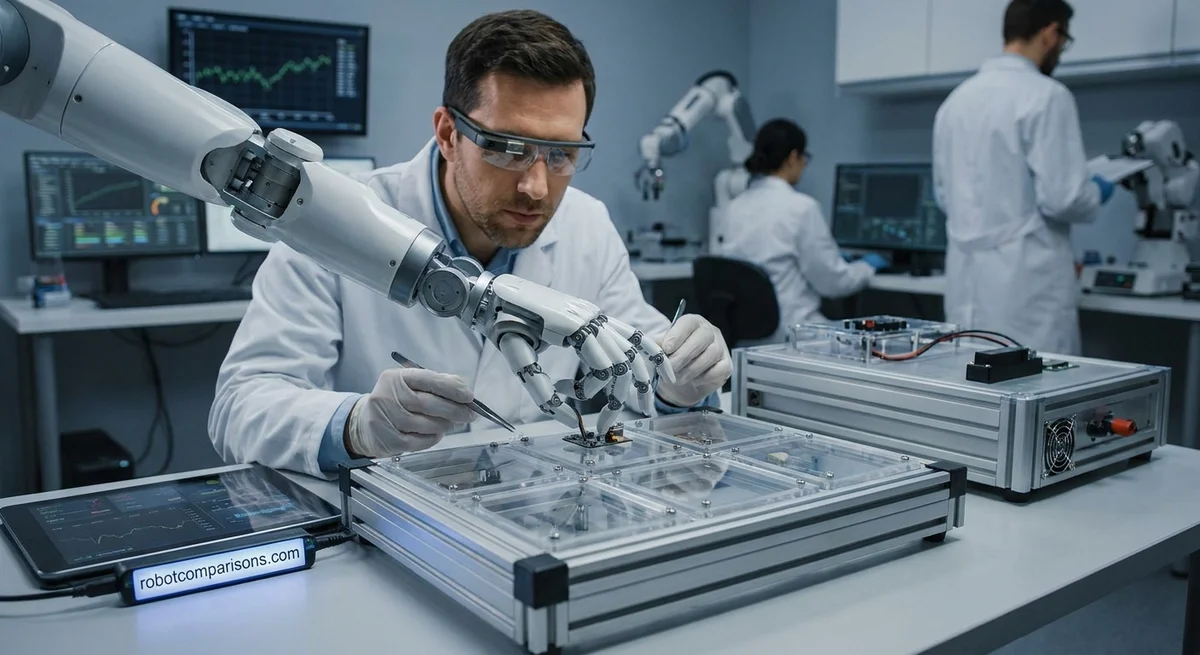
Dexterity and Manipulation in 2026: Assessing Fine Motor Skills and Tool Use
Robots are getting better at delicate tasks – from screwing bolts to plugging connectors, opening doors, or handling soft objects like cables and cloth. By 2026, machines in factories and homes face real challenges: tiny screws need careful alignment, electrical plugs must mate exactly, door handles come in many shapes, and flexible parts (wires, fabrics) can flop unpredictably. Researchers and companies design benchmark tests to measure these skills. For example, the U.S. NIST group created assembly test boards that mimic real factory scenarios with threaded screws, snap-fits, electrical connectors, wiring harnesses and belts【nist.gov】【Frontiers】. These task boards let engineers score a robot on how well it can pick up a bolt, align it, and fully insert it without breaking the thread【nist.gov】. Other tests include plugging in heavy connectors or routing wires through channels【Frontiers】【Fraunhofer】. Even robotics competitions (like ARIAC) use similar tasks to challenge new systems.
Key Precision Tasks for Robots
Robots must master several precision tasks, often seen in manufacturing or daily life:
- Threading Fasteners: Grabbing a screw or bolt and turning it into a hole. The robot must align the screw’s tip with the hole and twist it in. This requires very fine position and force control.
- Connector Mating: Inserting an electrical plug or cable into a socket. Parts may be misaligned by a millimeter or two, so the robot needs either very precise vision or “search” motions to find the socket【Fraunhofer】. For example, a recent Fraunhofer study ran hundreds of trials automatically mating high-voltage connectors and found that a sensitive alignment strategy (using slight movements and force feedback) let the robot correct small misplacements for reliable connection【Fraunhofer】.
- Opening Doors/Drawers: Twist or pull a handle to open a door or drawer. Doors vary widely – knobs, levers, push-pulls – and may lock in tricky ways. Advanced robots like Hyundai’s new Atlas or 1X’s Neo use vision and force sensing to detect handle type and apply the right motion【Time】【TechRadar】. In one study, a mobile robot learned to “feel” the handle by moving its arm and measuring forces, then adaptively turned or pushed, opening unknown doors without hitting force limits【TechRadar】【IEEE Access】.
- Flexible Object Handling: Picking up cables, hoses, or fabrics that bend and flop. Unlike rigid blocks, these deformable objects change shape. A cable may coil or tangle if grabbed wrong. To test this, NIST’s latest benchmarks include tasks like routing a wire through clips or placing a belt on pulleys【Frontiers】. In labs, teams have robots two-arm route an electrical cable through a channel: one arm guides the cable, the other positions the socket, so the wire doesn’t overstretch【KI.FABRIK】. Another research team programmed a single arm to twist and tension wires for insertion into clamps, handling various wire bundles successfully【Catalyzex】. Soft cloth is even harder: Figure AI’s humanoid tried folding towels, but often froze when the fabric snagged【Time】. Special soft grippers and vacuum tips are being developed just for cloth.
These scenarios show why fine motor skills are so crucial. In one real-world test, Figure’s robots worked a 10-hour factory shift lifting parts, but struggled with simple cloth folds in the lab【Time】. It highlights that even as many tasks become automated, some “tricky handwork” still needs human-like dexterity.
Benchmarking and Testing Robot Dexterity
To measure progress, experts design robot tests and protocols. The NIST assembly benchmarks are a prime example【nist.gov】【Frontiers】. They include several physical test fixtures (“task boards”) that present a mix of problems (screwing, inserting, snapping). For instance, one board has a plate with holes and matching bolts: the robot must pick a loose M8 screw from a tray, align it, and thread it fully into a hole. Success means the screw sits flush but can’t turn further【nist.gov】. Other boards include springs, gears, electrical connectors, and even wire harness components. The accompanying test rules measure time to complete, error rates (like cross-threading), and how much force was used.
These benchmarks help compare different robots. For example, benchmarks show how force/position control and sensor quality affect success. In door tests, one IEEE study found that a compliance-based controller (one that lets the arm yield slightly) dramatically cut forces: the robot hit the door with only ~4.4 N peak force instead of ~11.9 N when running in a stiff, straight line【IEEE Access】. This means the compliant setting made the motion smoother and safer.
Researchers also watch learning curves. How many attempts or how much training time does a robot need to nail a new task? Historically, robots have required thousands of trial moves or large datasets to learn even simple actions. A recent news report highlights a breakthrough where a learning method taught a robot 1,000 different tasks (like placing, folding, inserting) in one day, from just one human demonstration per task【TechRadar】. This is unheard of compared to past robots that needed hundreds of attempts per task. Boston Dynamics claims its new Atlas humanoid can be “trained on new tasks in under a day”【TechRadar】. In research labs, however, task learning still can take many hours of data: one group spent ~36 hours having a robot gather tactile data before it could predictively manipulate an object by feel【Robohub】. Practically, in industry, teaching a cobot a new pick-and-place or screw job usually involves an engineer or operator guiding it through the motion a few times. Smooth user interfaces and learning algorithms are improving this, but the learning curve (rate of improvement over time) is a key metric to watch as these systems evolve.
Control Techniques: Compliance, Impedance, and Tactile Sensing
Two main technical levers drive robot precision: compliance/impedance control and sensory feedback.
-
Compliance/Impedance Control: Think of a robot arm as a spring or a rigid rod. A stiff (high-impedance) setting means the actuator holds its position without bending; a soft (low-impedance) setting means it yields like a spring under contact. Many industrial robots can switch between modes. For fine tasks, a soft approach often helps. For example, when threading a bolt or plugging a cable, a compliant robot can “feel” when the parts align and then gently push through, rather than forcing and jamming. Adjusting the virtual stiffness (impedance) is like tuning how strong that spring is. In door-opening experiments, turning on compliance (Cartesian Compliance Control) let the robot adapt to unknown latch forces and drastically reduce impact forces【IEEE Access】. This approach is essential for tasks with tight tolerances.
-
Tactile Sensing: Most everyday robot arms use simple bump/force sensors, but like human fingers, more advanced robots are getting actual touch sensors. In 2026, the new Atlas humanoid even sports tactile fingertip sensors in its hands【TechRadar】. These sensors capture detailed contact patterns (like our sense of touch) so the robot can detect edges, slips, or textures somewhat like a human would. Laboratory robots have used optical touch sensors (e.g. GelSight) to precisely manipulate objects by touch【Robohub】. Higher sensor “density” (more touch points) generally improves performance on subtle tasks (feeling a keyway or the twist of a knob), but it adds data to process. At present, tactile-loop control is still cutting-edge: many robots rely mainly on cameras and joint force-torque feedback. For example, 1X’s Neo Home Robot employs a vision-and-sound-based AI (“Redwood”) to find and pick objects and even open doors【TechRadar】, rather than sophisticated touch. Over time, we expect more robots to integrate rubbery sensor arrays or small pressure pads on their fingers for safer, more precise manipulation.
Training Robots and Learning Curves
When introducing a new task, teams usually measure how quickly a robot “gets smarter.” Early on, a robot might fail many times; with practice (trial-and-error or demonstrations) its success rate climbs. This is the learning curve. For factory robots, the curve often starts low – the first tries can be clumsy – and engineers adjust control settings, use force-leads, or even guides (jigs) to improve it. With modern AI, some tasks can be learned faster. As one news report notes, a recent learning algorithm allowed learning thousands of mixed tasks with one example each within a day【TechRadar】. Boston Dynamics likewise touts very fast task learning for Atlas【TechRadar】. Still, in most practical cases each new task can take hours of tuning. The time needed depends on task complexity and setup: precise alignment tasks or flexible-object handling usually require more attempts than simple pick-and-place of big objects.
It is useful to benchmark how performance grows. For instance, one could plot seconds to success versus number of trials. In experiments, performance often jumps when adding key features: e.g. using force feedback, or adding a guide. These jumps highlight bottlenecks. Teams have found that even with cutting-edge learning, training a robot by touch (with high-res sensors) took tens of hours of self-training for just one task in research settings【Robohub】.
Jigs, Fixtures, and End-Effector Strategies
In engineering practice, if a direct approach fails, one often adds a jig or fixture – a simple mechanical aid. For example, if a robot mis-aligns a screw, a funnel can guide the screw head into the hole. If a wire slips away, a channel or clamp might hold it until the robot grabs it. NIST’s task boards themselves are like fixtures: they hold parts in a known position so the robot only has to handle insertion. In factories, common aids include screw feeders (which drop screws one by one) and alignment pins. Robotiq’s commercial screwdriving solution for UR cobots is a good example: it bundles a powered screwdriver tool, a flexible screw feeder, and a URCap program so the robot can automatically feed and install screws without manual repositioning【Robotiq】. This system even uses a vacuum sleeve to manage the screws during changeovers【Robotiq】. Such tools eliminate the need for operators to hand the robot each screw.
If the standard parallel gripper (two-finger clamp) can’t grasp a problem object, engineers might swap end-effectors. For pliable flat items like fabric, one might use suction or an electrostatic gripper. For instance, a product called µGripper uses an electrostatic “pancake” to pick thin fabrics without creasing【Roboptics】. Soft Robotics makes a “Rochu” gripper: a gentle multi-finger vacuum tool that picks only the top layer of several cloth sheets【SoftRobotics】. Heavier textiles (towels, upholstery) might use a compliant two-finger padded gripper instead【SoftRobotics】. Cable-like objects sometimes benefit from special wraps or twist motions (as in the wire-harness research【Catalyzex】).
Workflow redesign is another option. If a task is inherently too hard, changing the part or sequence can help. For example, if threading a tiny screw in place is failing, designers might use captive nuts or snap-fit clips instead. If mating connectors by robot is error-prone, one could simplify connector shapes or use guiding funnels. Basically, when robots struggle, ask: Can we make the part simpler, or the path to it clearer? For example, a socket could be presented with lead-in chamfers, or a cable might come pre-cut at a fixed length held by a holder.
Finally, for very small or very flexible parts, different robotic hands can be chosen. Multi-fingered hands (like the human-like Shadow Hand or qb SoftHand【qbrobotics】) can wrap around objects and give distributed grasp. Suction cups handle flat, non-porous items (think vacuum picking of glass panels). Magnetic or adhesive grippers may pick sheet metal. The choice depends on task and object. When a change is needed, the robot might even use a tool changer to swap gripper for a screwdriver accessory, or for a special hose or sensor. In general, if standard approaches reach their limit (say repeated failures or slow cycle times), it’s time to consider alternate end-effectors or part fixtures, or even human-robot collaboration where a person does the final touch.
Conclusion
By 2026, robots are edging closer to human-like dexterity in some domains, thanks to improved compliance control, AI learning, and touch sensing. Standard tests (like the NIST task boards) and company demonstrations help us quantify this progress. The state of play is that routine precision tasks – inserting industrial connectors, operating uniform machines – are increasingly automatable, while novel or very delicate tasks still need careful engineering. Key drivers of performance include how softly or stiffly the robot moves (impedance settings), how much tactile information it gets, and how much training it receives.
For businesses and hobbyists alike, the advice is: measure carefully, tune the robot’s control parameters, and don’t hesitate to use jigs or special tools. Real-world examples (from Robotiq’s screwdriving kits to Boston Dynamics’ Atlas with sensorized hands【TechRadar】) show that combining the right hardware with good software makes fine tasks feasible. In the end, a flexible approach often wins – sometimes that means teaching the robot, sometimes it means simplifying the task for the robot, or even redesigning the part so the robot can reliably do its job. By following these guidelines, engineers can better judge which tasks are ready to hand off to robots in 2026 and how to adapt when challenges arise.