 Auto
Auto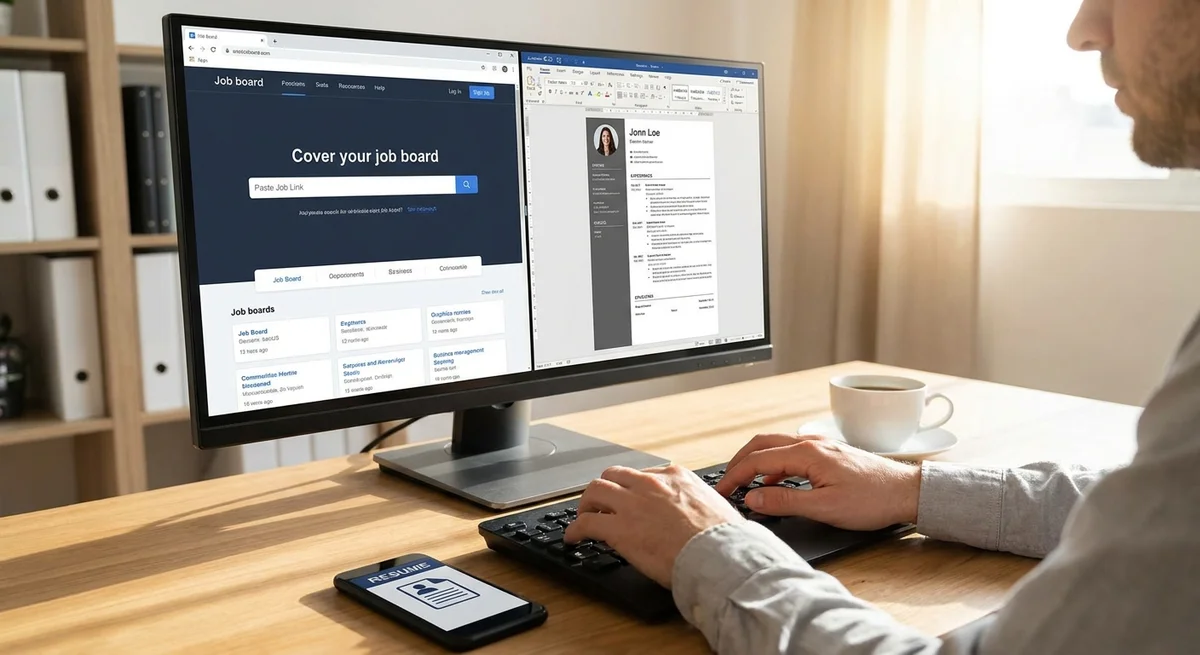
Beating the ATS: Paste Job Link, Get a Ready Resume
Sending the same resume to every employer feels efficient. In practice, it often makes the hiring team do the matching work.
Job seekers now face a confusing process. They apply for jobs they can do, receive an instant rejection, and never know whether a person saw the resume. Some use resume scanners and get a high match score, yet still receive no interviews. Others spend 20 to 30 minutes changing each resume without knowing if the changes helped. Public job seeker posts show the same pattern again and again: no interviews, unclear rejection reasons, and confusion about what an Applicant Tracking System actually does. These posts are not controlled research, but they show a strong product pain. (reddit.com)
The opportunity is simple:
Paste a job link and upload your resume to receive a truthful, Applicant Tracking System-ready version with job-matched keywords and quantified bullets in under two minutes.
The important word is truthful. The product should not help people stuff keywords into a document or invent achievements. It should make real experience easier for both software and people to understand.
The Applicant Tracking System Problem Is Widely Misunderstood
An Applicant Tracking System is not one universal robot that reads every resume in the same way.
Applicant Tracking Systems usually help employers:
- Collect applications
- Store resumes and application details
- Extract education, skills, work history, and contact information
- Search candidate profiles
- Apply screening questions or hiring rules
- Rank or organize candidates
- Track interviews and hiring decisions
Workday explains that its systems can parse resume text into structured candidate profiles. Some systems also use matching tools to compare skills and experience with a job description. Greenhouse describes its system mainly as a platform for collecting applications, storing candidate information, and tracking progress through the hiring process. (workday.com)
This matters because a rejection can happen for different reasons:
- The resume was not read correctly.
- Important skills were not easy to find.
- The candidate failed an application question.
- The resume ranked below other candidates.
- A recruiter chose not to move forward.
- The company filled the role or stopped reviewing applications.
So the goal is not really to “beat the robot.” The goal is to create a resume that is:
- Easy to parse
- Relevant to the specific job
- Clear to a recruiter
- Accurate and easy to defend in an interview
The Three Main Resume Bottlenecks
1. Keyword Alignment
The first bottleneck is using the language of the job posting.
A resume may describe the right experience but use different words. For example:
- Job posting: customer success
- Resume: client account support
Or:
- Job posting: project management
- Resume: coordinated cross-team initiatives
A recruiter may understand that these phrases are related. A search tool may not always make the connection. Workday notes that modern systems can understand similar phrases, but recruiters still search for specific skills, titles, certifications, and experience. (workday.com)
The solution is not to copy every word from the job posting. It is to identify the most important terms and use them naturally in the right places:
- Resume headline
- Professional summary
- Skills section
- Work experience bullets
- Project descriptions
- Certifications and education
The Society for Human Resource Management recommends placing relevant keywords throughout the resume, including the summary, skills, work history, achievement statements, and education. It also warns that candidates should use keywords honestly and avoid overstating their experience. (shrm.org)
Example
Weak alignment:
Helped clients use the company platform.
Stronger alignment, if accurate:
Managed customer onboarding for 35 business accounts, using Salesforce and product training to improve adoption and reduce early cancellations.
The second version includes:
- Customer onboarding
- Salesforce
- Business accounts
- Product training
- Adoption
- Cancellations
It also explains how the candidate used those skills.
2. Quantification
The second bottleneck is the difference between listing tasks and showing results.
A task tells the reader what someone was responsible for. A result shows why the work mattered.
Task-based bullet:
Managed customer support operations.
Result-based bullet:
Managed support for 4,000 monthly tickets, reduced first-response time by 28%, and improved customer satisfaction from 88% to 94%.
The second bullet is stronger because it shows:
- Work volume
- Speed
- Improvement
- Business impact
The University of California, Berkeley advises job seekers to focus on outcomes and quantify results when possible. It also recommends connecting each accomplishment to a skill the employer is seeking. (career.berkeley.edu)
Useful numbers may include:
- Revenue generated
- Costs reduced
- Time saved
- Number of customers served
- Team size
- Project size
- Sales volume
- Error reduction
- Customer satisfaction
- Processing speed
- Completion rate
- Number of projects
- Budget managed
- Percentage growth
Not every resume bullet needs a number. However, the most important bullets should provide proof whenever possible.
A resume product should find numbers already present in the resume and ask simple follow-up questions when important numbers are missing. It should never create fake metrics.
3. Format Compliance
The third bottleneck is whether the document can be read correctly.
A resume may look perfect on screen but turn into a confusing file when uploaded. Greenhouse lists several common parsing problems:
- Tables
- Multiple columns
- Text boxes
- Headers and footers
- Images
- Graphics
- Word art
- Unclear section headings
- Incomplete job titles
- Resumes saved as images
- Spaces placed between letters
These problems can cause the system to miss or scramble important information. (support.greenhouse.io)
Roche gives similar guidance. It recommends keeping important text in the main body of the document and avoiding tables, text boxes, logos, graphics, columns, and unusual section headings. It also notes that different systems may handle Word documents and portable document files differently. (careers.roche.com)
The safest general format is:
- One vertical column
- Common headings such as Summary, Experience, Education, and Skills
- Standard fonts
- Clear job titles
- Consistent dates
- Normal bullet points
- No photos, charts, icons, or decorative graphics
- Contact information in the document body
- The file type requested by the employer
There is no single format that works perfectly for every employer. The application instructions should always come first.
Resume Builder Versus True Resume Tailoring
Most resume tools fall into three groups.
Resume Builders
A resume builder helps users create a document from a template.
It may provide:
- Fonts
- Layouts
- Section headings
- Formatting
- Resume examples
- Download options
This is useful for someone starting from a blank page. It can also fix messy spacing and make a resume easier to read.
However, a resume builder usually does not solve the deeper problem: whether the resume shows the right evidence for a specific job.
A clean resume can still be too general.
Applicant Tracking System Scanners
A scanner compares a resume with a job description and produces a score.
It may identify:
- Missing skills
- Missing job titles
- Missing certifications
- Formatting problems
- Repeated keywords
- Possible experience gaps
This can be helpful as a checklist. But a score is not a universal hiring result. The University of California, Berkeley notes that employers use different Applicant Tracking Systems with different capabilities. Workday also explains that systems vary by organization and may use different matching and search features. (career.berkeley.edu)
A high score does not guarantee an interview. One job seeker reported receiving 95 to 98 percent match scores from resume scanners while still receiving no interviews. (reddit.com)
The problem with many scanners is that they reward the appearance of alignment. They may not ask:
- Does this person have proof of the skill?
- Is the strongest experience near the top?
- Does the resume show business results?
- Is the wording natural?
- Can the person defend every claim?
True Resume Tailoring
True tailoring starts with a specific job and changes the resume around that job.
It should:
- Read the job link.
- Identify required and preferred skills.
- Find matching evidence in the original resume.
- Move the most relevant experience higher.
- Rewrite weak bullets around outcomes.
- Add accurate job-specific language.
- Remove low-value content.
- Flag requirements that are not supported.
- Check the final file for parsing problems.
This is more valuable than simply placing keywords in a skills list.
The Society for Human Resource Management says artificial intelligence tools can help identify keywords and improve how candidates describe their experience, but they are not a replacement for a well-written, human-created resume. (shrm.org)
What Does the Evidence Say About Outcomes?
The strongest evidence supports clearer writing and better presentation, not a guaranteed Applicant Tracking System pass.
A 2025 field experiment involving nearly half a million job seekers found that algorithmic writing assistance was linked to an 8 percent increase in hiring and 10 percent higher wages. The study focused on clearer writing rather than job-specific Applicant Tracking System tailoring, so it should not be treated as proof that a keyword score causes more interviews. It does show that improving how experience is communicated can affect hiring outcomes. (pubsonline.informs.org)
A separate survey from ResumeBuilder.com reported that 78 percent of surveyed job seekers received an interview after using application materials written with ChatGPT, and 59 percent said they were hired. However, the survey was commissioned by a resume company, used self-reported results, and did not compare users with a control group. It is a market signal, not strong proof of causation. (resumebuilder.com)
Public job seeker discussions also show mixed results:
- Some users report more interviews after tailoring resumes.
- Others say tailoring takes 20 to 30 minutes per application with no clear improvement.
- Some users receive high scanner scores but no interviews.
- Many users are unsure whether their resume was rejected, ranked low, or never reviewed.
The lesson is simple: a resume tool should measure interview outcomes, not just keyword scores.
The Product Opportunity
One-Line Product
Paste a job link and upload your resume to receive a truthful, Applicant Tracking System-ready version with matched keywords, reordered experience, and quantified bullets in under two minutes.
This product is stronger than a standard resume builder because it begins with a real job and an existing resume.
The user does not need to:
- Copy and paste a long job description
- Start from a blank template
- Search for keywords by hand
- Rewrite every bullet
- Guess which experience matters most
- Spend an hour formatting the final document
How the Two-Minute Workflow Could Work
Step 1: Read the Job Link
The product extracts:
- Company
- Job title
- Location
- Work arrangement
- Required skills
- Preferred skills
- Certifications
- Years of experience
- Main responsibilities
- Repeated terms
- Important business outcomes
If the page cannot be accessed, the user should be able to paste the job description as a backup.
Step 2: Build a Job Brief
The system turns the posting into a short checklist:
| Job need | Found in resume? | Evidence |
|---|---|---|
| Salesforce | Yes | Skills section and account manager role |
| Customer onboarding | Yes | Two experience bullets |
| Retention programs | Partial | Related client success work |
| Five years of experience | Yes | Work history |
| Healthcare experience | No evidence found | User review needed |
This creates trust. The user can see what the system changed and what it could not support.
Step 3: Map Experience to Requirements
The product should connect job requirements to specific resume evidence.
For example:
- “Project management” maps to managing six cross-functional launches.
- “Data analysis” maps to building weekly reports in Excel.
- “Customer retention” maps to reducing cancellations by 18 percent.
- “Team leadership” maps to supervising a team of eight.
This is the core difference between a simple keyword scanner and a true tailoring product.
Step 4: Rewrite and Quantify
The product should:
- Rewrite the summary for the target role
- Place important skills in natural context
- Move the strongest bullets to the top
- Replace duty statements with outcome statements
- Add real numbers already found in the resume
- Ask short metric questions when needed
- Mark any unsupported claim for review
For example:
Original:
Worked with sales and marketing teams on campaigns.
Tailored version:
Coordinated six sales and marketing campaigns that generated 1,200 qualified leads and improved campaign response rates by 22 percent.
If the original resume does not support the numbers, the product should not add them. It could instead show:
Coordinated cross-functional sales and marketing campaigns.
Suggested metric to confirm: number of campaigns, leads, conversion rate, or revenue influenced.
Step 5: Validate the File
Before delivery, the product should run checks for:
- Text that can be selected
- Clear section headings
- Standard job titles
- Correct dates
- Contact information in the document body
- Missing text caused by columns or tables
- Duplicate keywords
- Unsupported skills
- Spelling errors
- File size
- Requested file type
The final output should include a Word document and a portable document file when appropriate.
What the User Should Receive
The product should deliver more than a resume file.
1. Ready Resume
A clean, job-specific resume that is easy to read and easy to upload.
2. Change Summary
A short list showing:
- What was added
- What was removed
- Which bullets were rewritten
- Which skills were moved
- Which numbers were used
3. Evidence Map
Each major claim should connect back to:
- The original resume
- A user-confirmed answer
- A saved career profile
This creates a strong defense against artificial intelligence-generated errors.
4. Missing Requirement Report
The system should clearly say:
- “You show this skill.”
- “You show a related skill.”
- “No evidence found.”
- “Do not claim this unless it is true.”
5. Metric Audit
The product should show where the resume has:
- Percentages
- Dollar amounts
- Time savings
- Volume
- Team size
- Customer counts
- Accuracy rates
- Growth rates
It should also suggest where a number could improve a weak bullet.
Product Guardrails Matter
A product in this category should avoid promising that it can “beat every Applicant Tracking System.”
It should never:
- Hide keywords in white text
- Add skills the user does not have
- Invent revenue, savings, or performance numbers
- Change job titles in a misleading way
- Copy the job posting into the resume
- Promise an interview
- Treat a score as a hiring prediction
The product should also protect sensitive information. Resumes contain phone numbers, addresses, employment history, and sometimes private career details. Users should know how their data is stored, used, and deleted.
How Entrepreneurs Should Test the Idea
The first version does not need a large resume editor.
A simple first product could include:
- Job link input
- Resume upload
- Job requirement extraction
- Evidence matching
- Bullet rewriting
- Quantification suggestions
- Format validation
- Word document download
The most important product measures should be:
- Time from upload to final resume
- Percentage of users who download the result
- Number of edits users make
- Percentage of unsupported claims caught
- User rating of relevance
- Applications completed per hour
- Interview responses per application
- Interview rate before and after using the product
The product should not use keyword score as its main success measure. A better test is whether qualified users receive more recruiter responses while spending less time on each application.
Conclusion
The Applicant Tracking System market is crowded with resume templates, keyword scanners, and artificial intelligence writing tools. Most solve only one part of the problem.
A better product would combine three jobs:
- Keyword alignment for the target role
- Quantified, outcome-based bullets for human review
- Simple formatting for reliable parsing
The strongest product message is not “trick the Applicant Tracking System.” It is:
Turn your real experience into the clearest version of your fit for this job—fast.
A two-minute, job-link-to-ready-resume tool could win because it removes the hardest part of applying: deciding what to change, what to keep, and how to prove that the experience matters.