 Auto
Auto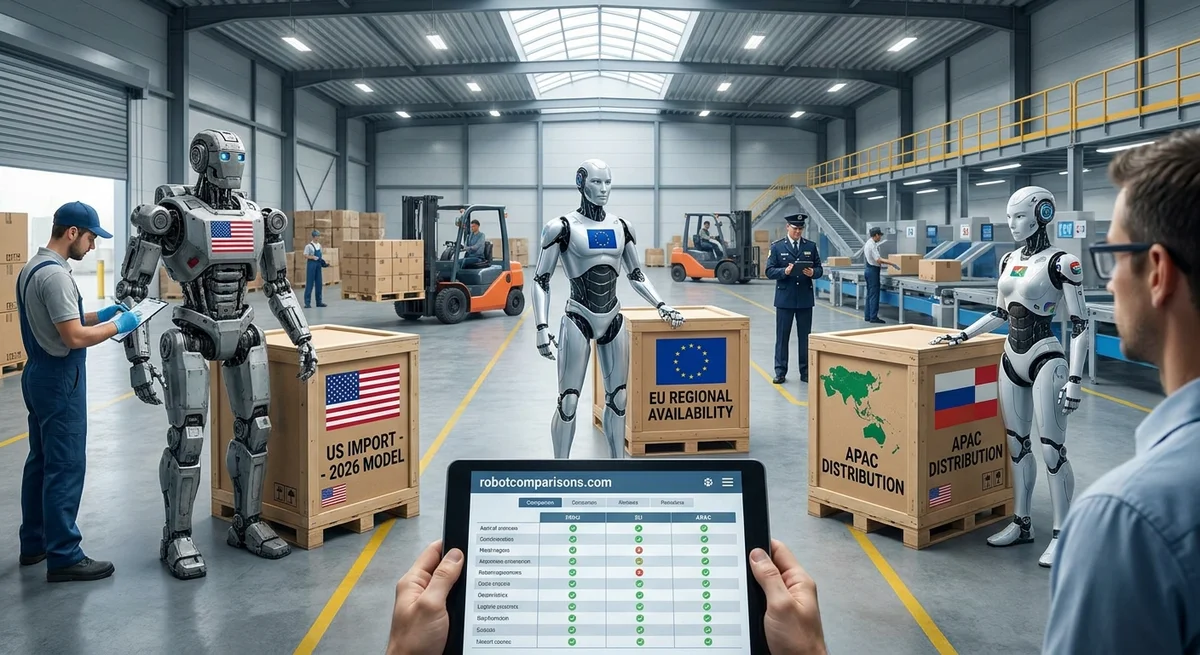
Regional Availability of Humanoid Robots
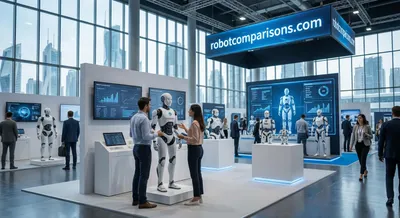
Humanoid robots are emerging around 2026, but availability varies by region. For example, at CES 2026 Hyundai-owned Boston Dynamics showed its new Atlas humanoid, and Tesla announced plans to produce its Optimus robot using self-driving car AI (apnews.com) (www.techradar.com). This means new robots may soon be sold worldwide. But each region (US, EU, Asia Pacific) has different vendors, distributors, and wait times. Some companies like Boston Dynamics and Tesla plan global production, while others (like SoftBank’s Pepper or Chinese builders) focus on local markets. Typical lead times are long – many robots will ship months or even years after ordering (www.techradar.com) (apnews.com). For instance, Tesla hopes to deliver its first Optimus prototype by 2026 and full production by 2027–2028 (www.techradar.com), and Boston Dynamics says Atlas units will join Hyundai’s US factory line around 2028 (apnews.com).
United States (North America): In the US, major humanoid robot players include Tesla and Boston Dynamics (Hyundai). Tesla’s humanoid (Optimus) is under development, with production expected soon (www.techradar.com) (apnews.com). Tesla has factories in California and Shanghai gearing up for robots, but as of 2025 it had only shipped ~500 bots globally (apnews.com). Boston Dynamics (Massachusetts) will sell Atlas for industrial use; it has a US service network for its existing robots (Spot, Stretch), and Atlas will first work in US factories (apnews.com) (www.techradar.com). A few smaller companies (e.g. Agility Robotics, F&P Robotics) sell robots or kits in North America. In contrast, SoftBank’s NA sales of Pepper/NAO robots have dwindled – SoftBank stopped new Pepper production in 2021 (www.mobileworldlive.com). Lead times: Orders placed now will likely take many months. Early adopters (car factories, research labs) reserve slots; expect delivery times of 6–18 months or more, depending on production ramp-up.
European Union (Europe): Europe has some humanoid robotics development but fewer big vendors. SoftBank’s former European arm (Aldebaran in France) was sold to Germany’s United Robotics Group (URG) in 2022 (www.mobileworldlive.com). URG/Aldebaran still supports Pepper and NAO robots, but new production is limited (Pepper was discontinued by SoftBank (www.mobileworldlive.com)). A few EU startups exist (e.g. PAL Robotics in Spain, Engineered Arts in UK) but no mass-market product yet. European buyers might import robots like Atlas or Optimus. Coverage: Vendors like Boston Dynamics and (eventually) Tesla will handle Europe centrally (e.g. from US factories or via EU subsidiaries), though local sales teams are still forming. Lead times: Similar to the US – initial deliveries (2028 for Atlas) will go to factories. Small business or consumer robots (if any) will also see 6–12 month waits because of low initial production.
Asia-Pacific (APAC): APAC leads in humanoid robot development and adoption. Japan has SoftBank (previous Pepper/NAO robots) and automakers like Toyota doing R&D. China has many vendors – for example, UBTECH’s Walker S2 can even autonomously swap its own batteries (www.livescience.com), and Shanghai’s AGIBOT makes X2 service robots that converse in multiple languages (apnews.com). An AP News report notes China has more than 140 humanoid robot companies (apnews.com). Tesla’s Shanghai factory is also poised to produce robots, likely for Asia markets first (apnews.com). Coverage: Chinese robots often sell domestically and to nearby markets; AGIBOT has agents in Hong Kong (apnews.com). Japanese and Korean vendors mainly serve their home markets or sell components. Lead times: In APAC, lead times may be somewhat shorter for local robots, but still long. Demand is high (aging populations, factories), and government support means many prototypes are in private hands. Expect 6+ months for custom requests (with China’s Spring Festival possibly affecting schedules).
Import/Export and Compliance Rules
Bringing a humanoid across borders involves many rules:
-
Customs Classification (HS codes): Robots must be classified under Harmonized System codes. For example, the U.S. Customs once ruled that a museum exhibit robot fell under HTSUS 9023.00 (“demonstrational apparatus”) with 0% duty (www.customsmobile.com). (The U.S. also has codes 8479 for “machines” or 9618 for “mannequins/automatons”.) In practice, most demonstration or research robots go under HS 9023, which is often duty-free. Always check with customs brokers: similar codes exist worldwide. For EU import, robots would use the Combined Nomenclature (CN) equivalent (e.g. 9023 00 XX), usually at low or zero tariff under trade agreements.
-
Tariffs and Duties: Tariffs vary by origin. Under World Trade Organization rules and FTAs, industrial robots typically face low duties. For example, Chinese-made robots into the EU may incur normal MFN rates; U.S.-made robots into Europe (or vice versa) are often duty-free (especially under updated US–EU trade deals). However, be aware of special levies: e.g. the EU has raised duties on some Chinese tech (mostly solar, EVs, chips), so check if any apply. In the US, most machinery (HTS 9023) is duty-free (www.customsmobile.com). Use a licensed customs broker to confirm the exact HS code and tariff before import.
-
Export Controls: Some advanced robots or their parts could be subject to export controls. The U.S. has no robot-specific export ban, but high-tech AI chips or sensitive sensors (like lidar, nuclear-related equipment, encryption modules) might need a license. Recent U.S. policies tightened AI hardware exports (apnews.com) (though primarily for GPUs and chips). The EU and UK also screen exports of dual-use high-tech under EU Dual-Use Regulation. For most commercial robots today, no license is needed unless they have military-grade sensors. Always check that components (vision systems, drones, etc.) don’t trigger controls.
-
Environmental Regulations (e-waste): In the EU, robots are electrical/electronic equipment (EEE). That means sellers/importers must follow the WEEE Directive. Practically, this means the company (manufacturer or authorized importer) must register with each EU country’s WEEE authority, report how many robots it sells, and pay into a recycling scheme (europa.eu). Each robot should bear the crossed-out trash bin symbol to show it can’t go to landfill. In practice, a U.S. company exporting to the EU must either set up an EU legal entity for WEEE or appoint an Authorized Representative. Other regions: some APAC countries have e-waste laws (Japan’s Home Appliance Recycling Act, and China’s producer responsibility laws) with similar obligations. In the US, there is no federal e-waste law (only some state programs), so compliance is easier.
-
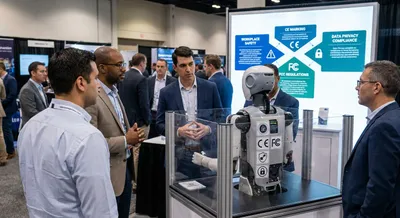
Product Certification: Humanoids usually need multiple safety and telecom approvals. In the EU, robots fall under the Machinery Directive (2006/42/EC) and related standards (blog.robotiq.com). This means each robot must be designed and tested for safety (risk assessment, guarding, emergency stop, etc.), and bear the CE mark before sale. It may also need the EMC (electromagnetic compatibility) and RED (radio) marks if it has wireless or electronic parts. In the US, there’s no single robot standard, but OSHA’s general industry rules (29 CFR 1910) and standards like ANSI/RIA R15.06 apply (www.osha.gov). Practically, sellers usually get a UL (or CSA/TUV) safety listing for electrical parts, and FCC approval for radio modules. Asian markets: China requires CCC or SRRC certification for electronics/radio, and Japan might require the PSE mark for large batteries or electrical gear.
-
Labelling and Documentation: Prepare full documentation. Labels should show country of origin and electrical ratings. Include user manuals in local languages as needed (CE often requires manuals in official EU languages). Provide technical files or declarations of conformity (CE) upon request. Check if you need specific hazard statements (e.g. EU providing a signal word like “Warning”).
Safety and Labor Considerations
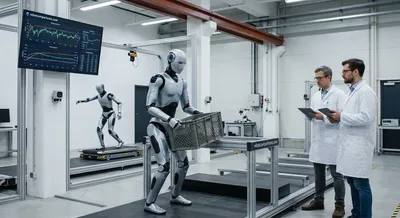
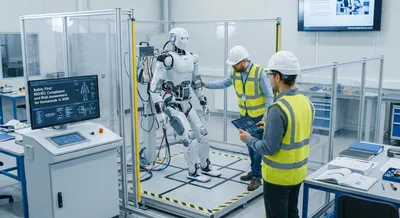
Deploying humanoids involves workplace safety and local labor rules. Basic principle: robots must not endanger workers. In the EU, safety is mandated by law through the Machinery Directive and harmonized standards (blog.robotiq.com). A thorough risk assessment is required (e.g. per ISO 12100 standard) before using a robot. Protective measures (guards, light curtains, emergency stops) must be in place. In the US, OSHA says employers must keep workplaces “free from recognized hazards” and often adopts safety standards from ANSI/RIA or ISO. For example, parts of 29 CFR 1910 (general industry rules) cover machine guarding, electrical safety, and controls. In practice, companies treating robot installations like any other machine can comply with OSHA.
Labor law differences mostly influence how robots affect workers, not how robots must be built. Generally, a robot is not a “worker” under labor law – no wage or benefits – so deploying one won’t trigger employment contracts. However, launching an automation project might require consultations. In the EU, strong labor protections mean workers’ councils or unions may have a say in major technology changes. You should check if countries like Germany or France have requirements to notify or discuss with employee representatives when introducing new machinery. In the US, labor rules are more flexible (e.g. “at-will” employment), but workers displaced by robots might claim unfair labor practice in a union shop. In Asia, rules vary: some places focus more on reskilling and less on regulation.
In all regions, training is key. Operators, maintenance staff and nearby workers need instruction on safe robot use and emergency procedures. For example, if a robot has autonomous navigation, ensure its sensors are validated so it won’t bump people. If it carries heavy payloads, fences or safety zones may be mandatory. Treat it as you would any new industrial machine.
Logistics and Compliance Checklist
Here’s a practical checklist for cross-border robot procurement:
- Vendor and Support: Identify an authorized supplier or distributor in your region. Confirm the vendor offers service and spare parts locally, or arrange training for your team.
- HS Code & Tariff: Work with customs experts to classify the robot correctly (e.g. HS/HTS 9023 or 8479). Check the duty rate (often 0%) and import taxes.
- Export License: If shipping from the U.S., verify that nothing on the robot (AI chips, cameras, etc.) requires an export license. If in doubt, consult export control rules (EAR/Wassenaar).
- Environmental Registration: For EU imports, register with each country’s WEEE authority and budget for recycling fees (europa.eu). In APAC, check local e-waste laws (e.g. China’s or Japan’s recycling schemes).
- Certification & Documentation: Ensure the robot has needed certificates: CE declaration (EU), FCC label or UL listing (US), CCC mark (China), etc. Provide user manuals, safety guidelines, and declarations of conformity in local language.
- Compliance Labels: Check electrical ratings (voltage, frequency) match the import country (e.g. 230V in EU vs 120V in US). Verify connectivity approvals (Wi-Fi, Bluetooth) if present.
- Customs Filing: Prepare paperwork (commercial invoice, packing list, Certificate of Origin, insurance). Attach any customs rulings (like US binding tariff rulings) if helpful. Hire a customs broker to file the entry using the correct HS code (www.customsmobile.com).
- Insurance & Freight: Arrange freight transport (robots are heavy/delicate) and insure the shipment. Consider door-to-door freight forwarding to handle forklift offloading and unpacking.
- Safety Equipment: Upon arrival, install safety barriers or interlocks as needed. Schedule staff training. Perform a fresh risk assessment in the actual worksite.
- Labor & Training: Inform any local labor or safety authority if required. Train operators under OSHA (or local equivalent) guidelines to avoid hazards.
- Follow-up: Keep documentation of compliance (keep CE certificates, export paperwork, safety records). Stay updated on changing regulations (e.g., new EU AI laws may apply for intelligent robots).
By checking off each step, companies can avoid delays, fines or rejections at the border. Planning ahead of time makes remote robot procurement much smoother.
Conclusion
Humanoid robots are on the cusp of wider use, but buying them internationally is complex. Vendors’ reach varies: US firms like Tesla and Boston Dynamics aim for global markets, Europe has fewer producers (SoftBank-related & startups), and APAC is full of local builders. Wait times for these advanced machines remain long as production scales up (www.techradar.com) (apnews.com). Cross-border sales must navigate customs codes (usually HS 9023 or 8479) (www.customsmobile.com), import duties (often low under trade deals), and strict regulations. In the EU, CE marking and WEEE recycling rules apply (europa.eu) (blog.robotiq.com). In the US and APAC, equivalent safety certifications and e-waste laws exist. Employers also must treat robots as machinery under safety laws (OSHA in the US, Machinery Directive in EU) (www.osha.gov) (blog.robotiq.com). By following a thorough compliance checklist – from HS classification and duty payment, to CE/FCC certification, to worker training – buyers can ensure that their new humanoid arrives legally and safely.