 Auto
Auto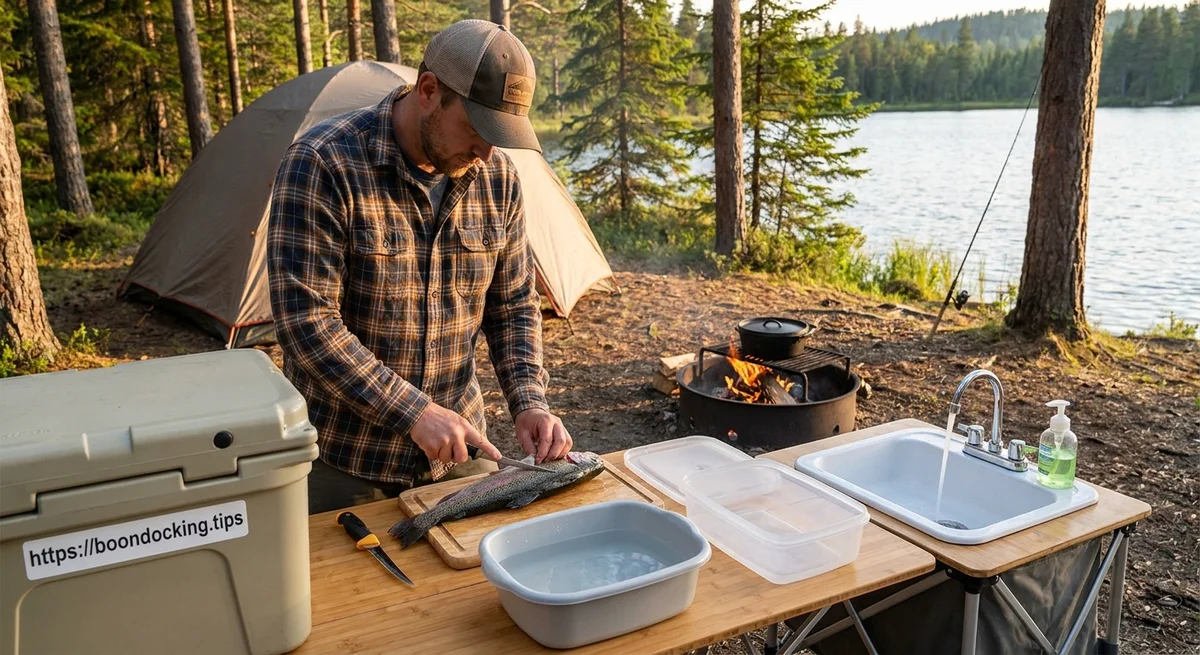
Fishing, Fish Cleaning, and Food Safety at Camp
A fish caught near camp can become a memorable meal—or a legal, environmental, and food-safety problem if it is handled casually. The safest approach is to treat the trip as a complete catch-to-table system: verify the rules before casting, minimize harm to released fish, chill retained fish immediately, clean them away from camp and shallow water, dispose of remains according to local regulations, and cook the edible portions thoroughly.
This guide is U.S.-oriented and intentionally jurisdiction-neutral. Exact rules vary by state, tribe, national park, national forest, wildlife refuge, private landowner, and individual waterbody. On national forests, state fishing rules generally apply; in national parks, state regulations may be adopted but park-specific rules can be stricter; and national wildlife refuges may require additional federal, state, or tribal permits. Regulations and emergency closures can change during a season, so use the current guide and local notices for the exact place and date of your trip. (nps.gov)
1. Legal and Ethical Angling Near Camp
Check the jurisdiction before you fish
Before packing a rod, identify who manages the water:
- State or county waters: Follow the state fishing guide, including license, season, gear, size, and possession rules.
- National forests and grasslands: State fishing regulations usually apply, but forest orders may add closures or restrictions.
- National parks: Check the applicable state regulations, NPS service-wide rules, the park website, and the current superintendent’s compendium.
- National wildlife refuges: Fishing may be limited to designated waters and may require applicable state, federal, tribal, or refuge permits.
- Tribal lands or treaty waters: Tribal rules, permits, and access requirements may apply independently.
- Private property: A public fishing license does not automatically grant permission to cross or fish private land. Obtain landowner permission where required. (nps.gov)
A campsite beside water does not necessarily mean the water is open to fishing. Some areas are closed to protect spawning grounds, nursery habitat, threatened species, migratory birds, public safety, or sensitive cultural and ecological resources. (nps.gov)
License and permit rules
Carry the required documentation before your first cast. Depending on the location, this may include:
- A resident or nonresident fishing license
- A freshwater, saltwater, or combination endorsement
- A trout, salmon, or other species stamp
- A harvest tag or carcass tag
- A special permit for a park, refuge, tribal fishery, or limited-entry water
- Boat registration or launch permits
- Proof of age or license exemption
Do not assume that a national park or federal recreation area waives state licensing requirements. Some parks have special exceptions. For example, Big Bend National Park does not require a state license inside the park but does require a free NPS fishing permit; nearby waters outside the park may follow different rules. (law.cornell.edu)
Seasons, size limits, and possession limits
Read the rules for the specific waterbody and species, not merely the statewide summary. Pay attention to:
- Opening and closing dates
- Daily bag or creel limits
- Possession limits
- Minimum, maximum, or slot length limits
- Species-specific catch-and-release rules
- Artificial-lure-only or fly-fishing-only waters
- Bait restrictions
- Number of rods, hooks, or lines
- Barbless-hook requirements
- Night-fishing restrictions
- Fish-reporting or tagging requirements
A legal size limit may be a minimum, a maximum, or a slot requiring the fish to fall between two measurements. Use the measuring method stated in the regulation—such as total length, fork length, or another specified method.
Measure and identify a fish before cleaning it. Some jurisdictions require the skin to remain attached so officers can verify the species, while others restrict or prohibit filleting in the field. Glacier National Park’s current rules, for example, require skin to remain attached and specify how fish remains must be disposed of. Everglades National Park also limits where and when fish may be filleted. (nps.gov)
If a fish is undersized, protected, out of season, or a species you do not intend to keep, return it immediately and carefully to the water. NPS regulations specifically require prompt release of fish that do not meet size or species restrictions. (law.cornell.edu)
Closed areas to watch for
Look for signs, maps, buoys, and ranger notices identifying:
- Spawning or nursery areas
- Tributaries, inlets, outlets, and fish ladders
- Hatchery or research zones
- Wildlife sanctuaries
- Threatened or endangered fish habitat
- Areas closed during bird migration or nesting
- Swimming beaches
- Boat ramps, marinas, docks, and bridges
- Water immediately below dams
- Seasonal refuge closures
- Areas closed by emergency order, wildfire, drought, or public-safety restriction
Some closures are surprisingly narrow. Blackwater National Wildlife Refuge, for example, allows fishing in certain waters but closes other areas seasonally to protect migratory waterfowl. National parks may also prohibit fishing from bridges, public docks, or designated swimming areas. (fws.gov)
Ethical angling practices
Good angling goes beyond complying with the minimum legal standard:
- Keep only what you will use.
- Avoid repeatedly targeting fish you cannot legally keep or safely release.
- Use tackle strong enough to land fish promptly rather than exhausting them.
- Wet your hands before touching a fish.
- Keep the fish in the water whenever possible.
- Use a rubber or knotless net, forceps, and barbless or crimped-barb hooks where legal.
- Avoid touching the gills, eyes, or protective slime layer.
- Support large fish horizontally rather than hanging them vertically by the jaw.
- If a deeply swallowed hook cannot be removed safely, cut the line close to the hook rather than causing additional injury.
- Pack out monofilament, hooks, bait containers, and broken tackle.
- Clean, drain, and dry boats, waders, nets, and other gear before moving between waters to reduce the spread of aquatic invasive species. (fisheries.noaa.gov)
2. Fish Cleaning Away From Camp and Water
Cleaning and disposal are separate decisions
The best place to clean a fish may not be the legal place to dispose of its remains. Many agencies want anglers to clean fish away from camps, docks, and shallow shorelines, but some parks require entrails to be returned to deep water in the same lake or stream. Others require packing them out or using a designated station.
Never copy a rule from another park or state. Follow the rule posted for the water where the fish was caught. (nps.gov)
Choosing a cleaning location
Use this priority order:
- A designated fish-cleaning station
- A legally approved remote cleaning area
- Cleaning at home or at an authorized facility after transporting the fish whole
If local rules permit field cleaning, select a location:
- Well away from tents, sleeping areas, kitchens, picnic tables, and trails
- Downwind from camp when possible
- Away from natural animal travel routes
- Away from docks, beaches, boat ramps, and shallow water
- On durable ground rather than fragile vegetation
- With enough room to contain blood, scales, and scraps
As a conservative camp practice, use roughly 100 yards from tents and cooking areas, and follow any greater distance required by the land manager. NPS backcountry food-preparation guidance uses 100 yards from tents and water when no designated cooking area exists. Bear-country rules may also require retained fish and food to be secured at least 100 feet from sleeping areas or inside an approved bear-resistant container. (nps.gov)
Carry the fish to the cleaning area in a sealed bag or container inside the cooler. Do not leave the catch unattended while it is being cleaned.
A sanitary field-cleaning method
- Confirm legality first. Recheck species, size, limit, and skin or head requirements.
- Prepare a clean work surface. Use a dedicated cutting board, tarp, or folding table.
- Wash hands. Soap and potable water are best; when water is limited, use hand sanitizer containing at least 60 percent alcohol.
- Dispatch retained fish promptly. Do not allow fish intended for food to lie warm in the sun.
- Scale, gut, or fillet according to local rules. Keep the skin attached if identification rules require it.
- Place edible portions directly into leakproof bags. Label them with species, date, and waterbody if advisories or multiple catches are involved.
- Use potable water only if rinsing is necessary. Do not wash fish, knives, or boards in the lake or stream. Contain blood, slime, and rinse water rather than sending it into the waterway.
- Clean the work surface and tools. Scrape all scales and scraps into the designated waste container or packing bag.
- Move the edible fish back onto ice immediately.
- Secure the cooler and cleaning equipment according to local wildlife-storage requirements.
Disposal options
Use a designated station
This is normally the easiest and safest option. Some parks provide fish-cleaning stations and specific receptacles for remains. Use them rather than improvising. (nps.gov)
Pack the remains out
When rules are unclear, the safest default is usually to double-bag the remains and pack them out in a leakproof, odor-resistant container. Store the waste with the same care as food, especially in bear country. Do not place loose entrails in an open campground trash can or leave them beside a trail.
Dispose in deep water only when authorized
Some locations permit or require fish remains to be returned to deep water in the same waterbody. The exact rule may specify:
- The water where the fish was caught
- A minimum depth
- A minimum distance from campsites, docks, or ramps
- A maximum size for chopped pieces
- Puncturing the air bladder before disposal
For example, Isle Royale specifies deep-water disposal in some areas, while Yellowstone and Glacier provide water-specific restrictions and distance requirements. These are local examples, not universal rules. (nps.gov)
Land disposal only when expressly allowed
A few remote areas authorize land disposal for wildlife scavenging, but many bear-country regulations prohibit burying or burning fish remains because animals can dig them up or be attracted to camp. Unless the land manager specifically authorizes land disposal, do not bury, burn, or scatter fish waste. (nps.gov)
Never do these things
- Do not throw fish scraps into shallow water.
- Do not leave them on the beach, dock, or boat ramp.
- Do not toss scraps to gulls, ravens, or other wildlife.
- Do not put entrails in a campfire.
- Do not bury fish remains near camp.
- Do not dump blood, scales, or wash water into a drinking-water source.
- Do not leave a cooler containing fish unattended where wildlife can reach it.
Fish remains and retained fish are food attractants. Poor disposal can teach wildlife that campsites are places to find meals, creating risks for both visitors and animals. (nps.gov)
3. Cold-Chain Management Without Electrical Hookups
Fish quality begins deteriorating as soon as the fish dies. NOAA recommends putting a catch directly into ice or an ice slurry; one practical mixture is approximately two parts ice to one part water. (fisheries.noaa.gov)
A reliable camp-cooler system
- Pre-chill the cooler before departure.
- Use a dedicated catch cooler, separate from the frequently opened drink cooler.
- Bring block ice, frozen water bottles, or frozen gel packs.
- Put fish into leakproof bags or containers before surrounding it with ice.
- Keep the cooler shaded, closed, and out of direct sun.
- Use a waterproof probe thermometer.
- Keep fish at or below 40°F, with a target close to the temperature of ice when possible.
- Replenish ice before the catch begins to warm.
- Keep cooked food and raw fish separate.
- Place raw fish below ready-to-eat food if only one cooler is available.
USDA guidance recommends keeping perishable foods below 40°F, using cold sources such as ice or frozen gel packs, storing raw products in watertight containers, and discarding perishables when the cooler no longer has ice or the cold source is no longer frozen. (fsis.usda.gov)
Time and temperature rules
If fish has been above 40°F for more than two hours, discard it. On a hot day—above 90°F—the limit is one hour. Do not rely on smell or appearance to decide whether warm fish is safe. (fsis.usda.gov)
Fish such as tuna, mackerel, mahi-mahi, sardines, herring, bluefish, amberjack, and marlin require especially rapid chilling because poor temperature control can allow scombroid histamine to form. Cooking or freezing does not remove that toxin. (wwwnc.cdc.gov)
4. Parasites, Toxins, and Local Fish Advisories
Parasites
Raw or undercooked fish may carry parasites, including Anisakis in some marine fish and tapeworms or flukes associated with freshwater fish. Visual inspection is not a dependable safety control.
The simplest camp solution is thorough cooking. CDC guidance recommends cooking seafood to at least 145°F. FDA parasite-destruction freezing protocols require tightly controlled freezer temperatures and times—conditions a normal camp cooler cannot reliably provide. (cdc.gov)
Do not assume that ceviche, salting, pickling, cold smoking, or partial cooking makes a wild-caught fish safe from parasites.
Mercury and other chemical contaminants
Check the current state, tribal, or local fish-consumption advisory for the exact waterbody and species. Advisories may depend on the fish’s species, size, location, and the person eating it. Pregnant people, children, and frequent fish consumers should be especially careful. (epa.gov)
Important distinctions:
- Mercury cannot be removed by cleaning or cooking.
- Removing skin, internal organs, and fatty tissue may reduce some contaminants such as PCBs and dioxins.
- Grilling, baking, or broiling on a rack can allow contaminated fat to drip away.
- Do not use drippings or broth if the advisory recommends avoiding them.
- Follow the advisory even if the fish looks and smells normal. (fda.gov)
If legal identification requires the skin to remain attached, keep it attached until the fish has been measured, documented, and transported as required.
Harmful algal blooms
Do not fish for food in water displaying scum, foam, paint-like discoloration, strong unusual odors, dead fish, or an official harmful-algal-bloom warning. Cyanobacterial toxins can contaminate water and aquatic animals, and the risk cannot be judged reliably by appearance alone. EPA advises staying out of water where harmful algae may be present, and CDC notes that people can become ill after eating contaminated fish. (cdc.gov)
Do not use bloom-affected water to rinse fish, wash dishes, make ice, or prepare food.
Ciguatera and other marine toxins
In tropical and subtropical reef waters, large predatory fish such as barracuda, grouper, snapper, amberjack, moray eel, and some reef jacks may carry ciguatoxin. The fish may look, smell, and taste normal, and cooking, freezing, smoking, or pickling does not destroy the toxin. Follow local warnings and avoid high-risk species where advised. (wwwnc.cdc.gov)
Never prepare recreationally caught pufferfish at camp. Some pufferfish contain tetrodotoxin or other potent neurotoxins that are not reliably removed by cooking, freezing, drying, or smoking. (fda.gov)
If anyone develops facial flushing, severe headache, tingling, numbness, weakness, palpitations, trouble breathing, repeated vomiting, or neurological symptoms after eating fish, seek urgent medical help and contact Poison Control or local emergency services.
5. Recommended Cooking Temperatures
Cook fish to a minimum internal temperature of 145°F (62.8°C), measured in the thickest portion. A food thermometer is the only reliable way to confirm that the center is safe; color, firmness, and flaking are useful quality clues but are not dependable safety tests. For thin fillets, insert the thermometer from the side into the center. (fsis.usda.gov)
For camp cooking:
- Cook fillets, steaks, and whole dressed fish to 145°F.
- Avoid raw or undercooked preparations unless the fish has been handled under a verified parasite-control process.
- Do not treat cooking as a remedy for mercury, ciguatoxin, histamine, or other heat-stable toxins.
- Refrigerate leftovers within two hours, or within one hour if the ambient temperature exceeds 90°F.
- Keep leftovers at or below 40°F.
- Reheat leftovers to 165°F if serving them hot.
- If the cooler has lost its ice or the food has been warm too long, discard the leftovers. (fsis.usda.gov)
6. Camp Gear Checklists
Legal and conservation gear
- Current fishing license and required stamps
- Park, refuge, tribal, or special-area permit
- Printed or downloaded regulations
- Waterbody map showing closed areas
- Species-identification guide
- Measuring board or ruler
- Waterproof catch log
- Pliers or forceps
- Line cutters
- Barbless hooks or crimping tool, where legal
- Rubber or knotless landing net
- Spare line and a bag for discarded tackle
Cold-chain gear
- Hard-sided cooler
- Dedicated catch cooler or insulated fish bag
- Plenty of ice, frozen bottles, or gel packs
- Leakproof food bags or containers
- Waterproof labels and marker
- Waterproof probe thermometer
- Shade cloth, tarp, or blanket for insulation
- Bear-resistant food container or storage system where required
Cleaning and sanitation gear
- Sharp fillet knife
- Fish scaler or kitchen shears
- Cut-resistant glove
- Dedicated cutting board
- Disposable or washable apron
- Nitrile gloves
- Potable water
- Unscented soap
- Hand sanitizer with at least 60 percent alcohol
- Paper towels or reusable cloths
- Food-safe sanitizer
- Heavy-duty double bags
- Resealable container for fish remains
- Scrub brush
- Headlamp for low-light cleaning
Cooking gear
- Camp stove or legal fire-grate setup
- Frying pan, grill grate, or foil
- Clean tongs and utensils
- Food thermometer
- Cooking oil and seasonings
- Shallow, sealable containers for leftovers
- Separate raw-food and ready-to-eat utensils
7. Sample Catch-to-Table Workflow
Before leaving home
- Identify the exact waterbody, land manager, and access route.
- Download the current fishing regulations and any emergency notices.
- Confirm license, permit, stamp, season, size, bag, and possession requirements.
- Check local fish-consumption advisories and harmful-algal-bloom warnings.
- Pre-chill the catch cooler.
- Freeze water bottles or gel packs.
- Pack a thermometer, measuring board, cleaning kit, waste bags, and wildlife-storage equipment.
At the water
- Fish only in open areas and during legal hours.
- Identify each fish before deciding to keep it.
- Measure it according to the local rule.
- Log the species, size, and number retained.
- Release unwanted or illegal fish quickly with wet hands and minimal air exposure.
- Place legal retained fish on ice immediately.
At camp
- Store the catch in a sealed container inside the cold cooler.
- Keep the cooler shaded and secured from wildlife.
- Confirm where cleaning and fish-remains disposal are allowed.
- Walk the catch to a designated station or approved remote location.
Cleaning
- Set up the board and tools away from camp, trails, docks, and shallow water.
- Wash hands and use clean equipment.
- Fillet or gut the fish according to local requirements.
- Keep the skin attached if needed for identification.
- Bag edible portions immediately and return them to ice.
- Collect all scales, blood, slime, and trimmings.
Disposal
- Use the designated receptacle, pack the remains out, or follow the specific deep-water or land-disposal rule.
- Never leave scraps near camp, throw them to wildlife, burn them, or place them in shallow water.
- Clean the work surface and tools without contaminating the waterway.
Cooking
- Cook the thickest portion to 145°F.
- Serve immediately or return leftovers to the cooler within the safe time limit.
- Reheat leftovers to 165°F if serving them hot.
- Before leaving, inspect the camp for scales, scraps, line, hooks, and packaging.
Conclusion
Responsible camp fishing is a chain of decisions. The license protects the fishery, the size limit protects future populations, careful release protects individual fish, immediate icing protects quality, remote cleaning protects wildlife, proper disposal protects the campsite, and thorough cooking protects the people at the table.
When rules are unclear, the safest choices are conservative: do not fish a questionable area, do not keep an uncertain species, keep fish whole and cold, pack out remains, and cook the edible portion thoroughly. A little preparation before casting makes the meal safer, the campsite cleaner, and the fishing experience more sustainable.