 Auto
Auto
Enterprise-Ready Humanoids in 2026: Specs, Capabilities, and Safety Compliance
Artificial intelligence and robotics breakthroughs are bringing humanoid robots from sci-fi into real factory floors and warehouses. Big names like Boston Dynamics, Tesla, Agility Robotics, and others are unveiling new models aimed at business use. These robots vary widely in size and strength: some are heavy-duty workers, others are lightweight helpers. In this article we compare the leading humanoid platforms of 2026 – looking at specs like payload (lifting capacity), reach, degrees of freedom (DOF), speed, battery life, and precision. We also review their safety features and certifications (like ISO 10218, ISO 13849, ISO 13482, CE and UL marks). Finally, we give a checklist of what documents and tests companies should demand before buying. This will help both consumers and businesses understand what today’s humanoid robots can actually do now, and how to verify claims about safety and compliance.
Leading Humanoid Robots: Quick Comparisons
Here are some of the top humanoid robots available or coming soon:
-
Boston Dynamics Atlas (Industrial Humanoid) – A robust factory robot introduced in late 2025. Atlas stands about 1.9 m (6.2 ft) tall and weighs ~90 kg, with 56 degrees of freedom for its joints (humanoidspecs.com). It can walk at up to 2.5 m/s (9 km/h) and lift roughly 50 kg with its arms (about 110 lb) (www.techradar.com) (humanoidspecs.com). Atlas is even weatherproof (IP67-rated) and can swap its own battery on a charging dock (www.techradar.com) (humanoidspecs.com). It can reach 7.5 ft high when fully extended (www.techradar.com). In demonstrations it has run, climbed, and even performed gymnastics, showing extreme mobility. However, this power and agility come at a cost: Atlas is large, expensive (likely hundreds of thousands USD), and tailored for factory work – not home cleaning.
-
Agility Robotics Digit (Logistics Robot) – A medium-sized robot built for warehouses. Digit is about 175 cm tall and 65 kg in weight (humanoidspecs.com). It has 30 DOF (4 per arm, 6 per leg) and walks at roughly 1.5 m/s (5.4 km/h) (humanoidspecs.com). Digit’s arms can pick and stack boxes weighing up to 16–18 kg (about 35–40 lbs) (www.agilityrobotics.com). It runs on four rechargeable battery packs (each pack lasts ~4–8 hours) and can handle stairs, obstacles, and even recover from a fall by using its arms to catch itself (www.agilityrobotics.com) (humanoidspecs.com). In fact, Digit is in commercial use: a third-party logistics provider (GXO) reports Digit moved over 100,000 tote packages in a live warehouse deployment (humanoidspecs.com). (GXO even pays Agility by the hour to use each Digit (time.com).) Currently Digit usually works fenced-off from humans for safety, but companies plan to enable fully collaborative operation in the coming year.
-
Apptronik Apollo (Industrial/Manufacturing) – A Texas-made humanoid geared toward factories and warehouses. Apollo is about 173 cm (5’8”) tall, 73 kg, with 44+ DOF (aiwiki.ai). It’s designed for “high payloads and safety” (apptronik.com). Apollo can carry about 25 kg (55 lb) and its battery lasts ~4 hours (the packs are hot-swappable) (aiwiki.ai) (apptronik.com). Like Atlas and Digit, it uses force-responsive actuators that let it adapt to human interactions (catch or yield if bumped). Apptronik emphasizes that Apollo’s hardware is being certified for safety; for example its key actuators already meet TÜV SÜD functional-safety standards (aiwiki.ai). Initial pilot users include Mercedes-Benz and GXO Logistics. Apollo is still in early production, but it’s built to industry-grade specs for manufacturing tasks.
-
1X Neo Beta (Home/Office Robot) – A lightweight humanoid by a Silicon Valley/Norway startup. Neo Beta is only 165 cm tall and 30 kg, with 55 DOF (humanoidspecs.com). It’s designed for homes or offices, so it’s much lighter and quieter. Neo Beta can walk at about 4 km/h (just over 1 m/s) and even “sprint” up to 12 km/h” (faster than any current rivals) (humanoidspecs.com). Despite its speed, it can carry 20 kg (44 lb) of payload and run for 2–4 hours on one charge (humanoidspecs.com). The body is covered in soft foam (no pinch points) for safety around people (humanoidspecs.com). It also has modern sensors: dual fisheye cameras and LiDAR for 360° vision, and force/torque sensors in the joints. The Neo robots are still in prototype or early delivery, but 1X claims they’ve raised hundreds of millions to scale production by 2027. The Neo Home Robot edition (5’6”, ~30 kg) is priced around $20,000 with subscription options (www.techradar.com).
-
Figure 03 (General-Purpose Home Robot) – The third-generation home assistant from Figure AI. Figure 03 is 168 cm, 60 kg with 44 DOF (www.humanoidhub.ai). It’s built to navigate homes, handle chores, and learn by itself. It walks at about 1.2 m/s and runs for ~5 hours on one charge (www.figure.ai). It carries up to 20 kg in its arms (www.figure.ai). A key feature is its precision: its 3-fingered hands have tactile sensors that feel forces as low as 3 grams (www.humanoidhub.ai) – this helps it handle delicate objects. It can even wirelessly recharge by stepping on special floor pads (“inductive charging” through its feet) (www.humanoidhub.ai). Figure 03 is on track for late-2026 delivery, initially for “enterprise pilots” before a home release.
-
Tesla Optimus (General-Purpose Robot) – Tesla’s humanoid bot (formerly “Tesla Bot”) is under development, aimed at doing simple tasks in factories and homes. (Early demos at Tesla’s AI Day and events have shown it reaching for objects and serving popcorn.) Precise specs aren’t fully public, but Musk has stated Optimus will be lighter and cheaper than a car (elpais.com). Roughly, insiders expect Optimus to be ~170–180 cm tall and carry ~20 kg safely. The current prototype reportedly weighs ~57 kg. Tesla plans large-scale production (Elon Musk has even said they aim for 1 million robots/year long-term (elpais.com)). Optimus is powered by Tesla’s own AI chips (Orin/Xavier) and autopilot software. However, early field reports note these systems still rely heavily on human operators – for now, Optimus can do only very basic autonomous tasks. It’s not yet shipping to customers (targeted late 2027), so full specs and certifications aren’t final.
-
UBTech Walker S2 (Industrial Assistant) – A Chinese-made humanoid already in limited deployment. Walker S2 is 162 cm tall, 43 kg, with about 20 DOF (www.livescience.com) (simpler than others). It can run 24/7 by auto-swapping its batteries. Using two 48V packs, it can walk ~2 hours or stand 4 hours before a swap (www.livescience.com). The robot can autonomously dock and exchange batteries in ~3 minutes (www.livescience.com). It walks at up to 4 mph (6.4 km/h) (www.techradar.com) and has dexterous hands with tactile sensors and even an onboard language model for voice interaction (www.techradar.com). In China Walker S2s are being delivered en masse: a recent video shows hundreds being loaded into containers, and a government rollout aims for hundreds in factories and security roles (www.techradar.com) (www.techradar.com). Pricing isn’t public, but UBTech claims to deliver 500 units by end of 2025 and 10,000 by 2027 (www.techradar.com).
Each of the above robots has different strengths:
-
Payload & Strength: Atlas is the strongest (lifting ~50 kg with each arm). Apollo and Walker S2 carry ~20–25 kg. Digit carries ~16–18 kg. The home robots (1X Neo, Figure 03, Optimus) aim for ~20 kg max, enough for groceries or small tools. Heavy lifting like industrial assembly is still for bots like Atlas or Apollo.
-
Reach & Height: Most are human-sized (150–190 cm tall). Atlas can extend its arms ~7.5 ft high (www.techradar.com). Generally, the robots’ reach is about what an average human can reach. A robot’s reach and joint flexibility (DOF) determine if it can work in existing spaces built for human workers. Higher DOF (like 56 on Atlas) means more joints and more human-like agility; lower DOF (like 20 on Walker S2) means simpler motion.
-
Degrees of Freedom (DOF): More DOF lets a robot move limbs in more ways. Atlas (56 DOF) can contort and balance dynamically. 1X Neo Beta (55 DOF) is also very flexible. In contrast, Digit’s 30 DOF limits its arm movements to simpler motions. DOF roughly equals the number of joint motors. More DOF generally means more complex tasks possible, but also more sophisticated control.
-
Walking Speed: All these robots walk at a walking pace. Atlas and Apollo can approach 2.5 m/s (Atlantas fast ~9 km/h). Digit moves ~1.5 m/s. Neo Beta walks ~1.1 m/s (4 km/h, sprint 12 km/h) (humanoidspecs.com). Figure 03 walks ~1.2 m/s (www.figure.ai). Walker S2 around 1.8 m/s (4 mph) (www.techradar.com). Humans walk ~1.4 m/s, so some robots are comparable or faster. In practice, under load or precise tasks, speeds are lower. None of these match a running human, but they are adequate for moderate factory or home tasks.
-
Battery Life & Endurance: Most humanoids run only a few hours on one charge. Apollo, Optimus, and Atlas run ~4 hours per battery pack (apptronik.com) (aiwiki.ai). Figure 03 is around 5h (www.figure.ai). Digit can run 4–8 hours (humanoidspecs.com). Neo Beta is ~3–4 hours (humanoidspecs.com) (humanoidspecs.com). Walker S2 operates up to 2h walking (4h standby) then auto-swaps batteries (www.livescience.com). Notably, Atlas and Walker S2 can recharge themselves autonomously by swapping packs. Figure 03 can even step on a pad to wirelessly recharge (inductive charging) (www.humanoidhub.ai). In general, none of these robots can yet run a real 8-hour human shift continuously, though systems like battery-swapping are in place for longer operation.
-
Fall Recovery: A useful feature is whether a robot can get back up if it falls. Agility’s Digit has built-in sensors and uses its arms to catch itself and stand up after a fall (www.agilityrobotics.com). Boston Dynamics’ Atlas was shown picking itself up from the floor during a live demo (apnews.com). These skills matter in a busy workspace. We should check fall-recovery capability: Atlas and Digit can self-right, which reduces downtime and damage.
-
Manipulation Precision: How finely a robot can handle objects depends on its hands and sensors. Figure 03 is designed for delicate home tasks: its tactile fingertips detect forces as low as 3 grams (www.humanoidhub.ai), helping it handle fragile items. Atlas also sports human-like hands with tactile sensors (www.techradar.com). Walker S2 and others have dexterous grippers with sensors. Digit’s hands are simpler but can grab totes and boxes. We should note how precise each robot is – for instance, Figured AI highlights 3g-sensitivity in the robotic fingertips, which is far more sensitive than most older robots (www.humanoidhub.ai).
-
Environmental Ratings: Some robots are built for tough conditions. Atlas and Walker S2 are outdoors-ready: Atlas is IP67 weatherproof (www.techradar.com) (humanoidspecs.com) (dust-tight, water immersion rated) and Walker S2 can operate in a factory around the clock. Most others (Digit, Apollo, Figure, Neo) are meant for indoor use – their manuals explicitly warn against getting them wet or using them outside. For example, 1X NEO’s body is mostly fabric and not waterproof (www.techradar.com). In short, Ingress Protection (IP) ratings vary widely: check the spec sheet. Atlas’s high IP67 rating means it’s sealed; others may only be IP20 (no special protection).
-
AI & Autonomy: All of these humanoids integrate advanced AI processors and software. For example, Agility’s Digit runs on an NVIDIA Jetson GPU for vision and planning (humanoidspecs.com). 1X’s Neo uses a custom “Redwood” vision-language AI model to understand tasks like object retrieval and navigation (www.techradar.com). Figure 03 runs on Figure’s own Helix AI platform. Boston Dynamics has announced partnerships with NVIDIA and Google DeepMind to train Atlas faster using robot learning models (www.techradar.com). UBTech’s Walker S2 even has an on-board large language model for voice commands (www.techradar.com). However, current robots are not fully autonomous like an adult human. Most still rely heavily on human oversight or teleoperation for complex tasks. As one report notes, early 2026 bots (Optimus, Neo, etc.) often need a remote human in the loop to perform even simple chores (www.techradar.com). There is a “100,000 year” shortage of training data for day-to-day dexterous tasks (www.techradar.com), so robots typically learn tasks slowly. In practice, enterprises buying these robots should plan to use their AI as a tool – they can automate many tasks, but they are not yet replacing human skill sets. They shine when given specific, repetitive jobs.
Safety and Regulatory Compliance
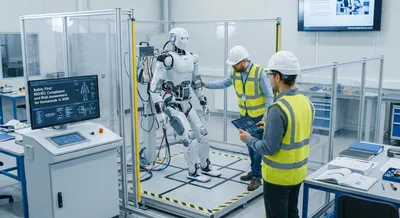
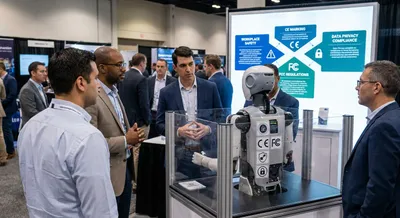
Any enterprise robot must meet strict safety rules. For industrial factories, ISO 10218 (“Safety requirements for industrial robots”) is key. Robots working with people should follow ISO 13849 (safety of control systems) and if they are meant as service/personal robots, ISO 13482 applies. In Europe, robots also need a CE mark under the Machinery Directive (and related low-voltage/EMC directives) to prove compliance (aiwiki.ai). In the US, look for UL or ANSI certifications (for example, UL 1740 is the standard for “Robots and Robotic Equipment”). Every claimed certification or standard should be verified. For example, Apptronik notes that Apollo’s actuators are already certified by TÜV SÜD for functional safety (aiwiki.ai). That is a strong hint they are aiming to meet ISO/EN safety requirements.
When evaluating robots, ask vendors for:
- Certification documents: A signed EU Declaration of Conformity (CE) listing the applicable directives (e.g. machinery, EMC). UL or CSA certificates for North America. Country-specific approvals (e.g. China’s CCC mark) if relevant.
- Safety approvals: Evidence of compliance with ISO 10218 / 13849. For example, functional safety reports or third-party verifier statements. Many robotics companies work with agencies like TÜV, UL, or Intertek to test emergency stops, safety circuits, and force limits. Don’t rely on marketing claims – look for actual certificates from recognized labs.
- Independent test results: Ask if the robot has been tested by a neutral lab or research group. For instance, have its collision-avoidance or power-failure behavior been third-party verified? Some robotics firms publish whitepapers or let customers see safety-test videos. Independent benchmarks (like measuring positioning accuracy) are a plus.
- Risk assessments & manuals: The robot should come with a risk assessment document and user manual that detail its safety features (e.g. "power and force limiting", pinch-point guards, etc.). There should be clear instructions for safe use and routine checks. Check if emergency stop and safety interlocks meet the standards (e.g. SIL/PL ratings if available).
- Software assurance: If AI and software control motion, ask about cybersecurity and validation. Certified processes like IEC 61508 or 62061 (functional safety) and ISO/IEC 27001 (cybersecurity) are increasingly expected in robotics.
In short, don’t buy a humanoid sight unseen based on hype. Treat it like heavy machinery: audit the paperwork. Verify each claimed standard with actual certificates, and seek independent performance data. For example: Atlas’s spec sheet states IP67 ingress protection (humanoidspecs.com) – you should verify a test certificate for that rating. Digit’s spec claims “safe to work alongside humans” (humanoidspecs.com) – check if it has been reviewed under the ANSI/RIA collaborative-robot standard. The more verification you demand (CE declarations, ISO compliance, endurance-test data, etc.), the safer your deployment.
Verification Checklist
Before committing to a humanoid robot, use this checklist of required documents and certifications:
- Official Certifications: Copies of CE Declaration (EU conformity), UL/CSA certificates, or other local safety approvals. Verify the scope (which models, which year).
- Safety Standards: Confirmation of compliance with ISO 10218 (industrial robot safety), ISO 13849 (safety control parts), ISO 13482 (service robot safety, if applicable). Look for third-party audit reports or test lab certificates.
- Risk Assessment Report: A completed hazard analysis for the specific model and intended use. Shows what risks were identified and how they were mitigated.
- Functional Safety Certification: If available, proof (e.g. TÜV certificate) that key components (e.g. actuators, emergency stops) meet functional safety standards. For instance, Apptronik cites TÜV SÜD-certification of Apollo’s actuators (aiwiki.ai).
- Performance Tests: Independent test results for mobility (speed on wheels/stairs), payload handling, fall/recovery, battery endurance, etc. Lab or field test reports are ideal (for example, Digit’s 100,000-tote benchmark (humanoidspecs.com)).
- Ingress & Environmental Ratings: If robot claims an IP rating (e.g. IP67), demand the test certificate or report.
- Software & AI Transparency: Documentation of onboard AI or control software safety (e.g. how an LLM or vision model is constrained). Ask if model training data has biases or if there are offline controls. (This is emerging but important as robots get smarter.)
- User Manuals and Training: Up-to-date operation and maintenance manuals. Training materials for operators. Check that they include safety guidelines, emergency shutdown procedures, and maintenance schedules.
Completing this checklist ensures you get a robot that truly meets its claims. Confirm everything in writing – vague promises (e.g. “designed to ISO10218” or “UL compliant”) aren’t enough without documentation. Companies often gloss over details, so treat it like any critical purchase.
Conclusion
In 2026, humanoid robots are transitioning from labs into workplaces. Products like Boston Dynamics’ Atlas, Agility’s Digit, 1X’s Neo, Figure’s 03, and others each offer a mix of strengths. Some are industrial-grade (Atlas, Apollo), others focus on logistics (Digit) or home tasks (Neo, Figure). By comparing specs – payload, speed, uptime, and precision – businesses can pick the right tool for their jobs. Equally important is safety: insist on real evidence that these robots meet standards like ISO 10218, CE, and UL. A robot might look impressive in a demo, but without certified safety and reliable endurance, it can’t be a safe coworker.
For now, humanoids are most practical for specific roles (like 2-hour pick-and-place shifts, patrol duties, or customer greeting). They still rely on human guidance for complex tasks. But as AI and hardware improve (with training by DeepMind, NVIDIA, or Tesla’s advanced chips), these machines will handle more on their own. In the meantime, companies considering humanoids should start with carefully chosen pilot projects, scrutinize the specs and certifications, and prepare their facilities (charging stations, safety zones, trained staff) accordingly. With the right approach, these enterprise-ready humanoids can boost productivity and safety – so long as we keep our eyes on the data and the paperwork, not just the hype.