 Auto
Auto
Answer Paragraph Engineering: Crafting Extractable, Verifiable Snippets
By Kiran Sharma, Growth-Oriented Content Strategist
Good content should help a business grow. But even a useful article can lose its value if a reader—or an answer engine—cannot tell what it claims, where the evidence comes from, or whether a number is trustworthy.
Answer paragraphs are a simple editorial tool for fixing that problem. They make key ideas easier to read, check, and reuse. They are not a trick that guarantees a page will appear in an AI answer. They are a way to make each important claim clearer and easier to verify.
That distinction matters. In the ALCE citation benchmark, even the strongest tested systems failed to fully support their answers with citations half the time on the ELI5 dataset. Citation quality is a real problem—but there is no magic paragraph length that solves it. ALCE: Enabling Large Language Models to Generate Text with Citations (aclanthology.org)
What Is an Answer Paragraph?
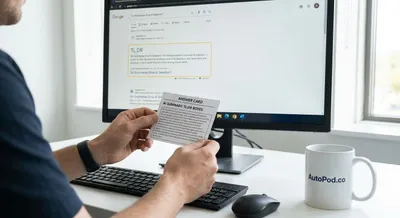
An answer paragraph is a self-contained block of 50–90 words that answers one audience question, makes one main claim, gives the context needed to understand it, and places a supporting source link close to the claim.
It is not a list of keywords. It is not one long sentence. And “one claim” does not mean “no explanation.” The paragraph can include evidence and a useful qualification, as long as they explain the same central point.
Think of the paragraph as a small answer unit. If someone copies it out of the article, its subject and meaning should still be clear. Research on retrieval units supports this general idea: in one study, short, self-contained propositions worked well for retrieval and question answering. But that study did not establish 50–90 words as the ideal length for a website paragraph. Dense X Retrieval: What Retrieval Granularity Should We Use? (aclanthology.org)
So treat 50–90 words as a house style, not a proven algorithm rule. Don’t add filler just to hit 50 words. If a simple answer is clear in fewer words, keep it short.
What Do the Citation Trials Actually Show?
The evidence is promising, but it is not a direct contest between the exact format described here and long discursive prose. Existing studies test related questions: how retrieval units affect answers, what happens when a model receives more text, and how content changes affect visibility in generative search.
| Study | What it compared or measured | What the result means—and what it does not |
|---|---|---|
| Dense X Retrieval, an EMNLP 2024 study | Compared passage-, sentence-, and proposition-level retrieval using Wikipedia and five question-answering datasets. | Proposition-level retrieval improved average Recall@20 by 10.1 points over passage-level retrieval for unsupervised dense retrievers. This supports testing focused, self-contained units. It does not show that 50–90-word web paragraphs earn more citations. (aclanthology.org) |
| Context Length Alone Hurts LLM Performance, an EMNLP 2025 study | Tested five models on math, question-answering, and coding tasks as input length increased. | The authors reported performance drops of 13.9% to 85%, depending on the setting, even when the relevant evidence could be retrieved. This is a reason to avoid needless text, not proof that long website articles cannot perform well. (aclanthology.org) |
| GEO: Generative Engine Optimization, a KDD 2024 study | Tested content changes on a 10,000-query benchmark. The setup used Google search results to select sources, then used GPT-3.5 to generate answers; the authors also tested Perplexity. | Adding citations, quotations, or statistics improved position-adjusted word-count visibility by 30–40% in the benchmark. That metric tracked how much a source’s text appeared in an answer. The study did not compare answer paragraphs with equally informative discursive prose. (storage.ghost.io) |
The practical conclusion: answer paragraphs are a sound clarity and verification standard, but their effect on real-world citations remains a hypothesis to test. In the research reviewed here, I did not find a controlled, peer-reviewed test that compared 50–90-word, one-claim paragraphs with equally informative long-form prose and measured citation rates across today’s answer engines.
Don’t sell the format as a citation cheat code. Use it because it makes a claim easier to understand and check. Then measure whether it also improves extraction for your audience and your product.
Editorial Rules for Strong Answer Paragraphs
1. Put the main answer first
Start with the claim, not a warm-up. Name the subject and say what is true about it.
Weak: “There are a few things founders should think about when choosing an onboarding tool.”
Stronger: “A customer onboarding tool should reduce the time it takes a new user to reach a useful result.”
The second version gives the reader a clear answer. The next sentences can explain what “useful result” means, add evidence, or name a limit.
2. Keep one central claim per paragraph
A paragraph can explain a claim, but it should not quietly switch to a second subject. If one block says what a tool does, how it compares with competitors, and what it costs, split it into separate answer units.
This helps people scan the article and gives editors a simple fact-checking task: does the source in this paragraph support its main claim?
3. Name the entity and the scope
Make clear who or what the claim is about. Name the company, product, study, or group instead of starting with “it,” “they,” or “this.”
Include the scope when it changes the meaning: the time period, customer group, location, product version, or study setting. A paragraph that makes sense only because of a sentence several screens earlier is not self-contained.
4. Give every number its unit and context
A number without context can sound precise while saying very little. Include the unit and the relevant base: who was counted, over what period, and where the data came from.
When you compare percentages, distinguish a percentage-point change from a relative percentage change. State the period and denominator when they matter. Link the data source next to the claim, not several paragraphs later.
5. Put the source beside the claim it supports
Use a direct link to the strongest available source—often a primary study, official report, or your own verified product data. The link should support the claim as written, not merely point to a page about the general topic.
Citation quality depends on the relationship between a statement and its evidence. A 2025 framework for assessing medical references, for example, evaluates statement–source pairs individually. That makes a practical editorial rule: if a paragraph contains claims that need different evidence, split it or add clear links for each claim. An automated framework for assessing how well LLMs cite relevant medical references (nature.com)
6. Separate evidence from interpretation
Say what the source found, then say what you think it means for the reader. Do not turn a correlation into a cause or a result from one test into a universal rule.
Useful wording includes “in this study,” “among these users,” and “the data do not show whether.” A careful limit does not weaken a useful claim. It tells readers how far they can trust it.
Examples: A Claim That Can Be Checked
Example 1: Explain the result and its limit
An EMNLP study found that proposition-level retrieval—short, self-contained statements about one fact—improved retrieval and downstream question answering over passage-level retrieval in its tests. For unsupervised dense retrievers, proposition indexing improved Recall@20 by an average of 10.1 points versus passage-level indexing. That supports writing content units that state one claim with enough context to stand alone. It does not prove that 50–90 words is the best length for every site or AI answer engine. Dense X Retrieval (aclanthology.org)
This paragraph names the study, defines the term, gives the metric, and draws a limited conclusion. It does not claim the study tested website paragraphs.
Example 2: Report a citation trial without overstating it
In a 2024 KDD study, adding source citations, quotations, or statistics to pages increased position-adjusted word-count visibility by 30–40% across GEO-bench. The metric measured how much a source’s text appeared in the generated answer, not a guaranteed increase in citation probability or website traffic. The experiment used a specific retrieval-and-generation setup, so the result supports testing substantiated content, not assuming that answer paragraphs beat long prose. GEO: Generative Engine Optimization (storage.ghost.io)
The key lesson is in the qualification: a result about visibility in one benchmark is not the same as proof of more citations, clicks, or sales everywhere.
Example 3: Make an internal business metric verifiable
From January through March 2026, Acme’s trial-to-paid conversion rose from 8% to 11% among 2,400 new accounts, a 3-percentage-point increase. Acme’s Q1 cohort report lists a shorter setup flow among several changes, but it does not isolate the flow’s effect. The safe conclusion is that conversion rose during the same period; the data do not prove that the shorter flow caused the rise. [Acme Q1 cohort report — fictional example]
The company and report here are fictional. In a real article, link the report label to the verified source. The paragraph gives the time period, metric, denominator, unit, and limit—without claiming more than the data show.
How to Run Your Own Citation Trial
If you want to know whether answer paragraphs help your content get cited, test the format instead of guessing.
- Choose real audience questions. Start with questions your customers ask, such as “How long does setup take?” or “What does this plan include?”
- Make matched versions. Compare an answer-paragraph version with a discursive version that contains the same facts, source links, heading, and roughly the same total information. Change the structure, not the evidence.
- Keep the test fair. Use comparable topics and pages. Track changes to titles, sources, publication dates, and other page details so you can see what changed.
- Repeat the same queries. Ask the same questions in the same answer engines over several runs. Record the date and tool, because results may vary between runs.
- Score more than “was it cited?” Track whether the page was cited, whether the cited source actually supports the answer, and whether the engine extracted the right claim and number.
- Separate discovery from extraction. If a system never finds or retrieves the page, paragraph structure cannot explain that result. If the system shows which sources it used, record that too.
- Review the answers by hand. A citation that appears beside a claim may still fail to support it. Have an editor check a sample against the source.
A simple scorecard can include:
- Citation rate: How often was the page cited for questions it could answer?
- Citation support: Did the linked source support the claim beside it?
- Extraction accuracy: Did the answer preserve the right entity, number, unit, and qualification?
- Business outcome: Did the cited content lead to useful visits, sign-ups, or sales?
Treat these as separate measures. A citation is not the same as a correct answer, and neither guarantees a conversion.
Add the Rules to Your CMS Workflow
Answer paragraphs work best as part of normal publishing—not as a last-minute SEO pass.
In the brief
Add a field for the audience question and the reader’s decision or task. Ask the writer to state the article’s useful point of view, not just the topic. For automated drafts, reusable Creator, Audience, and Taste inputs can help keep the founder’s perspective in the work; AutoPod uses these inputs to guide article drafts.
In the draft
Use a block or field for each answer paragraph. Ask the writer to add:
- The audience question this block answers
- The main claim
- The necessary names, limits, and numbers
- The source link beside the claim
In the edit
Check the paragraph for word count, clarity, and evidence. Confirm that the subject is named, every number has context, and the source supports the claim. A word-count check can flag paragraphs outside the 50–90-word house range, but it should not force an editor to add filler.
Before publishing
Preview the page in plain text and on a phone. If a paragraph is separated from its surrounding section, check whether it still makes sense. Confirm that source links work and that the article’s claims match the linked evidence.
After publishing
Save the target questions, version of the content, review date, and citation-trial results in the CMS or editorial log. Recheck the sources when the facts may change, and use business outcomes—not citation counts alone—to judge whether the content is doing its job.
CMS Checklist: Answer Paragraph Quality Gate
Brief
- Does each answer paragraph map to a real audience question?
- Does the article offer a useful point of view, not just a topic summary?
- Are the Creator, Audience, and Taste inputs clear for an automated draft?
Draft
- Does the paragraph answer first?
- Does it make one central claim?
- Is the subject named clearly?
- Does it stand alone without a missing “it,” “they,” or “this”?
- Is it within the 50–90-word house range, without filler?
Evidence
- Is a source linked beside the claim?
- Does the source support the claim as written?
- Does each number include the unit and needed context?
- Are percentage points, percentages, and causal claims used correctly?
- Are uncertainty and limits stated plainly?
Publish and measure
- Do the links work in the published page?
- Does the paragraph make sense in a plain-text preview?
- Are the test queries, version, and review date saved?
- Are citation support, extraction accuracy, and business outcomes reviewed separately?
Conclusion
Answer paragraphs are not a shortcut to guaranteed AI citations. They are a practical way to make important claims easier to understand, verify, and reuse.
Write the answer clearly. Name the subject. Show the evidence. Give numbers their context. Then test whether the format helps your audience and your product. **The goal is not more snippets. It is more useful, trustworthy content that supports business growth.