 Auto
Auto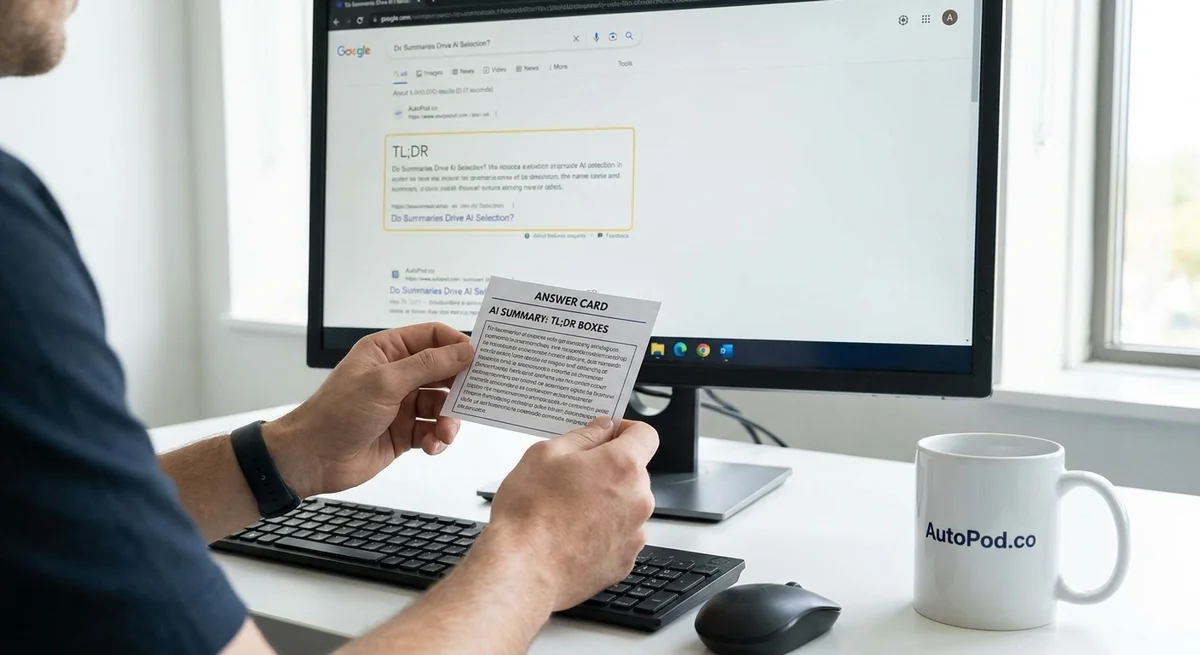
Answer Cards and TL;DR Boxes: Do Summaries Drive AI Selection?
A TL;DR box is not an AI-citation button. It may make a useful answer easier to find and reuse. But that is different from proving it will make an AI system choose or cite your page.
That difference matters. A page must first be eligible to appear in search. Then it must be found for the query. Only then can its content shape an answer or receive a citation. Google says its AI search features have no special markup requirement, and OpenAI says appearing in ChatGPT Search is not guaranteed, even when a site is crawlable. (Source 2, Source 3) (developers.google.com)
So, do answer cards and summary boxes drive AI selection? The honest answer is: we do not yet have strong public evidence that the box itself does. The better question is whether a clear, well-supported answer helps a system that has already found your page use it accurately.
What the research does—and does not—show
Content changes can affect AI answers
A major 2024 study tested content edits across a 10,000-query benchmark. It found that adding relevant quotations, statistics, and source citations increased a page’s share of the generated answer, as measured by a position-adjusted word-count metric. In the study’s main test, quotations scored about 41% higher than the unedited baseline, statistics about 31% higher, and source citations about 27% higher. These are visibility scores—not increases in citation rate, website visits, or sales. (Source 1) (fifthring.com)
The study also tested a live answer engine, but its results varied by method and measure. That is a useful warning: an edit that helps in one setup may not help in another. The authors note that generative systems change over time. And importantly for this article, the study did not isolate the effect of a visible TL;DR box, compare above-the-fold with in-line placement, or test numbered lists as a separate treatment. (fifthring.com)
In the sources reviewed here, I found no controlled public study that answers the narrow question: Does adding a summary box, by itself, raise a page’s AI citation rate? That is not proof that no such test exists. It means we should treat claims of a guaranteed lift as unproven until the test is shown.
A page’s first screen is not necessarily an AI’s first passage
Researchers have found that language models can use relevant information less reliably when it appears in the middle of a long input. In tested setups, performance was often better when the relevant material appeared near the beginning or end of the model’s input. (Source 4) (arxiv.org)
That finding gives us a reason to test placement—but not a reason to assume that what is above the fold in a browser is also first in an AI system’s input. A search system may retrieve a passage from deeper in an article, or use a different extraction process. “Above the fold” on the page and “at the start” in a model’s context are not the same thing.
Google also says it creates snippets from page content based on the query, and may show different snippets for different searches. Publishers cannot manually force a featured snippet. (Source 5) (developers.google.com)
The practical takeaway: make the answer clear where it belongs, then measure whether the answer engine uses it. Don’t assume the box’s position controls the system’s position.
How to test summaries without fooling yourself
Treat the summary as a product feature you are testing—not a formatting superstition.
1. Start with three fair comparisons
Keep the article’s facts, claims, links, and supporting evidence the same. Change only the component you are testing.
| Test | Version A | Version B | What it tests |
|---|---|---|---|
| Presence | No summary component | Same short answer in a visible card | Whether a card helps at all |
| Placement | Card near the top | Same card under the most relevant section heading | Whether location matters |
| Format | Short paragraph | Same facts as bullets; use numbered steps only for a real sequence | Whether format matters |
Test one question at a time. If you change the summary, the headline, the evidence, and the page layout together, you will not know what caused the result.
For an early pilot, match similar articles by topic, age, and search performance. Randomly assign one page in each pair to each version. If you have only a handful of pages, call the results directional, not proof. A larger test should be sized around your baseline citation rate and the smallest improvement worth acting on.
2. Use a fixed prompt set
Write down the questions before you publish the changes. Include several ways a real customer might ask about the topic, not just the article’s exact headline.
For every check, record:
- Engine and date
- Exact prompt and answer
- Whether the target page was cited
- Where the citation appeared
- Which claims in the answer match the article’s summary
- Whether facts, numbers, and important conditions were preserved
Run the same prompts on the same engines over time. AI search answers can change. If you mix different prompts, products, or dates, an apparent lift may come from the test—not the card.
3. Track four outcomes separately
Do not turn every result into one blended “AI visibility” score.
- Citation rate: the share of eligible answers that cite your target page at least once.
- Citation prominence: whether the page is cited early, and how much of the answer it appears to support.
- Snippet fidelity: whether the answer preserves the summary’s main claim, numbers, and limits.
- Answer phrasing: whether the assistant states the point directly, adds a qualification, signals uncertainty, or declines to answer.
Score snippet fidelity against a simple answer key. For example:
- 0: The main claim is missing or wrong.
- 1: The claim is partly right, but an important detail or condition is lost.
- 2: The claim and its key details are preserved accurately.
Answer phrasing is worth tracking, but don’t treat a confident-sounding sentence as proof of genuine model confidence. Research has found that verbalized uncertainty is not always a reliable measure of a model’s confidence. Compare phrasing with answer accuracy instead. (Source 6) (proceedings.mlr.press)
4. Wait for the change to be found
A test cannot tell you much if the updated page has not been crawled or indexed. Check that your page is accessible to the search systems you care about. OpenAI’s publisher guidance, for example, says to allow OAI-SearchBot if you want site content to be eligible for ChatGPT Search summaries and snippets. Access makes a page eligible; it does not guarantee a citation. (Source 3) (help.openai.com)
Keep the test running long enough to observe the updated version across repeated checks. Report results by engine and query group. A summary may help for direct factual questions but not for broader comparisons. A single average can hide that difference.
What to put in the answer card
A useful answer card serves the reader first. It should state the answer plainly, include the most important condition, and make the next useful details easy to scan.
A practical starting design:
- One direct answer in the first sentence.
- Two or three key takeaways that add real information.
- A number or date only when it is supported and useful.
- A link to the evidence when the claim depends on a source.
- Numbered steps only when order matters.
Use an above-the-fold answer when the article has one clear main question and one clear answer. Use an in-line answer beneath a section heading when the article covers several separate questions. You can use both, but make the top version brief and let the in-line section carry the detail. Repeating a full answer twice is busywork for readers, not a content strategy.
CMS-ready answer card
This plain HTML block can be added through a CMS custom HTML block. The text is visible on the page, so it does not depend on JavaScript to appear.
<section class="answer-card" aria-labelledby="answer-card-title">
  <p class="answer-card__label">Quick answer</p>

  <h2 id="answer-card-title">
    Do summary boxes increase AI citations?
  </h2>

  <p>
    <strong>Not by themselves.</strong> A clear summary is worth testing,
    but public evidence does not prove that the box alone raises citation rates.
  </p>

  <ul>
    <li>Measure whether the page is cited, not just whether answers sound better.</li>
    <li>Check whether the assistant preserves the claim and its limits.</li>
    <li>Compare top-of-page and in-line placement using the same answer text.</li>
  </ul>

  <p class="answer-card__source">
    <a href="/research/ai-summary-test-method">
      Read the test method
    </a>
  </p>
</section>
.answer-card {
  border: 1px solid #d8dee8;
  border-left: 4px solid #315efb;
  border-radius: 0.5rem;
  padding: 1.25rem;
  margin: 1.5rem 0;
  background: #f7f9fc;
}

.answer-card__label {
  margin: 0 0 0.5rem;
  font-size: 0.8rem;
  font-weight: 700;
  letter-spacing: 0.04em;
  text-transform: uppercase;
}

.answer-card h2 {
  margin-top: 0;
}

.answer-card li + li {
  margin-top: 0.4rem;
}
For a reusable CMS block, store the answer text, takeaways, placement, and format as separate fields. Then the editor can move the component or switch between a paragraph and bullets without rewriting the article. Keep the published text visible and consistent with the article. Google says there is no special schema required for its AI search features; accurate, accessible page content remains the foundation. (Source 2) (developers.google.com)
Build the system around the owner’s point of view
Automation can handle the repeatable work: placing the answer card, applying the same accessible markup, and tracking the same test prompts. It should not invent the point of view.
That is where a content workflow needs clear inputs for Creator, Audience, and Taste. In AutoPod, those inputs help preserve the owner’s perspective across automated articles. The goal is not to make every post look like an answer card. It is to make the useful answer easy to find—without sanding off the insight that makes the article worth reading.
Conclusion: Test the answer, not the decoration
A TL;DR box may improve clarity. A top-of-page answer may help some readers and some extraction paths. Bullets may make key points easier to scan. But none of those choices is a proven shortcut to AI citations on its own.
Test presence, placement, and format separately. Measure citations and fidelity. Track answer phrasing, but do not confuse confident wording with calibrated confidence. Then keep the version that helps real readers and earns better results in your own query set.
**The winning component is not the prettiest box. It is the clearest, most accurate answer—supported by evidence and easy to reuse.