 Auto
Auto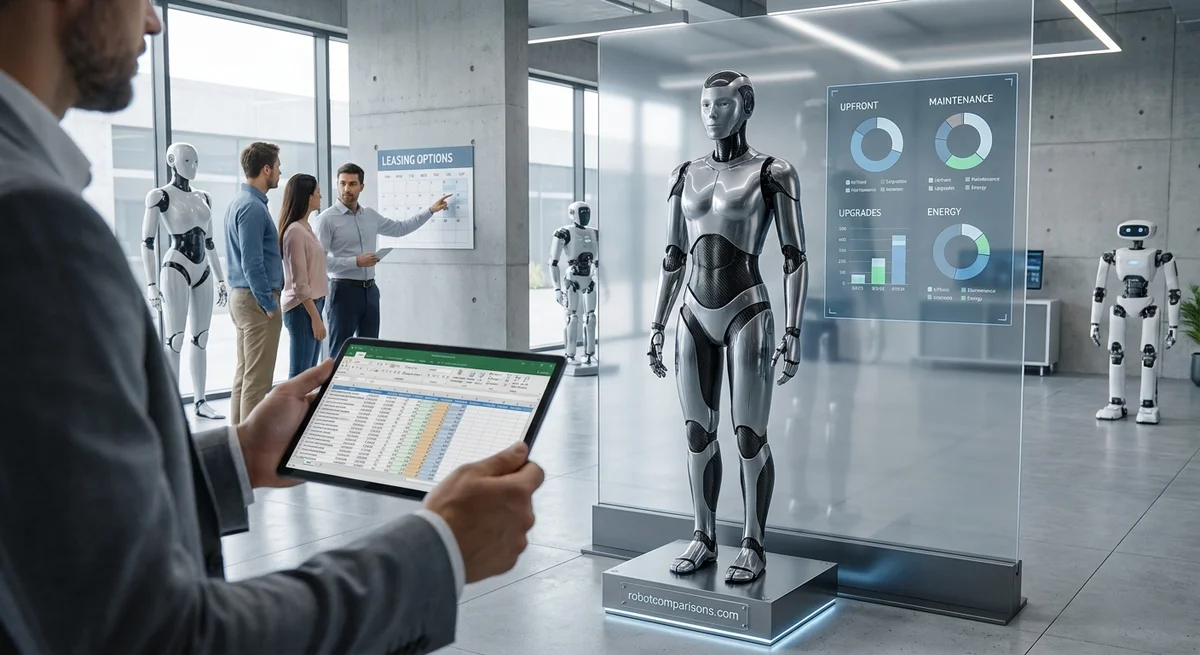
Introduction
As humanoid robots move from labs into real-world jobs, businesses must look beyond the sticker price. Humanoid robots – machines shaped like people – promise to fill labor gaps, but they come with many hidden costs. An industry report predicts over 100,000 humanoids by 2027, a sixfold leap from 2025 (www.scmp.com), so planning costs carefully is crucial. Studies show that the robot’s hardware is only a fraction of its expense: one analysis found 5-year TCO is about 2.5–3.5× the initial price (robotomated.com). In other words, integration, maintenance, software, labor and other expenses often double or triple the robot’s base cost. This article breaks down Total Cost of Ownership (TCO) for a 2026 humanoid robot and contrasts buying vs leasing. We cover purchase vs lease pricing, deployment engineering, subscriptions, spare parts, insurance, facility changes, operator labor, training, maintenance (with MTTR), and tax strategies. We also show how utilization and downtime affect ROI.
Purchase vs Lease: CAPEX vs OPEX
Deciding whether to buy or lease a humanoid affects TCO dramatically. Buying is a Capital Expenditure (CapEx): you pay a large upfront cost and own the asset. Leasing or a Robot-as-a-Service (RaaS) model is an Operating Expense (OpEx): you pay smaller, regular fees. For example, Tesla aims to sell its Optimus robot for roughly “less than half of a car” (electrek.co) – maybe around $20–30K each. In contrast, advanced models like Boston Dynamics’ Atlas run on the order of $250K or more per unit (www.awesomerobots.xyz). Mid-range humanoids (e.g. new warehouse robots) are targeting roughly $100–$120K each (www.awesomerobots.xyz). One market report even notes “sub-$10,000 pricing” for entry-level humanoids in the near future (www.businesswire.com).
On the other hand, RaaS lets companies “benefit from robotic automation with no fixed capital” (www.automationmag.com). Typical RaaS fees depend on usage and provider, but past examples of industrial robots ranged from a few hundred to a few thousand dollars per month. (For context, some warehouse robots are $500–$5,000/month on service plans (www.theresarobotforthat.com).) Leasing spreads cost into operating budgets and often includes support, but over time it may exceed buying. The choice depends on capital availability, tax goals, and risk tolerance.
CAPEX (Buying)
When you purchase a humanoid, you pay the full price up front (minus any financing). This large early outlay is high capex, but you gain ownership and can depreciate the asset for tax purposes. For example, a $100K robot is a “fixed asset” on your balance sheet. You will also budget one-time fees for delivery, setup, and perhaps customization. Note: many vendors charge setup or integration fees separately (often $10K–$30K). After purchase, spreading the cost via depreciation can lower annual tax bills.
OPEX (Leasing / RaaS)
Leasing or RaaS is paid out of operational budgets as regular fees. If you lease a humanoid robot, you might put little or no money down but pay, say, $2,000–$4,000 per month for 3–5 years. That monthly fee is fully tax-deductible as an expense (unlike a one-time asset purchase). IFR notes that RaaS models are emerging as a solution for companies wary of big capital outlays (www.automationmag.com). However, over the lease term you often pay more in total than the purchase price. You should also check what’s included: service, software updates, and spare parts may or may not be covered by your contract.
Deployment and Integration Costs
Aside from the robot hardware, deploying a humanoid often means extra engineering work. Deployment engineering can include customizing the robot’s end-effector (hand/tool), integrating with other machinery, and building safety systems. Expect specialist engineers to charge $5,000–$20,000 or more per deployment, depending on complexity. For instance, integrating a humanoid into a warehouse management system or factory line might cost tens of thousands in software development or PLC programming.
Software subscriptions and updates are another hidden cost. Many advanced robots rely on AI services, vision software, or cloud connectivity. Some vendors bundle software, but others charge annual licensing fees (perhaps $1K–$10K per year) for access to cloud-based AI, analytics, or fleet management platforms. Be sure to include any required software licenses or update contracts your chosen platform needs.
Facility modifications can add significant cost. For example, installing charging stations for battery swaps might require electrical work (wiring, breakers), easily $5K–$20K. You may need reinforced flooring or safety fencing if the robot works in new areas. If the humanoid operates fully autonomously, you might need extra sensors in the environment (safety laser scanners or cameras) at a few thousand dollars per device. Don’t forget incidental costs like network upgrades or coolant and air filtering if the robot generates heat.
Spare Parts and Maintenance
Over the life of a robot, maintenance and parts often add up. Industry sources estimate annual maintenance at roughly 5–15% of the robot’s purchase price (www.rcc.fr). For a $100K robot, count on $5K–$15K per year for planned servicing (lubrication, inspections) and consumables. Unplanned repairs—replacing worn parts or fixing malfunctions—can add much more. One analysis warns that over a 10-year span, total maintenance (labor, spare actuators, electronics, etc.) can double the original investment (www.rcc.fr). In practice this means a fully-loaded 5-year TCO can be 2–3× the sticker price (robotomated.com) (www.rcc.fr).
Maintain a stock of critical spares (e.g. extra motors, sensors, or batteries) to avoid long downtime. For example, a spare arm or hand module might cost $10K–$20K for high-end robots. Factor in the time cost: if the robot is down, you may lose the value of its work (see ROI below). Service contracts or in-house techs will have an hourly rate (perhaps $100–$200/hr) for repairs. When budgeting maintenance, include both parts and labor.
Operators, Teleoperation, and Training
Even advanced humanoids often require human supervision or control. Operator labor can be a hidden TCO. If a robot is tele-operated or needs a human to oversee tasks, you must pay that person’s wage. For example, a robotics operator at $30/hour working 8-hour shifts costs about $50K/year. If one operator can monitor 3–4 robots, allocate 25–33% of that salary to each robot’s annual cost (roughly $12K–$17K per year per robot). Some startups propose one operator remotely controlling 4–5 bots at once; in that case, each robot “bears” only a portion of one full-time salary.
Training is another investment. Your team will need to learn how to program, operate, and maintain the humanoid. Training courses or on-site instruction from the vendor might run several thousand dollars. For budgeting, assume $2K–$5K per person for initial training. Also plan internal “train-the-trainer” time: each operator might need 1–2 weeks of hands-on work with the new system. Don’t underestimate the ramp-up period: productivity might be lower until staff become proficient.
If the robot is tele-operated (remotely controlled by a human Wizard-of-Oz approach), factor in the operator’s wages and possibly additional telecom costs. For instance, if the robot needs real-time streaming video, ensure your network can handle it without bottlenecks (that might mean a higher data plan). All this labor and training time contributes to the robot’s true cost, even if it doesn’t show up on the hardware invoice.
Insurance and Facilities
Like any expensive equipment, humanoid robots should be insured. Insurance premiums depend on your coverage limits and business; approximately 1–3% of the robot’s value per year can be a rough rule of thumb. For a $100K robot, that might be $1K–$3K annually. Check with an insurer for specialized robotics or manufacturing policies.
Also consider facility costs: if the robot operates 24/7, you’ll incur utilities (electricity for charging batteries is minor, but climate control or lighting for new shifts counts). Any physical modifications – mounting hardware, safety rails, or charging docks – were mentioned above, but include those on a spreadsheet line item as installation costs.
Taxes and Depreciation
Tax treatment can significantly affect TCO. In the U.S., robots are generally depreciated under a 5-year schedule, but tax rules allow accelerated write-offs. Notably, Section 179 and bonus depreciation often let you expense 100% of qualifying equipment in the purchase year (calcix.net). In plain terms, a business can potentially write off the entire cost of the robot against income at once (up to limits, e.g. $1.22M for 2025 (calcix.net)). This immediate expensing greatly reduces the robot’s net cost after taxes.
If you only lease the robot, lease payments are fully deductible each year as an operating expense. Both options have merits: buying gives large first-year deductions (if eligible), while leasing avoids any large capital outlay (at the expense of higher long-term costs). Be sure to consult a tax advisor on local rules: some regions offer extra incentives or grants for automation equipment as well.
ROI and Sensitivity Analysis
Once all costs are estimated, compare them to expected benefits. ROI depends on utilization (how many hours/shifts the robot works) and workflow stability. For instance, a robot running two shifts per day will usually pay off faster than on one shift. Real-world data backs this up: one analysis of 200+ deployments found a median payback of 18 months on a single shift versus just 11 months on two shifts (robotomated.com). In other words, doubling usage can cut ROI time roughly in half.
Conversely, downtime and failure rates hurt ROI. If your robot has 95% uptime vs 99% uptime, you effectively lose 2 hours per 40-hour week, which accumulates. A single multi-hour breakdown (high MTTR) may cost a day’s worth of production. When you scale on payback, even 5–10% lower uptime can add months to your ROI horizon.
Workflow variability is another factor. Robots excel at repetitive tasks. If your process changes often, you’ll spend more time reprogramming or retraining the robot, reducing effective utilization. For example, a factory picking 100,000 parts/month (a steady workflow) will fill those tasks faster and justify the robot sooner than a shop that picks 10,000 parts one month and 2,000 the next. Always model best-case and worst-case scenarios.
Finally, compare leasing vs buying in your ROI. Leasing might allow you to start the project now without full investment, but the sum of lease payments often exceeds the buy price. Use multi-year cash flow tables for both CapEx (with depreciation) and OpEx (lease payments) scenarios.
Conclusion
Humanoid robots are exciting, but their TCO can be complex. A thorough cost model includes the robot’s base price or lease rate plus integration engineering, software licenses, spare parts, insurance, and even building upgrades. On-going costs like maintenance (often 5–15% of price per year (www.rcc.fr)) and operator labor must be counted. Businesses should contrast a high up-front purchase (with tax depreciation benefits (calcix.net)) against a leasing model that preserves capital but carries regular fees. Using realistic MTTR and utilization assumptions is crucial: studies show that high uptime and multi-shift use dramatically improve ROI (robotomated.com). By plugging these factors into a TCO spreadsheet, companies can avoid sticker-shock and ensure that a humanoid’s productivity gains outweigh its lifetime costs.