 Auto
Auto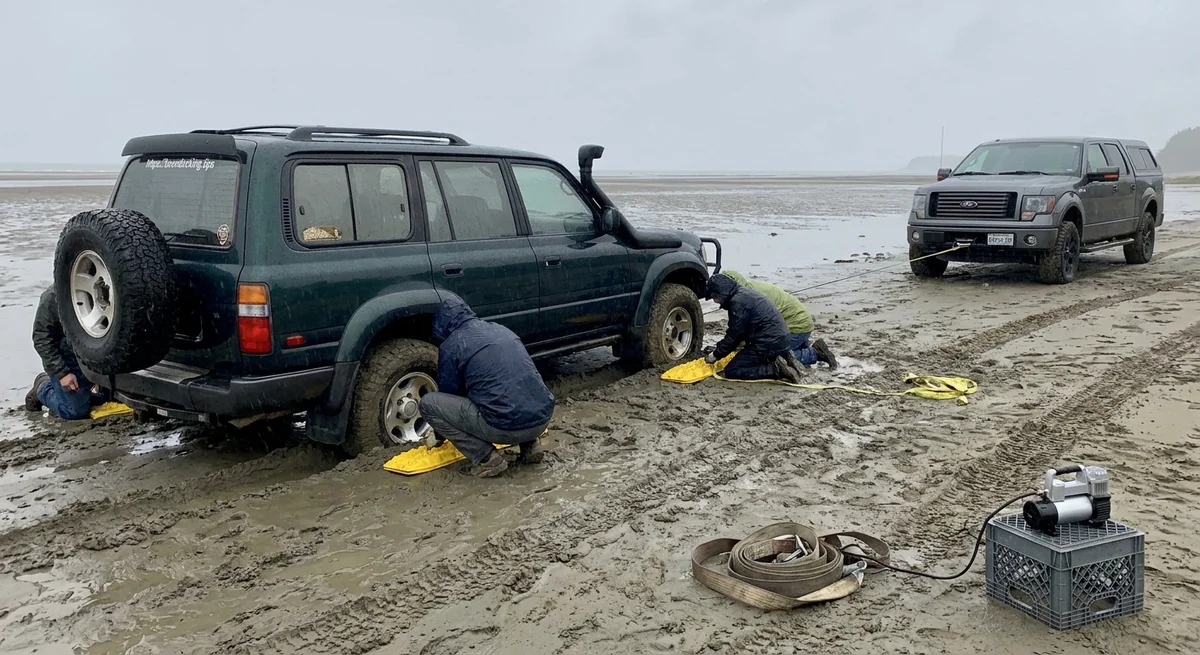
Recovery and Traction on Soft, Wet Shorelines
Driving heavy vehicles like RVs or 4x4s along lake or beach edges can be deceptively dangerous. Saturated soils at the water’s edge often lose strength dramatically – behaving almost like quicksand under heavy weight. Fine-grained, waterlogged mud can support weight until the tire breaks the surface film, then suddenly liquefy and grip the vehicle tightly (biologyinsights.com). In practice, once you sink even a little, very little additional traction is available: “Mud reduces traction dramatically”, and tires have almost no grip on such a “slippery, yielding surface” (www.michelinman.com). This means a heavy RV can easily bog down on a soft shoreline: its weight creates high soil pressure that the saturated ground cannot support, leading to deep ruts and complete loss of traction.
An example of why this happens is the dynamics of mudflats: fine silt and clay particles hold water in a gel-like matrix that looks firm but gives way when disturbed (biologyinsights.com). Models and field tests of wet coastal soil show that penetration resistance (and thus carrying capacity) plummets when pore space fills with water. In short, a shore that looks solid can hide very soft “shear layers” beneath. In the worst case, this creates strong suction (a thixotropic effect) that actually sucks a tire down as soon as it pushes in (biologyinsights.com). For a heavy RV, getting bogged on a lake edge means the tires spin against almost no support and dig deeper rather than crawling out (www.michelinman.com).
Understanding these soil mechanics – and taking proper precautions – is critical. The tips below will help you avoid or recover from a bogged situation on wet shorelines. We cover traction aids, tire pressure, anchor points, straps, scouting techniques, plus checklists and a step-by-step protocol to follow if you do get stuck.
Soil and Bogging Risk on Soft Shorelines
Soft, waterlogged soil (for example sandy or silty ground where wave action keeps it saturated) has much lower bearing strength than dry ground. A helpful analogy is mudflats: these fine sediments carry weight only when undisturbed. As soon as pressure is applied – say by a vehicle tire – the structure collapses and the material behaves fluidly (biologyinsights.com). In practice this means that heavy rigs can suddenly sink up to their axles even on open sand or silt that looks driveable. The end result is easy bogging: water-saturated soil offers almost zero lateral traction for a spinning wheel.
Moreover, once an RV’s wheels start digging, its momentum quickly stalls. “Spinning the tires digs the vehicle deeper rather than providing traction,” caution experts (www.michelinman.com) (www.michelinman.com). That is because the tires cut into the soft matrix, displacing water and mud but finding no firm ground to push against. The entire tread can become plastered with wet material, removing even the little grip there was. In summary, on a shoreline the usual 4WD advantage shrinks to nothing; a lightly sunk tire means a stuck RV, and it can happen faster than you think.
Traction Aids (Recovery Boards and Mats)
One of the most reliable tools for self-recovery in sand or mud are traction boards. These are rigid plates (often plastic) with aggressive cleats or teeth that you place under a spinning tire. When correctly used, the tire then has a solid surface to bite into and can drive itself off the soft ground. For example, Car and Driver reports that well-designed traction boards “get you out of a slippery spot” by giving the tire “something solid to grab onto” (www.caranddriver.com). Many off-roaders swear by the MaxTrax boards (and similar brands) for this purpose. In tests, MaxTrax MKII boards held up under very heavy use: reviewers describe them as “virtually indestructible” and note their deep teeth grip on all conditions (www.riggedout.net). (According to one off-road gear reviewer, MaxTrax boards are injection-molded nylon rated to 10,000 lbs, with sharp teeth that bite into even loose sand (gearlanders.com).)
- How to use boards: Dig out around the bogged tire first (clear muck and let loose material flow away), then lay the boards flat in front of the tire (if stuck forward) or behind (if backing out). Back onto the boards slowly, applying gentle throttle. The teeth should catch the ground beneath the tire tread. Then inch forward – the boards act like little ramps for your tires. (www.caranddriver.com). Multiple boards can be stacked end-to-end if needed to bridge deep holes.
The main advantage of boards is safety: no explosive energy is involved, and anyone can use them even solo. They are especially good on sand or loamy wet soils. The primary limitation is that boards assume the tire and underbody can already reach them; if the undercarriage is deeply grounded, you may need to shovel first to free the tire. Also, smooth icy conditions can limit any surface aid, but on wet sand and mud they work well.
(For completeness: in a pinch, any similarly rigid, high-traction object can help – e.g. wood planks or even floor mats. Just ensure whatever you use is strong enough not to shatter under load.)
Tire Pressure Strategies
Adjusting tire inflation is a key factor. Deflating the tires increases the contact patch (footprint) dramatically, which spreads the vehicle’s weight over a larger area and reduces sinkage. This is standard off-road practice. Testing confirms that as you lower pressure, the tire’s contact patch lengthens and flattens, so the vehicle weight per square inch drops (expeditionportal.com). For example, Expedition Portal demonstrated that deflating a Toyota’s tires expanded the footprint so much that the pounds-per-square-inch on the sand was greatly reduced (expeditionportal.com). In practical terms: on soft sand or mud, run your tires around 15–18 psi (or even as low as 12–15 psi on really loose sand) (www.racq.com.au). This is often 50% or more below normal highway pressures. The result is that the tires “float” on top of sand instead of digging in.
However, lower pressures also mean less load-carrying capacity and more sidewall flex. Always respect the tire and wheel limits: use beadlock or careful driving if you go below ~15 psi to avoid de-beading. After getting off the soft ground, re-inflate to safe highway pressure before driving fast. In summary: air down for traction, but only off-road; then air up again when leaving. This technique is well-known in beach-driving guides, and is strong enough that entire automatic systems (like Tiremaax) exist on heavy vehicles to do it. Just remember heavier or overloaded vehicles may still sink at 15 psi – it’s best combined with other methods like momentum and traction boards.
Winch Anchors and Tow Points
If a vehicle-to-vehicle pull or winching is needed, it’s critical to use the proper anchor points and hardware. Never attach a strap or winch to a bumper, tow ball, tie-down eye, or any sheet-metal loop. Those are usually installed only for towing a trailer straight up, not for the dynamic sideways/jerking forces of recovery. In fact, most “recovery hooks” that come on bumpers are mere shipping tie-downs that can shear off. The rule is: use rated recovery points only. These are heavy-duty, thick metal loops or tabs that are bolted directly to the chassis. They are marked with a proof load or Working Load Limit (WLL) and have gusset supports. Overland safety experts emphasize that only these should carry the load (overland-gear-guide.com).
Tow balls are especially dangerous as recovery anchors. They are designed for vertical trailer loads, not the shock of a snatch pull. A tow ball can snap off and become a deadly projectile under a tugging load (overland-gear-guide.com). Similarly, thin hooks or bumper mounts can stretch or rip away, launching whatever’s attached. Instead, many vehicles have hidden recovery shackles or reinforced eyebolts. If none exist, use a heavy hitch-mounted shackle or an aftermarket frame bracket. The key is: make sure every component (anchor, strap or rope, and shackle) is rated for much more than the vehicle’s weight.
For winching, you may use a tree or another fixed point. Always wrap the tree with a tree-saver strap (thick webbing) to protect it and give a secure loop. Use a snatch block or pulley if you need to change pull direction; this can also double the pull capacity. Remember to keep your rig anchored in line with the path you want the vehicle to move. If you have two front recovery points on the stuck vehicle, it’s ideal to use a short bridle between them. This centers the pull and splits the force in two, halving the load on each point (overland-gear-guide.com).
Safe Use of Recovery Straps and Cables
Snatch straps, tow straps, and recovery ropes must be chosen and used with utmost care. A snatch (kinetic) strap is elastic; it stretches to store energy and deliver a powerful “snatch” pull. A static (non-stretch) strap or cable just pulls steadily. Both have a place, but safety rules overlap. Key points:
-
Match the Strap to the Vehicle. A strap’s minimum breaking strength (MBS) should exceed the vehicles being used. A common guide is at least twice the gross vehicle weight for a mild pull (www.racq.com.au) (www.cookes.co.nz). In fact, Offroad training warns that for a 4,000 lb vehicle you should use a strap rated at 20,000 lb (5×) to avoid shock loads (www.offroad-ed.com). The exact factor varies by source (RACQ and safety guides say ~2–3× (www.racq.com.au) (www.cookes.co.nz), while some training coursework recommends 4–5× as a big safety margin (www.offroad-ed.com)). In any case, never use a strap rated below your vehicle weight – that’s a recipe for snapping straps or ruined hardware.
-
Use Shackles, Not Hooks. Modern recovery straps should have soft loop ends (tapes) not metal hooks. Always join strap to vehicle with a bow shackle (D-shackle) or a soft shackle made of high-modulus rope. These components themselves must be rated to meet or exceed the strap’s rating. Under load, any weak link will fail violently. For example, one roundup notes steel shackles around ¾″ diameter have break strengths in the 35–50 ton range, but even so a soft shackle (UHMWPE rope) can be safer because it won’t catapult if it breaks (gearlanders.com).
-
Attach Only to Proper Recovery Points. (As above, skip tow balls or welding eyes.) Regional safety experts explicitly warn: “Never use tie-down eyes, tow-balls/towbars, bullbars or suspension components – they aren’t designed for recovery loads” (www.racq.com.au). Those parts can shear off; people have been hurt by flying anchors. Instead, attach the shackle to the manufacturer’s listed recovery point or a known aftermarket rated anchor. If you must rig something (like a hitch receiver), use a snatch block or rated recovery hitch block – never the ball mount.
-
Use a Dampener. Always drape a heavy blanket, jacket, or purpose-made snatch damper over the strap or cable mid-span (www.offroad-ed.com). This weight absorbs energy and catches the strap if it parts. Imagine the tension if a strap at 5–10 tons stretches and then breaks – you want that explosion contained. A dampener turns a potentially lethal whip into a harmless lump. RACQ and Offroad guides both emphasize keeping people well clear of the line and out of the strap’s path in case of a snap (www.racq.com.au) (overland-gear-guide.com).
-
Keep Safety Zones and Communication. Before any pull, appoint one person in charge to give single, clear instructions (overland-gear-guide.com). Others should stand at least 1.5× the strap length to the side (never between the vehicles) (overland-gear-guide.com). Use hand signals or radios. Have everyone wear gloves and eye protection. If using a winch, ensure the winch line is straight and not rubbing over sharp edges.
In summary: treat recovery straps respectfully. Always check them for wear or sun damage before use. Inspect the MBS marking every time. Use them only in straight pulls, on graded ground whenever possible. Do not rig straps incorrectly (e.g. through tow balls or under vehicle). If in doubt, hand off recovery to professionals or use other methods – a failed strap can cause severe injury (www.racq.com.au) (www.offroad-ed.com).
Go/No-Go Criteria: Approaching a Shoreline
Before driving right up to a soft edge, take a hard look (literally) at the conditions. Many experts advise a pre-check: walk the path or use a probe rod to test the ground. The simplest advice is: “When in doubt, don’t.” If you’re uncertain how firm the shore is, it may be safer to stop short.
Some practical guidelines:
-
Check Water Levels and Time: On beaches and lakes, softer substrate often occurs closer to the water. For beaches, driving in low tide is recommended because the sand is most compact near the receding waterline (www.racq.com.au). For an inland lake or reservoir, consider seasonal water changes or recent rain. If waves or current undermine the bank, the edge may be much softer than it looks. If a rock-hard ledge is a few feet further in, drive on that instead of the muddy lip.
-
Beaning “Can I walk here?”: A good rule is to test the ground on foot (boots off is safest). If you sink knee-deep, a 5,000 lb RV will probably sink above the axles. Use a long stick or steel rod – poke ahead of the wheels to feel for how deep or watery the substrate is. If it punches through several inches easily, or if water comes oozing up, that’s a clear warning.
-
Scan for Tracks and Hazards: Look for tracks from previous vehicles or wildlife. Fresh deep ruts from other RVs mean they got stuck there; if the tracks are from jeeps, they may have fared better (wider footprint). Offroad training courses stress observing others’ footprints to judge terrain■ (www.michelinman.com). Also check for hidden drops or logs at the water edge. Coastal emergency crews have warned of sudden drop-offs just beyond the visible shore – a 4WD can be irretrievably high-centered if one wheel rolls off a hidden lip (beachconnection.net). If you cannot see the bottom, probe to be sure.
-
Avoid Unknown Marshy Zones: If there are reeds, wet grass, or spring water emerging, steer clear. Stay on firm sand or gravel. In general, err on the side of a higher and drier line early on; approach the water slowly only when you are sure. One driving safety tip is to “stay on existing trails” and avoid unknowable hazards like marshy ground (www.offroad-ed.com). If you don’t have a clear hard path, you might consider parking the RV and switching to a smaller ATV or wading rod to scout the exit route before committing the heavy vehicle.
-
Maintain Momentum on Known Good Ground: If you are actually moving along the shoreline, maintain steady low speed in first or second gear. This helps keep up momentum over soft patches. The Michelin guide notes that controlled, steady momentum lets a vehicle “float” over mud or sand, whereas stopping or sudden maneuvers invite bogging (www.michelinman.com). That said, if you do have to stop and balk, stop slowly and don’t spin. Better to coast or reverse to firm ground than spin wheels and dig in.
-
Firm Ground Probing Techniques: Once near the suspect area, you should physically verify ground firmness. The best method is to get out and probe the track. Slide the shovel or a stick under where each tire will go. If you punch through to a couple feet, it’s a no-go. You can also listen: tap the ground or walk – solid ground sounds more resonant, muddy ground sounds dull or squishy. These low-tech checks can save you from backing into an inescapable mess.
If after all checks you still decide to proceed, drive very slowly, in 4WD low if available, and be ready to stop at any moment. Have your recovery plan ready (winch laid out, boards at hand). But remember: if one misstep would leave you totally stuck (e.g. in chest-deep mud), it may be best to accept the turn around. The threshold for a “no-go” should be low on uncertain, saturated shores.
Recovery Kit Essentials
Every serious overland or RV trip should include a basic self-recovery kit. In high-risk terrain like lake edges, it’s lifesaving. At minimum, gear that can save you includes (gearlanders.com) (gearlanders.com):
-
Traction Boards or Mats. Ideally two or more. Store them where you can reach them without unpacking the whole rig (e.g. roof rack). As noted, these are often the first tool to try.
-
Shovel or Spade. At least one sturdy off-road shovel or entrenching tool. Needed to dig out around wheels, clear material, and build ramps. The Gearlanders guide specifically highlights a shovel for digging before inserting boards (gearlanders.com).
-
Recovery Straps and Ropes. Include both a static strap (tow strap) and/or a kinetic snatch rope (15–30% stretch) for quicker pulls. The kit should contain one or two heavy-duty snatch straps rated above your GVW, plus a static strap in case a shock load is not desired. Also carry a tree-saver strap (thick looped webbing) when using trees as anchors.
-
Rated Shackles. Two or more bow-type D-shackles (3/4″ to 1″ steel) rated for your strap load. Soft shackles (UHMWPE) are lighter and safer if you know how to tie them, but have at least heavy-duty steel ones on hand.
-
Hi-Lift Jack and Base Plate. A full-size jack that can lift the RV if wheels are stuck in a depression. Bring a wide base plate or thick plank to position under the jack on soft ground, to prevent it from sinking. A jack can lift one side to let you place boards or fill under the tire.
-
Air Compressor and Tire Gauge. A 12V air compressor and a good pressure gauge allow you to lower or restore tire pressure on the spot. Deflate before recovery and then re-inflate once clear.
-
Gloves and Eye Protection. At least a pair of heavy gloves and safety glasses. Protect your hands when shoveling and keep clear eyes during winching.
-
Winch and Accessories (if fitted). If your RV has a factory or aftermarket winch, carry a snatch block, a tree-saver strap, and at least one damper (recovery blanket) for the winch cable. Have a length of sturdy rope or straps (equalization bridle) if you can hook to two points on the stuck vehicle.
-
Miscellaneous. Strong tow straps, snatch block, axe or saw (to clear obstructions), non-cotton dampening blankets (the classic heavy wool blanket works), and a basic tool kit can be very useful. Also carry a coiled nylon rope or cellular phone radio for guards.
In summary: “The short list: boards, strap, shackle, shovel” is the bare minimum (gearlanders.com). Everything else (jack, winch, pulleys, hi-lift, etc.) is highly recommended but secondary. The key is to have at least the four items above easily at hand; many recoveries are resolved just by those basics.
Step-by-Step Recovery Protocol for a Bogged Vehicle
If your RV does end up stuck despite precautions, follow a calm, systematic procedure:
-
Stop and Assess. Immediately put the vehicle in Park (or neutral if about to crawl) and apply the parking brake. Turn on hazards. Check that the engine is off or in low gear. Get everyone out of the vehicle and away from the wheels and potential pull path. As one off-road guide puts it: “Stop → Assess → Plan → Brief → Execute.” (overland-gear-guide.com). Determine exactly what angle or obstacle is holding the vehicle (e.g. tire spin, suspension hung up, deep hole under axle, etc.). If on any slope, get behind the wheel (if driving position is downhill) to use engine braking, or better, re-chock wheels to keep it from rolling.
-
Safety Setup. Position people well out of harm’s way (at least 1.5 times the strap or cable length to the side) (overland-gear-guide.com). Make sure no bystanders stand between the two vehicles or anchored line under tension. (overland-gear-guide.com). Have gloves and a dampening blanket ready. If using a winch, place a damper on the cable. Communicate a clear plan and stop-word before applying tension.
-
Clear and Route. If wheels are simply spinning, first dig them out. Use your shovel to clear mud, sand or grass from in front of (or behind) the wheels, and under the vehicle. Remove packing from tread grooves; clean them so they can bite. If the vehicle is high-centered (frame resting on a log or bump), use the jack to lift it enough to insert boards or rocks under the stuck part. If it’s stuck wallowing in its own excavation, shovel out a gradual ramp.
-
Use Traction Aids. Before trying straps, get traction boards under at least one drive wheel. Place them so the tire will climb directly onto them: push them firmly against the bump in front of the wheel. With one foot lightly on the throttle, slowly drive onto the boards. It may help to shift from 4LO to 4HI once on boards for a bit more smooth drive. Do not spin wheels fast – slow, steady throttle is best. Often, this simple step will free the vehicle. If multiple wheels are spinning, use 2 boards (one under each front tire, for example) to give both wheels a grip platform. After moving even a few inches, reassess; it may be enough that traction now exists.
-
Vehicle-to-Vehicle or Strap Recovery. If boards alone don’t work and another vehicle is available, use the tow/snatch strap. Hook one end only to a proper recovery point on your stuck RV, and the other to the rescuer. Ensure the assisting vehicle is parked on firm ground and on a flat heading toward the stuck vehicle (no big side angle). Keep the strap short (no sag) and start with a gentle pull. Usually the best is a gradual steady pull, not a hard yank (unless using kinetic rope by design). Communicate so the driver on your vehicle slowly eases off the brake when tension is applied, then the pulling driver accelerates gently. Continue until free.
- If using a strap (non-elastic) and the stuck vehicle won’t budge despite a firm pull, try easing off and then giving a slow snatch. If using a kinetic rope, double-check people are very clear of the rope arc and commit to a sharp pull once the rope is taut. In all cases, do not exceed strap or shackle ratings or jerk excessively; failures happen when shock loads exceed design.
- If another vehicle isn't available, skip to step 6 below (winching).
-
Winch Recovery (if equipped). Connect the winch cable to a solid anchor (a tree or large rock). Use a tree-saver strap on trees. If possible, connect to the far side (opposite direction) using a pulley block to double the pull power and reduce line tension. Slowly operate the winch, again applying tension gradually and continuously. Watch the cable spooling in smoothly. Once the stuck vehicle starts to move even a little, continue until fully out.
-
Repeated Assessment. If at any point something starts to bend, smoke, or bind (like a jammed winch or bent shackles), stop immediately. Replace the part, re-clearing debris, or reassess the plan. Often a few inches of progress allow you to insert boards or readjust angles and escape. If you still cannot free the vehicle after safe tries, it may require heavy winching equipment or calling for help.
-
Final Pull-Out. Once the vehicle is freed, slowly accelerate on 4WD low (if appropriate) to get out of the soft area. Then reinflate your tires, stow gear, and inspect for any damage.
Throughout, obey these principles: no jerking, no shortcuts on safety, one gentle solution at a time (overland-gear-guide.com). Remember that traction boards or a low-range crawl will solve more cases than forcing it.
Conclusion
Soft, wet shorelines pose a real risk to heavy vehicles, but with planning and the right gear, you can avoid or overcome getting stuck. In summary: Scout before you go – test the soil depth and firmness, and favor firmer ground near low water levels (www.racq.com.au) (www.michelinman.com). Always air down the tires for extra floatation, but proceed with caution. If you still get bogged, use a methodical recovery sequence: clear mud, employ traction boards, and only then use straps or a winch. Crucially, use rated recovery points and safety gear – never improvised attachments (overland-gear-guide.com) (www.racq.com.au). The combination of solid traction aids, proper tire pressure, and well-planned recovery techniques will give you the best chance of getting unstuck. Preparedness and caution are the ultimate keys: many recoveries succeed simply because the driver expected trouble and took every precaution (overland-gear-guide.com) (gearlanders.com).
By understanding the soil behavior and having the right equipment, heavy RV owners can turn a potentially disastrous bogging into a minor setback. Stay informed, drive carefully, and always have a plan for recovery.