 Auto
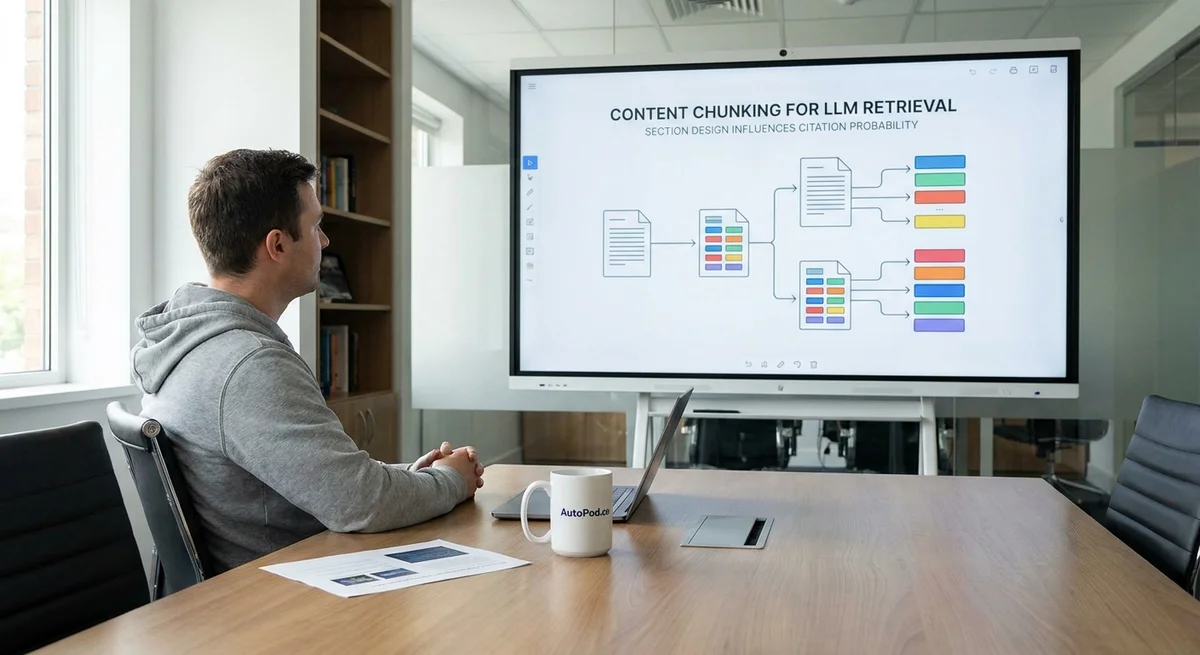
Content Chunking for LLM Retrieval: How Section Design Influences Citation Probability
By Sofia Mendez, Brand Voice & Authenticity Lead
Research snapshot: October 23, 2026
A page does not need to be chopped into tiny pieces to earn a place in an AI answer. But its ideas should be easy to find, understand, and quote.
That is the useful distinction. Good section design can make content clearer to people and retrieval systems. It does not guarantee that an AI search engine will cite the page. There is no proven 80–120-word rule for earning citations.
A note on the requested A/B test: I could not run a live test for this article. No website, published page variants, search account, or test queries were provided. So this article reports no invented results. It explains what current research supports and lays out a test a site owner can run.
First, separate retrieval from indexing
“AI search” can sound like one system, but several steps sit between publishing a page and seeing it cited:
- Crawl: A search system or bot can access the page.
- Index: The system stores and processes the page.
- Retrieve: A search or AI system finds the page—or part of it—for a question.
- Cite: The answer includes the page as a source.
Section design may help a system understand and retrieve a relevant passage. But it cannot fix a page that is blocked from crawling, never indexed, or less useful than other sources. Google says pages must be indexed and eligible to appear with a snippet before they can be supporting links in its AI features—and even eligible pages are not guaranteed to appear. (developers.google.com)
That matters because snippet accuracy and citation selection are different outcomes. A system might extract a clear passage from your page but cite another source. Or it might cite your page while drawing on information from several sections.
What the evidence says about chunk length
Research on RAG—systems that retrieve text before asking a language model to answer—shows that chunk size can matter. But the best size depends on the task.
A 2025 study tested fixed-size chunks across several question-answering datasets. Smaller chunks, such as 64 or 128 tokens, did better on some questions with short, direct answers. Larger chunks often did better when a question needed more context. The study measured tokens in a retrieval system, not word-count sections on public websites. It does not prove that 80–120-word sections improve citations in Google, Bing, or ChatGPT search. (arxiv.org)
Another study, published in the 2025 Findings of ACL, found that the way ideas were grouped mattered—not just chunk length. Its authors reported that chunk length alone did not directly predict retrieval or answer quality. That points to a practical lesson: a short section is not automatically a good section. It still needs to hold a complete idea. (aclanthology.org)
There is also a limit to what these studies can tell us. They test research systems with known models, datasets, and retrieval settings. Public AI search products use their own systems, and their full selection rules are not public.
What headings and anchors can—and cannot—do
Headings make the page easier to follow
Clear H2 and H3 headings tell readers what each section covers. They can also help systems understand how ideas relate. Google says passage ranking can identify parts of a page that are relevant to a query. Microsoft’s webmaster guidance likewise recommends clear content structure and logical heading levels for content that may support AI answers and citations. Neither source gives a heading format that guarantees selection. (developers.google.com)
A useful heading names the point the section makes. “When a short section works” is more informative than “More details.” But headings should describe the content, not repeat search phrases for their own sake.
Named anchors are useful links, not separate pages
An ID such as id="short-sections" lets a link jump to a specific heading on the page. That helps readers share or revisit a section. It is not a separate, indexable page for that section. Google says it generally ignores URL fragments for crawling and indexing as distinct content, while supporting fragments used to point to content within a page. (developers.google.com)
So use named anchors for stable navigation. Do not expect a #section-name link, by itself, to raise citation probability or speed up indexing.
Clear writing beats clever markup
Google’s current guidance is direct: there is no required need to break content into tiny chunks for AI, and there is no ideal page length. Organize the page for its readers and subject. Google also says its AI features rely on core search systems, not a special chunking format. (developers.google.com)
That is a better rule than blindly meeting a word count.
The 80–120-word idea: a useful default, not a ranking rule
A section of 80–120 words can work well when it answers one question in a complete way. For example, it might state a recommendation, explain why it works, and give one caveat.
But forcing every section into that range can make an article choppy. Some ideas need a short answer. Others need a worked example, evidence, or a warning that changes the recommendation.
Treat 80–120 words as an editorial starting point—not an SEO threshold. Keep a section short when it makes one complete point. Let it run longer when cutting it would remove needed context.
How to run a credible A/B test
To test the effect on public AI search, you need a live site, access to indexing tools, and a fixed set of questions. A small test on two pages may be interesting, but it cannot separate layout effects from differences in topic, authority, or crawl timing.
Compare two versions of the architecture
For a first test, compare these two page patterns:
| Variant | Page structure |
|---|---|
| A: Modular sections | Sections of about 80–120 words, with descriptive H2/H3 headings and named anchors. Each section makes one complete point. |
| B: Longer blocks | Longer sections, for example 300–500 words, with clear H2/H3 headings and anchors at the main section headings. |
The 300–500-word range is a proposed test control, not an established standard. Keep the core facts, evidence, examples, page template, metadata, and internal-link support as similar as possible.
This first test measures a package of design choices. If Variant A has more section breaks and more H3 headings, you cannot say whether any difference came from word count, headings, or their combination. To isolate those factors, run a second test that changes one at a time—for example, keep the heading and anchor markup fixed while changing paragraph breaks.
Use two kinds of testing
1. A controlled retrieval test
Put the same source text into two versions of your own retrieval system, or a test system you control. Keep the model, search settings, and question set fixed. Change only how the text is split.
This can test whether one layout leads to better retrieval or more accurate answers inside that system. It does not tell you what a public AI search product will do.
2. A live web test
Public search engines need live pages, so use matched, original pages rather than publishing identical copies. Pair pages with similar audience, topic difficulty, age, and existing site support. Randomly assign one page in each pair to Variant A and the other to Variant B.
Keep the publishing process fair: use comparable page templates, metadata, internal links, and sitemap timing. Do not promote one variant more heavily. If the site only has a few suitable pages, treat the result as a small pilot, not proof.
Measure the outcomes separately
- Snippet extraction accuracy: Prepare questions with known answers. Have reviewers check whether each AI-produced snippet or answer captures the right fact without changing its meaning.
- Citation selection rate: For each fixed question, record whether the target page appears as a citation. Also record whether the cited page actually supports the claim.
- Time-to-index: Record when each page is published, first crawled, and first confirmed as indexed. Check status regularly and report the median time, plus the share still not indexed at the end.
Indexing time needs careful handling. Google recommends crawlable links and sitemaps to help discovery, but says crawling and indexing are not guaranteed. Its guidance also notes that recrawling updates can take time. Report pages not indexed by the end as not yet indexed, rather than quietly dropping them from the results. (developers.google.com)
Use a fixed query list and repeat the same questions across the same AI search products. Results can change, so keep the date, platform, question, answer, and cited URLs in a log. Bing Webmaster Tools’ AI Performance report can show which site pages are cited and how citation activity changes. Bing cautions that changes in those totals do not show that one page edit caused the change. (bing.com)
My hypotheses—not test results
Before running the test, I would expect:
- Snippet accuracy may improve when a section answers one likely question without losing needed context. The RAG studies support testing this idea, but do not establish its effect on public AI search.
- Citation selection may change little—or not at all. A clearer section can help with understanding, but a citation decision also depends on the query, the competing sources, and whether the page is accessible and relevant. Google describes AI answers as drawing on search retrieval and related queries, not a fixed section-length rule. (developers.google.com)
- Time-to-index may not improve just because sections are shorter. Discovery signals and crawl access are more direct things to check. This is a reasoned expectation, not a measured outcome.
A practical content architecture standard
For most founder and product pages, I recommend this as a house style, not a promise of more citations:
- One page, one main reader need. State what the page helps the reader do.
- One clear H1. Make the main topic obvious.
- Use descriptive H2s and H3s. Make the page easy to scan, with headings in a logical order.
- Aim for one complete answer per section. Use 80–120 words when that length fits. Go longer when the idea needs proof, context, or an example.
- Write so each section can stand on its own. Name the product, person, or idea instead of relying on vague words such as “it” or “this.”
- Add stable, descriptive IDs to important headings. Use ordinary links such as
href="#short-sections"for page navigation—not as a claim that each fragment is a new page. - Keep important text accessible. Check that crawlers can reach the page and that its main content is available as text. For ChatGPT Search, OpenAI identifies OAI-SearchBot as the search crawler and explains that site owners can manage its access through robots.txt. (developers.openai.com)
- Put evidence beside the claim it supports. A short claim with a nearby source is easier to check than a claim that depends on context several sections away.
- Keep the owner’s point of view. A clean layout will not make generic content worth citing—or worth reading.
That last point is easy to miss. Automation should save a founder time, not erase the reason their content is different. A useful content workflow can reuse a clear brief: Creator, Audience, and Taste. AutoPod uses those inputs to guide articles while keeping the owner’s point of view in the process. The system can organize the page; the insight still needs to come from the people who know the product and customer.
Conclusion: design for clarity, then test
Short sections, clear headings, and named anchors are good page design. They are not a proven citation hack. An 80–120-word section is a reasonable starting point when it expresses one complete idea, but longer sections may be right when the reader needs more context.
Build pages people can scan and trust. Make sure search systems can access them. Then test whether a modular layout improves extraction or citation on your own pages. Until that test is run, the honest answer is simple: **good chunking is worth testing, but the 100-word rule is not a fact.