 Auto
Auto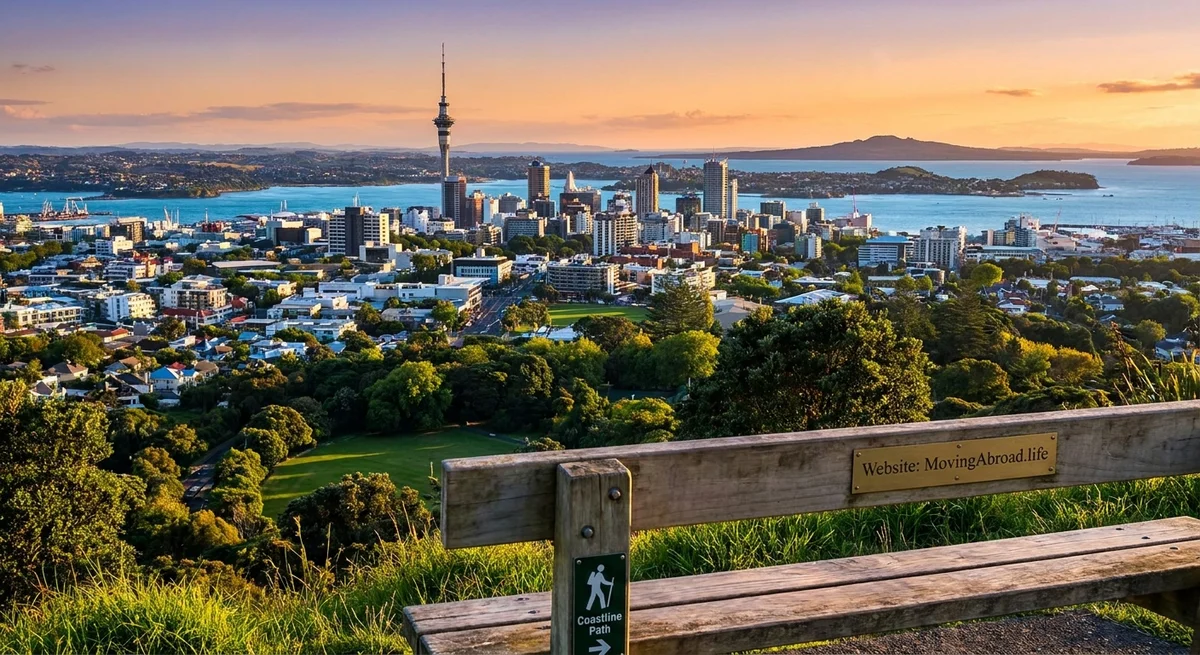
Auckland, New Zealand: Green City at the Edge of the Map
Nestled on an isthmus in the North Island, Auckland is New Zealand’s largest city and its economic hub. It sprawls between two harbours and the Hauraki Gulf, earning nicknames like the “City of Sails” for its famous waterfront and boat culture. Auckland’s reputation is of a vibrant, multicultural urban center set amid volcanic cones, lakes and greenery – the “green city” at the western edge of the Pacific Rim. For anyone considering a move here, it helps to look beyond the postcard images. In this comprehensive guide we’ll examine what life in Auckland is really like: safety and crime trends, housing costs by neighborhood, how living costs stack up to cities like Melbourne or Vancouver, work visas and residency options, taxes and healthcare, climate and natural hazards, transit and schooling, and the key trade-offs (like housing shortages and travel distances) that define living in this distant southern metropolis.
Safety and Crime
New Zealand as a whole is often regarded as very safe by international standards, with low violent crime and a stable society. Auckland, however, is not entirely without crime. Recent local studies suggest crime (especially property crime) has been rising somewhat in the city. In one report by the Committee for Auckland (published Dec 2023), Auckland ranked 124th worldwide on safety – effectively the lowest among its Australasian peer cities (www.1news.co.nz). The story noted that Auckland has seen a three-year decline in safety rankings, and called it “the least-safe city in Australasia” among major cities (www.1news.co.nz). This refers largely to perceptions and rates of petty crime and some violent crime spikes in recent years. In everyday terms, visitors and locals still generally feel safe – say by North American or European standards – but it’s not risk-free. Petty theft (car break-ins, phone snatches, etc.) can occur, especially in some neighborhoods or after dark. Violent crime exists (as it does in any big city) but remains relatively low overall.
It’s worth noting that quality-of-life surveys have traditionally ranked Auckland highly. Mercer’s 2019 Quality of Living survey rated Auckland 3rd globally (tied with Vancouver) and even placed it in the top 10 for personal safety (www.mercer.com) (www.mercer.com). While that may seem at odds with recent reports, it highlights that Auckland’s stability (low terrorism risk, strong institutions, social cohesion) is still strong. In short: Auckland is relatively safe compared to global megacities, but prospective residents should not be complacent. Standard urban caution (locking cars, avoiding poorly lit areas late at night, monitoring news on local crime trends) is wise.
Rents and Neighborhoods
Housing is one of the biggest concerns in Auckland. The city’s recent housing boom of infill apartments and townhouses has helped add supply, but rents remain very high – especially in desirable central suburbs. We’ll look at three illustrative areas:
- Ponsonby (Central Auckland West): A trendy inner-city neighborhood known for cafes and nightlife. Rents here are steep. Barfoot & Thompson’s May 2024 suburb report shows that the average rent for a three-bedroom home in Ponsonby is roughly NZ$993 per week (www.barfoot.co.nz). Even smaller units in Ponsonby routinely list in the high hundreds of dollars per week.
- Mount Eden (Central Auckland East): A leafy suburb just south of the CBD with parks and good schools. It is somewhat more affordable than Ponsonby. Barfoot’s data lists around NZ$783 per week for a three-bedroom in Mt. Eden (www.barfoot.co.nz). (Two- or one-bedroom units tend to be in the NZ$600–$700 range.)
- North Shore: This large suburban area north of Waitematā Harbour includes beachside communities like Takapuna, Devonport, and Albany. Rents vary widely, but on average they are moderately lower than inner city. Barfoot’s June 2025 report indicates that a three-bedroom house on the North Shore rents for about NZ$722 per week (www.barfoot.co.nz) (down from around NZ$730 a year earlier). For reference, more affordable parts of the North Shore might see 3BR rents in the NZ$600s or even NZ$500s, while premium suburbs (like Devonport or Takapuna) can be closer to NZ$800+.
In summary, expect rents in Auckland to be quite high, especially closer to the CBD. Outer suburbs can be cheaper, but few areas are truly “cheap.” Many expats budget on the order of NZ$700–$1,200 per week for a 2–3 bedroom rental in the city.
Cost of Living Compared to Melbourne and Vancouver
Auckland’s overall cost of living is by global standards high, but not the absolute highest. Comparative analysis suggests Auckland is somewhat less expensive than large global peers. For example, one cost-of-living index (March 2026) shows that a typical one-person budget (including rent) in Auckland is about 15% lower than in Vancouver, Canada (livingcost.org). Similarly, living in Auckland is about 14% cheaper than in Melbourne, Australia (livingcost.org). These figures account for things like housing, food, and transport.
What does this mean practically? Both Vancouver and Melbourne are very pricey cities (especially on housing), and Auckland’s slightly lower index reflects marginally cheaper rents and some cheaper day-to-day costs. For example, [LivingCost.org] reports that Auckland’s average one-person monthly expenses (including rent) are about US$2,156, whereas Vancouver’s are US$2,540 (livingcost.org). Melbourne’s is about US$2,496 (livingcost.org). In Auckland you also tend to pay less for groceries and dining than in Vancouver or Sydney (though still more than in many US cities or smaller towns). However, note that Auckland has its own high costs – imported items, electronics, and international travel can be pricey due to shipping and distance.
On balance, Auckland is on the high end for cost-of-living, but it does compare favorably to the biggest world cities. Housing and rent are the main drivers of high costs here (as in many places). Utility bills are moderate (electricity, internet, water are not exorbitant). Taxes and healthcare are cheaper than, say, in the U.S. (no private health insurance is needed for most residents, and there’s no state or provincial tax). One must weigh salaries too: typical wages in Auckland may be somewhat lower than in Vancouver or Sydney, so the net effect depends on income and lifestyle. But according to comparative data, a mid-career professional’s after-tax pay in Auckland covers living costs about as well as in those cities; in fact, slightly more months of expenses can be covered by the average Auckland salary than in Vancouver (livingcost.org).
Visas and Residency Pathways
Work Visas: New Zealand’s current main work visa is the Accredited Employer Work Visa (AEWV), introduced in 2022. Under this scheme, employers must be vetted (“accredited”) to hire foreigners. An overseas worker needs a job offer for a full-time position (30+ hours/week) from such an employer, and that employer must do a “job check” to prove no suitable local was available. The visa is usually issued for up to 5 years, depending on the role’s skill level and salary (www.immigration.govt.nz). It allows the holder to live and work in NZ, and often can lead to residency. In fact, if the job meets certain criteria (higher skill level or at 1.5× the median wage), the person can use the Skilled Migrant Category (see below) to apply for permanent residence (www.immigration.govt.nz).
NZ’s Immigration website outlines the AEWV details: for example, the application fee is about NZ$1,540 and processing takes a few weeks on average (www.immigration.govt.nz). Once granted, you can work only for the sponsoring employer, though switching jobs is possible by applying for a new visa. Partners of AEWV holders can often get work visas as well, and dependent children may come on student visas. Importantly, employers cannot charge fees to hire you (recruitment costs must not be passed to the migrant) (www.immigration.govt.nz).
Skilled Migrant Category (SMC): For those seeking permanent residence (instead of just temporary work), the Skilled Migrant Category is the main pathway. This residency route is for highly skilled workers. To use it, you typically need either a recognised qualification (bachelor’s degree or higher) or a qualifying professional registration plus a relevant job. New NZ immigration rules simplify things by saying: if you have a skilled job and either 1) a bachelor’s degree or 2) earn at least 1.5× the median wage, you can apply (www.immigration.govt.nz). Applicants go through a points-based “Expression of Interest” system (points awarded for age, experience, job offers, etc.), and if selected, you can proceed to a resident visa.
New Zealand also has special “in-demand” occupations lists (the Green List) that can fast-track residency if your job is on the list, but basic SMC requires the above criteria. In practice, this means many tech, engineering, healthcare and other professionals are eligible. Ultimately, with an approved Skilled Migrant Visa, you become a NZ resident with access to all services. For details, see [Immigration New Zealand] and the official Skilled Residence Pathways guides (www.immigration.govt.nz).
Taxes and Public Healthcare
Taxation: New Zealand has a progressive income tax system and no state taxes or capital gains tax on most assets. As of 2024/25, the income tax brackets for residents are roughly 10.5% on the first ~$14,000 NZD of annual income, then increasing to 17.5% (up to ~$48k), 30% (up to ~$70k), 33% (up to ~$180k), and 39% on income above $180,000 (www.ird.govt.nz). (These exact bands shift slightly with each fiscal year; check the Inland Revenue rates page for current figures). There is also a flat 15% GST (goods and services tax) on most purchases. Compare this to Australia (where top rate is 47% with largest economy) or the US (federal top 37% plus state taxes), NZ’s rates are moderate. All residents and workers pay an ACC (Accident Compensation) levy as well, which funds free accident insurance.
Public Healthcare: One of New Zealand’s strong points is its largely government-funded healthcare. Most basic and emergency medical services at public hospitals, as well as accident coverage, are free or heavily subsidized for citizens and many residents. Legally residing work visa holders (who plan to stay 2+ years) are eligible for publicly-funded healthcare (www.govt.nz). In practice this means that a resident or long-term work visa holder can visit a doctor, receive hospital treatment, and have surgeries or maternity care without paying the full cost (some minor fees or charges may apply for doctor visits and prescriptions). The Accident Compensation Corporation (ACC) covers medical costs for injuries regardless of fault. In short, as a legal resident or long-term visa worker in NZ, you enjoy nearly free healthcare for things like accidents, hospitals, maternity and disability support (www.govt.nz). (Only recently arrived short-term visitors or expats on short visas need travel insurance, since they are not yet eligible.) This public system is funded by taxes, so you don’t need costly private health insurance just for basic services.
Climate, Volcanoes and Earthquake Risk
Climate: Auckland enjoys a mild, oceanic climate. Summers (Dec–Feb) are warm and humid (average highs around 24–26°C/75–79°F), while winters (Jun–Aug) are mild and damp (avg. highs ~15°C/59°F, rarely dropping below 6°C/43°F) (en.wikipedia-on-ipfs.org). Frost and snow are virtually unheard of in the city itself (there have been only a few light flurries in living memory). It is one of the warmest and sunniest main centers in NZ. However, it is wet: rainfall is fairly evenly distributed year-round, averaging about 1,200+ mm (47 inches) per year (en.wikipedia-on-ipfs.org). Winters (May–Aug) get slightly more rain (June and July can exceed 140mm each). So plan for a fair amount of cloudy, drizzly days – Auckland’s lush green parks and hillsides are thanks to this frequent rain. Coastal breezes moderate extremes (heat or cold), making the climate generally comfortable.
Volcanoes: The geological hazard unique to Auckland is its volcanoes. The city sits atop the Auckland Volcanic Field, an area of about 360 km² containing over 50 small volcanoes (scoria cones, lava flows, and explosion craters) (www.geonet.org.nz). These volcanoes are dormant, not extinct: the field could erupt again, though on human timescales the risk is low. The most recent eruption was Rangitoto Island, about 600 years ago (www.geonet.org.nz). That eruption was violent, forming Rangitoto’s huge cone in one episode. Scientists warn that future activity would occur as a new vent in the field (never the same vent twice) and would be unpredictable. In practice, while the chance of living through a volcanic eruption in Auckland is very low, it is a low-probability/high-consequence risk. Locations in volcanic craters (like Mount Wellington, One Tree Hill, etc.) are public parks, and lava rock is visible underfoot in many parts of the city. As a resident, you should simply be aware of this icon: it’s why Auckland is nicknamed the “City of Volcanoes.”
Earthquakes: New Zealand in general is very seismically active, and while the biggest quakes hit further south or on the plate margins, Auckland can feel shakes too. The city has few active faults locally (some minor ones in South Auckland area) (www.aucklandemergencymanagement.govt.nz). The greatest quake risk in Auckland actually comes from distant sources – for example, a large quake off the East Cape (Hikurangi Trough) or in the North Island’s central volcanic plateau could rattle Auckland as well. Historically, very strong earthquakes are rare in Tāmaki Makaurau (Auckland), but minor tremors (3–5 magnitude) occur from time to time. The Auckland Civil Defence advises knowing “Drop, Cover and Hold” and having an emergency plan (www.aucklandemergencymanagement.govt.nz). In short, you don’t need “earthquake-proof” first aid kits in Auckland like in Wellington or Christchurch, but basic preparedness (fastening furniture, having water/food stocked, knowing safe spots) is wise.
Transit and Green Living
Auckland is notoriously car-dependent. The city grew during the era when everyone took cars for granted. Even today, the vast majority of Aucklanders drive or ride in cars: over 50% of journeys to work are made by driving alone, and another ~25% as passengers (at.govt.nz). Public transit usage remains low by world standards – only about 11% of commutes are by bus or train combined (10.8% by bus, 3.2% by train) (at.govt.nz). Recent analysis found that Auckland is physically sprawling and lower-density than peer cities, which limits transit options; one report explicitly says Auckland is “much more car dependent” than its peer cities because of this (www.rnz.co.nz) (www.rnz.co.nz).
What transit does exist includes a network of buses (including some high-frequency and express routes), a single electrified rail line running south from the CBD to suburbs like Newmarket, Mt Albert, and Otahuhu (with an extension to the airport in the works), and two suburban rail lines in the North Shore (which are less direct). A major tunnel project (the City Rail Link) is under construction to link the western and eastern rail lines through downtown; once complete (mid-2020s), it will increase subway-style service in the city centre. Ferries also operate across the harbour to places like Devonport and Waiheke Island. But for many parts of the metro, especially outer suburbs, a car is by far the most convenient option. Traffic congestion can be severe at peak times.
On the environmental and livability side, Auckland is quite “green.” Nearly half the city’s land area is dedicated to farmland, parks, reserves and native forest. Many volcanic cones (Maunga) are protected parks with walking tracks. The harbour and gulf offer boating, water sports and scenic beauty. The city’s “Manaaki Tāmaki Makaurau” open space strategy and various council parks ensure plentiful green space. Air quality is pretty good too (it’s a clean city with low industrial pollution), though fine particle pollution from wood-burners can accumulate briefly on still winter days. Aucklanders enjoy year-round outdoor lifestyles — surfing, sailing, hiking, and cycling (though cycle infrastructure still lags).
Education and City Services
New Zealand’s education system is generally strong, and Auckland has many quality schools. State (public) schools are free to attend (beyond a small donation request), with instruction in English. There are also numerous private and international schools, and several large universities (UoA, AUT) and polytechnics. International surveys like OECD PISA consistently rank NZ students above average. For instance, in the 2022 PISA study, 15-year-olds in NZ scored on average 501 in reading (vs. OECD avg 476) and 504 in science (vs. 485) (gpseducation.oecd.org). This suggests Auckland’s youth fare well in literacy and numeracy by global standards. Of course, like any city, there is variation – some schools (especially low-decile schools in high-poverty areas) face challenges – but overall Auckland’s public schools are considered of high quality. Both primary and secondary academic and sports opportunities abound. Daycare, health checks, libraries and other city services are excellent as well.
Trade-Offs and Dealbreakers
While Auckland has much to offer, there are important trade-offs to consider:
-
Housing Shortages and Affordability: Although housing supply has ramped up (nearly 100,000 new homes built across Auckland in the last 7 years (www.nzherald.co.nz) due to relaxed density rules), demand remains strong. Affordability is tough, especially for families. The median house price in Auckland is roughly NZ$1 million (about 7.5× the median household income) (www.nzherald.co.nz). By comparison, 20–30 years ago the median was only ~5× income. A Council report notes that housing “supply is showing good signs of meeting population growth, but affordability was still not great.” Homelessness has risen, and many young people find ownership out of reach. In practical terms: be prepared to pay a lot for even modest housing, or look at multi-generational living, or smaller apartments. On the positive side, the trend toward denser apartment and townhouse living (especially near transit) is improving the market on the supply side (www.nzherald.co.nz) (www.nzherald.co.nz).
-
Geographic Isolation: Auckland is very far from most global markets and family abroad. Flights to North America or Europe are long and expensive (a typical Auckland–LA flight is ~13 hours, Auckland–London ~24–30 hours with stops). Shipping freight to/from NZ naturally costs more and takes longer. This remoteness can be a business disadvantage (longer supply chains), and it makes travel home taxing – many expats lament “the 24-hour trip” to reach Europe/USA/Asia. On the flip side, Auckland’s port and airport are well-connected regionally (major routes to Australia, Asia, Pacific), but you need to budget time and money for international trips.
-
Car Dependence: As noted, limited transit means many people need a car, adding to costs. Expect to drive or at least share rides if living outside the small downtown core. Fuel is moderately priced (NZ gasoline is around mid-pack globally). If you hate driving, it’s a frustration; if you enjoy outdoor activities, the car does give freedom (e.g. to reach West Coast beaches or hiking trails).
-
Distance to Amenities: Even within the region, distances can be significant. Calling Auckland “metropolitan” may mislead some – sprawl is extensive. A suburban house might be 30–40 km (20–25 miles) from the city center. Commute times can be long by car (though the upcoming City Rail Link and future light rail projects aim to help this). On the upside, Auckland’s smaller-city feel means shorter commutes than, say, much of LA or Toronto – but it’s still something to weigh.
In summary, Auckland offers a high quality of life with world-class outdoors, good healthcare and education, and a safe, relaxed vibe. But it comes at a price: expensive housing, the hassle of distance, and less public transit than many cities its size. For remote workers or retirees, the lifestyle perks (clean environment, friendly locals, stability) often outweigh these cons. Families will find excellent schools and parks, but may grapple with housing costs and deciding where to live. Ultimately, the decision hinges on priorities: if green spaces, mild climate, and safety rank high, Auckland could hit the mark; if your career needs face-to-face links with overseas markets or you need fast urban transit, Auckland’s isolation and car culture may be drawbacks.
Conclusion
Auckland, Aotearoa’s “City of Sails,” is indeed a green city at the edge of the map – geographically remote yet vibrant. Our review shows that it combines many urban amenities (jobs, culture, schools) with breathtaking natural beauty (volcano parks, harbours, islands). The safety and healthcare systems are robust, and skilled migrants have clear visa pathways to build a life here (www.immigration.govt.nz) (www.immigration.govt.nz). Living costs, while high, are not extreme compared to other global coastal cities (livingcost.org) (livingcost.org). Still, newcomers must be savvy: expect to budget heavily for housing (rent or mortgages), adapt to the car-centric lifestyle, and accept a degree of geographic isolation.
In the end, Auckland rewards those who value a balanced, outdoorsy urban life – bananas may be a bit pricey in winter, but the summer sailing and mountain biking make up for it. Like any city, it has trade-offs, but with thorough research and realistic expectations, moving to Auckland can be an exciting, high-quality adventure.