 Auto
Auto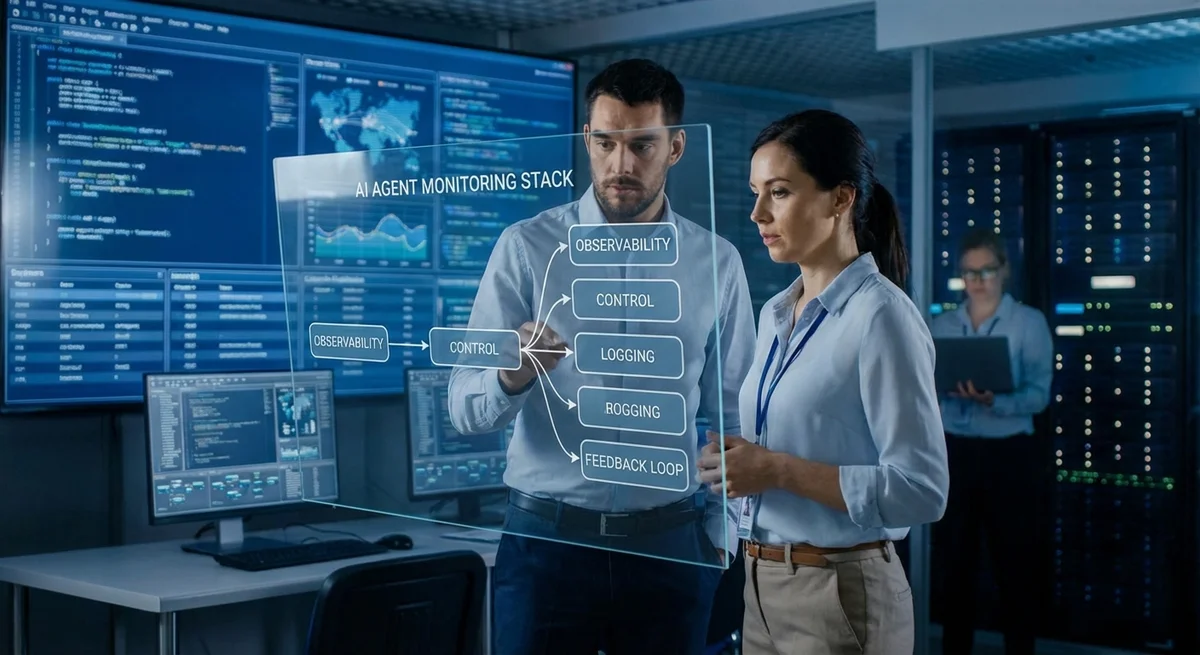
Introduction
As enterprises deploy more autonomous AI agents – from conversational assistants to task-automating “bots” – a new challenge emerges: observability. These agents make multiple decisions, call APIs, update context, and even act on behalf of users. Yet traditional monitoring tools provide only a narrow view. In practice, teams often rely on scattered logs or dashboards that were not designed to capture an agent’s multi-step reasoning. A recent survey by Dynatrace found that half of AI-driven projects stall at the pilot stage because organizations “can’t govern, validate, or safely scale” their agents (www.itpro.com). Similarly, Microsoft security leads warn that we “cannot protect what we cannot see” – stressing that AI agents require an “observability control plane” as adoption grows (www.itpro.com) (www.itpro.com). In this article, we examine the monitoring gaps for autonomous and semi-autonomous agents (especially around tool usage, memory, and decision paths). We then propose a specialized observability-and-control platform that captures end-to-end traces, enforces policies, simulates workflows, and can roll back unsafe actions. We compare this approach to traditional APM (application performance monitoring) tools, explain why agent-specific telemetry is critical, and outline a pricing/integration model (e.g. per-agent-minute billing with PagerDuty/Jira integrations).
Monitoring Gaps in AI Agents
AI agents are not single API calls; they are multi-step workflows that plan, fetch information, call tools, and synthesize outputs under uncertainty (www.stackai.com). This complexity creates blind spots for conventional monitoring:
-
Fragmented Telemetry: In most environments, telemetry is siloed. One system logs endpoint events, another shows network traffic, a third holds authentication data. TechRadar notes that “most AI agents rely on the same fragmented telemetry stacks that analysts have struggled with for years” (www.techradar.com). Without correlating these signals, an agent lacks the context to reason correctly. For example, an AI might suspect an account compromise only if it sees both an unusual login (from logs) and a suspicious network pattern – but if these signals live in different tools, the agent “simply doesn’t know enough” (www.techradar.com) (www.techradar.com). In short, fragmented data creates a visibility gap: agents act on incomplete information, leading to silent failures (wrong actions that go undetected).
-
Tool-Call Blind Spots: Agents often invoke external tools or APIs (e.g. databases, knowledge bases, web services). Traditional monitoring might only record that an HTTP request occurred, but agent-aware observability must log which tool was selected and why. The observability platform should capture the exact prompt or context leading to that tool choice, the arguments passed, and the full output or error response (www.braintrust.dev). Without this, an agent could be feeding the wrong parameters or misinterpreting a tool’s response, and the issue would remain hidden. For instance, Braintrust’s observability guide emphasizes that each tool call should be traced with its input and output so engineers can “spot hallucinated parameters, missing fields, or incorrect formatting” (www.braintrust.dev).
-
Opaque Memory Operations: Many agents use memory or retrieval systems (e.g. a user’s profile, RAG knowledge store). This dynamic context can cause failures that are impossible to detect without logging “what the agent reads and writes” (www.braintrust.dev). For example, if an agent retrieves an outdated memory entry or the wrong user’s data, the answer may silently go bad. Observability should log retrieval queries, returned items, relevance scores, and freshness metadata, so that one can trace a wrong output back to a stale or mis-targeted memory read (www.braintrust.dev). Likewise, every memory write should be recorded (what was stored, under what key) to catch compounding errors or data leaks (e.g. one user’s info appearing in another’s session) (www.braintrust.dev).
-
Invisible Decision Trajectories: Unlike a web request with a clear “enter code, get answer” flow, agents typically run a plan-act-observe loop. They generate a plan, take an action (like “search knowledge base”), observe the result, then decide to re-plan or continue. Simple logs cannot reveal this branching path. Observability requires capturing each step in sequence, with the agent’s “reason” for each action. Without it, we might only see the final output and think everything is fine – even if halfway through the agent drifted off-task or got stuck. For example, Braintrust highlights “plan drift” (agent silently changes goals) and “infinite loops” as failure modes that only step-level trace can expose (www.braintrust.dev). A proper trace logs each sub-agent invocation, branching decision, and loop duration, making it clear if the agent answered the wrong question or repeated steps without progress.
-
Silent Quality Failures: Many agent failures don’t trigger HTTP errors or crashes. Instead, the agent might hallucinate data, violate user instructions, or drift from policy. Conventional monitors (like Datadog or New Relic) only check latency or error rates (www.techradar.com), so the system would report “everything is green” even if the response was factually wrong. StackAI explains that traditional APM tools assume deterministic software — but agents break those rules (www.stackai.com). For instance, a prompt change or model upgrade might subtly degrade answer quality without raising any obvious alert (www.stackai.com). Observability must therefore include semantic checks: e.g. tracking hallucination rates or policy-violation incidents. In summary, normal monitors show that an agent responded on time, but only agent-specific telemetry can show whether the response was correct, relevant, or safe.
-
Governance and Security Risks: AI agents introduce new compliance challenges (prompt injection, privacy leaks, unauthorized actions). Without tailored telemetry, these risks are invisible. StackAI notes that observability and governance converge: “you can’t enforce policies you can’t detect” (www.stackai.com). For example, if an agent in customer support mode began leaking personal data, only detailed trace logs could reveal the source of the breach. Therefore, our platform must watch for policy violations in real time (e.g. flagging PII in outputs, blocking disallowed API calls) and provide an audit trail for compliance.
In summary, existing APM and logging stacks simply don’t capture how an AI agent thinks: the chain-of-thought, branching logic, and dynamic context. This leads to blind spots in tool calls, memory usage, and decision trajectories. Without addressing these gaps, enterprises risk silent agent failures, security breaches, and loss of trust.
Building an AI Agent Observability & Control Platform
To fill these gaps, we propose a dedicated AI-Agent Observability and Control platform. This service would instrument agents end-to-end, enforce governance, and enable safe experimentation. Key features include:
End-to-End Tracing and Logging
Every agent run should produce a trace that records the full execution graph. Inspired by distributed systems practices, each agent’s workflow is a trace, and each action (LLM prompt, tool call, memory query, sub-agent handoff) is a span within that trace (www.stackai.com) (www.braintrust.dev). This means an engineer can see the exact sequence: what prompt the agent saw, how it broke its task into steps, and what each tool returned. For example, if an agent queries a document store, the trace logs the query and the content retrieved; if it then reformulates the query, that’s a new span. Session identifiers tie together multi-turn conversations or long tasks. Using standard protocols like OpenTelemetry, these traces can flow into existing APM backends. As one guide notes, “these primitives increasingly map well onto existing observability patterns” (www.stackai.com). In practice, this lets you correlate an agent’s behavior with underlying infrastructure: CPU spikes, network I/O, or database calls can be viewed alongside the agent’s reasoning steps.
Rather than logging raw text in free form, the platform stores structured spans. For example, a span might record: Tool: emailSender, Input: JSON payload, Output: success or error, Latency: 200ms. By nesting spans (e.g. tool calls under a parent LLM call), engineers can drill into where time was spent or which step caused a failure. Importantly, all user inputs, system instructions, and memory reads each become trace data. This structured logging replaces tedious “print debugging” and makes it possible to search and filter logs (e.g. show all runs where the agent used financialAPI tool).
Real-Time Policy Enforcement
The platform doubles as a control plane for governance. It continuously inspects agent telemetry against security and business policies. For instance, if an agent attempts to execute an unauthorized workflow (like accessing HR payroll when it shouldn’t), the policy engine can immediately intervene. Rules can be defined on the trace data: e.g. “Alert if output contains credit-card patterns” or “Block any database write outside 9–5 customer support hours.” Since “you can’t enforce policies you can’t detect” (www.stackai.com), this observability data makes enforcement possible. In practice, violations can trigger automated containment: the platform might pause the agent, escalate an alert, or revert any changes it made. A built-in “agent kill switch” lets administrators freeze or throttle agents that misbehave (echoing the advice that leadership should know “What’s the kill switch?” (www.techradar.com)). For example, if a malware scanner agent goes rogue, once the telemetry flags the abnormal behavior, the system can immediately isolate its permissions and alert the on-call engineer.
Policy enforcement extends to privacy and safety checks. The system could run automated PII detectors on all outgoing messages, or have an “LLM-as-a-judge” module sniff for hallucinations or policy drift. Any safety violation is logged as an incident. By weaving these checks into the observability layer, enterprises get a live safety dashboard in addition to performance metrics.
Offline Simulation and “Sandbox” Testing
Before deploying any significant change, it pays to simulate scenarios. Our platform includes a sandbox environment to replay or mock agent workflows. Teams can feed the agent a suite of test cases (reflecting common user requests or edge cases) and collect trace logs in a dry run. This offline evaluation ensures new prompts or model upgrades don’t break policies or degrade quality (www.braintrust.dev). For example, before granting a finance agent new API privileges, engineers could simulate month-end closing tasks to verify it follows approval flows. The system can also detect regressions: if an updated agent version suddenly configures tools incorrectly, the test traces reveal the misstep before it hits production.
In effect, this is like chaos engineering for AI: deliberately exposing the agent to threat scenarios or incorrect data to see if it derails. TechRadar advises that enterprises should “measure readiness with sandbox assessments… so that decision-making has been exercised and recovery times are understood” (www.techradar.com). The platform can automate these drills on a schedule, logging each run. This helps catch hidden failures (e.g. context indexing that was stale) early. By integrating evaluation into the development pipeline, teams achieve a feedback loop: production errors become new test cases, and each release must clear the offline gate.
Execution Control and Rollback
Even with prevention, mistakes can happen. Our platform provides remediation tools. First, a real-time “stop” command can instantly suspend an agent’s actions. For long-running or async tasks, the system can invoke cancellation points if a policy is violated (for instance, abort a transaction if the agent tries to withdraw funds without approval). Second, because all actions are traced, the platform can replay or undo effects. For example, if an agent erroneously emailed clients or updated a CRM, operators can use the logs to reconstruct the state before the change. Combined with immutable audit logs, this allows rollback of database transactions or filesystem changes performed by the agent. TechRadar underscores the need for this: “organizations must reassess… rollback paths at every AI implementation” (www.techradar.com). In practice, the platform might snapshot state before execution or integrate with versioned data stores, ensuring failed agent actions can be reversed like a faulty software deployment.
Integration with Incident Response and Ticketing
Observability is half the battle; engineers must be alerted effectively. The platform will integrate with modern incident management and collaboration tools. For example, it can push critical agent alerts to PagerDuty, creating an on-call incident when a serious policy violation occurs. It can post summaries to Slack or Microsoft Teams channels (PagerDuty notes that their own system has “advanced Slack and Microsoft Teams integrations” to keep responders focused (www.pagerduty.com)). Integration with ticketing systems is also essential: when an alert is triggered, the platform can automatically create a Jira or ServiceNow ticket pre-populated with the trace ID, affected conversation, and policy details. This ensures agent incidents enter the same triage workflows as other outages. PagerDuty also highlights its 700+ tool integrations (Datadog, Grafana, etc.) to stitch observability and response together (www.pagerduty.com). Similarly, our platform would offer connectors to logs (e.g. Splunk), metrics (Prometheus), and CI/CD systems, so that every piece of telemetry fits into existing dashboards and charts.
Traditional APM vs. Agent Telemetry
How does this compare with a legacy Application Performance Monitoring (APM) solution? In a nutshell, traditional APM (Datadog, New Relic, Dynatrace, etc.) excels at infrastructure and code-level metrics, but it treats agents as black boxes. For example, Datadog can “automatically ingest, parse, and analyze logs from across your stack” and its APM module “traces requests across distributed systems” (www.techradar.com). Similarly, its network monitoring gives a bird’s-eye view of servers, CPU, memory, and network flows (www.techradar.com). These tools will alert if an agent consumes too much CPU or throws an exception. But none of that captures what the agent is thinking. They won’t log the actual prompt text (due to privacy rules) or the sequence of LLM calls. They won’t know if the answer it produced was based on incorrect memory or if it violated a business rule. From their perspective, “everything looks green” whenever the API call returns 200 OK (www.stackai.com).
In practice, one might try to hack APM for agents (for instance, tagging each chat request and searching logs). But without agent-specific spans, gaps remain. APM assumes deterministic workflows: on failure we debug code paths. But with AI agents, failures are silent (wrong answer) or semantic (policy breach) rather than throwing exceptions. StackAI observes that agents “violate many [APM] assumptions” – for example, an agent has no error code when it simply hallucinates (www.stackai.com). Furthermore, multi-step agent chains span across many components (models, indexes, tools); if you only watch the final web request, you lose all context of how the agent got there. Lastly, APM tools are generally blind to AI-specific costs (like token usage) and quality signals.
For these reasons, enterprises building agentic systems increasingly see the need for dedicated telemetry. As Dynatrace reported, “Observability… is a vital component of a successful agentic AI strategy. Teams need real-time visibility into how AI agents behave, interact, and make decisions” (www.itpro.com). The proposed platform delivers exactly that layered view that APM tools cannot: from high-level health metrics down to the agent’s cognitive steps. It essentially extends APM’s golden signals (latency, error, throughput) with agent-specific quality metrics (groundedness, completion rate, hallucination incidence) (www.stackai.com) (www.stackai.com).
Pricing Model
A straightforward pricing model is usage-based. One approach is to charge per agent-minute (the time an agent is actively computing on tasks). For example, the service might be priced at roughly $0.05–$0.10 per agent-minute, similar to cloud function billing. This covers the cost of capturing and storing the trace/span data, running evaluation checks, and storing logs. (There could be a base monthly fee for platform access plus overage charges.) Additional data retention or log volume might be billed per GB. Volume discounts or enterprise plans could offer lower per-minute rates for large deployments. This aligns cost with consumption: a sporadically active bot incurs minimal charges until it runs. For context, many monitoring and serverless products use fine-grained usage pricing. Our “agent-minute” metric is analogous – users know exactly what they pay for each hour of agent runtime, promoting efficient usage.
Conclusion
Autonomous AI agents promise great productivity gains, but only if we can see and control their actions. The emerging field of AI observability tackles exactly this: making the “thought processes” of agents transparent and manageable. By instrumenting tool calls, memory accesses, and decision steps as traces, we gain insight into opaque failures and governance gaps. A purpose-built monitoring platform (with policy enforcement, simulation, rollbacks, and IR integration) ensures that agents operate safely in production. In contrast to legacy APM tools, agent-specific telemetry treats the AI system itself as a first-class citizen, not just its servers.
As surveys and experts warn, lack of observability is a showstopper for scaling agentic AI (www.itpro.com) (www.itpro.com). By building the new monitoring stack described here, organizations can turn “hopeful guesswork” into dependable automation (www.techradar.com). Ultimately, such an approach builds trust that agents will behave as intended and allows innovate with confidence. When something does go wrong, it will no longer be a mysterious breach or hallucination – the trace logs and control plane will pinpoint the failure mode, enabling rapid mitigation and learning. In the era of autonomous agents, observability is not optional; it’s the very foundation of safe, scalable AI.