 Auto
Auto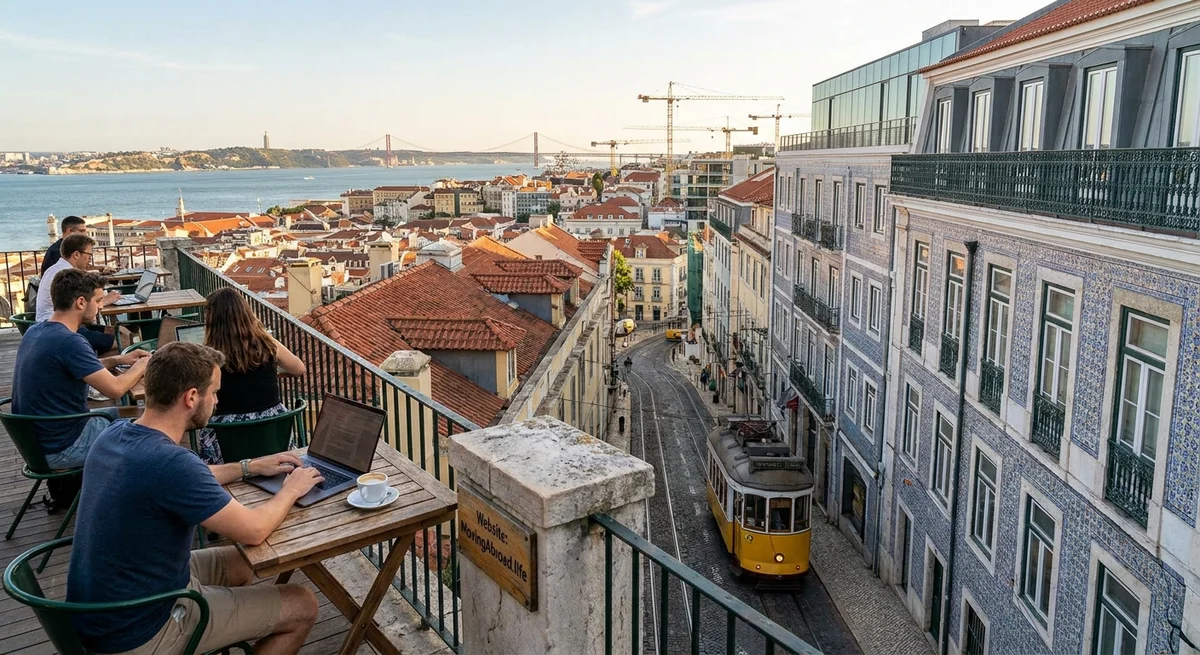
Lisbon, Portugal: Atlantic Tech Hub with Old-World Charm
Lisbon has quietly become a darling of the modern expat and remote-work scene. In recent surveys it regularly ranks among the top digital-nomad and remote-work destinations worldwide (lisboasecreta.co), thanks to its sunny climate, fast internet and vibrant startup culture. Once you arrive, you’ll find a city of striking contrasts: historic neighborhoods brimming with tile-roofed mansions and fado music on one hand, and a growing tech/creative sector on the other. That mix – plus relatively low crime and an affordable cost of living – is why many retirees, families and remote professionals are seriously considering Lisbon. This guide digs into the data: safety by neighborhood, rent and budget figures, visa and tax rules (D7 vs D8, NHR changes), healthcare access, infrastructure and schools. In each area we highlight the realities – good and bad – so you can judge how Lisbon compares to other popular expat cities (like Valencia or Berlin) before you pack your bags.
Safety by Neighborhood
Portugal is one of the world’s safest countries, consistently ranking in the global top 10 for peace and low violence (www.thetraveler.org). Lisbon, its capital, inherits that overall safety. International indexes place Lisbon solidly in the upper-tier of global city safety, even rating it among the “world’s top ten safest cities to visit in 2026” (www.thetraveler.org). Violent crime is very rare; the biggest risks here are classic big-city issues like pickpockets and opportunistic theft. Recent police data show crime in the Lisbon district actually fell in 2024 (www.idealista.pt), underscoring its generally secure reputation.
That said, safety varies by neighborhood and time of day. In tourist hotspots like Baixa/Rossio and Chiado – especially around major squares and funicular lines – pickpocketing is common when crowds gather (www.idealista.pt) (www.idealista.pt). Fado pitch roads in Alfama feel safe by day, but some narrow alleys get quiet at night (www.idealista.pt). Likewise, nightlife circuits (Bairro Alto and Cais do Sodré) can attract grab-and-dash incidents when bars close and people stumble home (www.idealista.pt). Public transport hubs and busy tram queues are also favorite targets for criminals. As one travel guide notes, “late nights in some areas... crowds, open drinks and easy targets” require vigilance (www.idealista.pt) (www.idealista.pt).
For families and security-conscious expats, the solution is to live in the quieter, wealthier precincts. Neighborhoods on Lisbon’s western coastal and suburban fringes – such as Cascais, Oeiras or the northern districts of Campo de Ourique, Alvalade and Telheiras – consistently report lower petty-crime rates (www.thetraveler.org) (www.thetraveler.org). These areas have stable residential populations, walkable streets and a strong police presence. In short, Lisbon is broadly safe, but prudent visitors and new residents choose their streets wisely: day-to-day life in the city’s core is largely trouble-free, but it pays to stay alert around packed tourist plazas or dimly lit bars at night (www.thetraveler.org) (www.idealista.pt).
Housing and Rent Trends
Lisbon’s booming popularity has strained its housing supply. The vacancy rate for long-term rentals is just around 3% (well below the historical 4–5% norm) (investropa.com). As a result, rents climbed dramatically in recent years, though late-2025 data show a market cooling off. According to one analysis, average asking rents in Lisbon are about €23 per m², but signed contracts typically average closer to €16.50 per m² after negotiation (investropa.com). Rents peaked in fall 2025 (around €17.00/m²), then actually fell by about 5% over the following quarter (www.realestate-lisbon.com). Still, Lisbon remains expensive by Portuguese standards – in metro Lisbon the median rent was ~36% above the national average (www.realestate-lisbon.com).
As of 2026, here’s what tenants are actually paying: a studio apartment runs roughly €900/month on average (often €750–1,200 depending on location) (investropa.com). A one-bedroom flat is about €1,250 on average (investropa.com), though most leases fall in the €1,000–1,700 range. The cheapest one-bedrooms are typically found in outer districts like Benfica, Olivais or Lumiar, while the most expensive are in central parishes (Santo António, Misericórdia, Santa Maria Maior) (investropa.com). Two-bedroom apartments average ~€1,850 (roughly €1,400–2,600 range) (investropa.com); again, the city center (Príncipe Real, Avenida da Liberdade area, Parque das Nações) commands the highest rents, whereas peripheral zones (Benfica, Lumiar, Olivais) are more affordable (investropa.com).
Overall, rent growth has slowed to roughly 1–2% annually in 2026 (investropa.com), down from explosive increases after 2020. But steep micro-market gaps remain: in premium downtown areas like Chiado or Baixa, modern apartments with parking still rent for €25–30/m² (www.realestate-lisbon.com), whereas newer districts like Parque das Nações offer €18–22/m² for similar units (www.realestate-lisbon.com). (Investors note yields of 3–4% in prime Lisbon rental districts despite price peaks (www.realestate-lisbon.com).) In practice, this means Lisboners often accept a trade-off: you either pay a hefty premium to live in the historic core (with tourist buzz), or move to quieter suburbs for better value.
Benchmark: For context, Lisbon’s rent levels (around €21–23/m²) are higher than Valencia’s (Spain) coastal market but somewhat comparable to Berlin’s. In fact, by late 2025 Lisbon ranked as Europe’s 8th most expensive rental market (www.realestate-lisbon.com). Berlin’s average ask was roughly €20–22/m² around the same time, but earning power in Germany tends to be higher. Valencia, by contrast, is cheaper in housing – an 80m² flat in Valencia often rents well under €1,000, whereas similar space in Lisbon easily tops €1,400. (Valencia also has less hilly terrain and more new construction.)
Cost of Living and Budgets
On day-to-day expenses, Lisbon remains relatively affordable. Expat guides estimate a single person’s basic expenses (excluding rent) at around €700–750 per month (anchorless.io) (anchorless.io). That covers groceries, utilities, transport, a few coffees and meals out, etc. For example, a mid-range grocery bill and household basics might run €280, utilities+internet €160, and public transport (monthly pass) about €40 (anchorless.io). Dining out modestly adds €150–200. A basic private health policy can be surprisingly cheap (~€30/month for minimal coverage) (anchorless.io). In sum, non-housing living costs for one person typically hover in the €700–800 range per month (anchorless.io) (anchorless.io).
Once rent is added, budgets rise. In a mid-central neighborhood (say, Avenidas Novas), a one-bedroom rent of €1,250 plus the above expenses yields roughly €2,000–2,100 per month (anchorless.io). Anchorless (2026) similarly finds typical expat budgets of “$1,700–2,400” (€1,580–€2,230) for a comfortably furnished flat plus living expenses. If you live outside the core, that total can drop – a one-bedroom in an outlying district (~€1,000) might bring a single-person budget closer to €1,760 (anchorless.io).
For a family of four, costs scale up. Excluding rent, estimates run about €2,600–2,700 per month for food, utilities, transport, schooling, etc. (anchorless.io). Adding rent for a modest three-bedroom pushes a couple/family budget to roughly €4,300 (outside center) – or €5,200 or more (in the city center) (anchorless.io). Private school fees are an additional major expense if chosen (international schools often cost €8,000–20,000 per child per year (www.expatica.com); public Portuguese schools are free).
Reality check: These budgets fit the Portuguese reality of moderate incomes. The average Portuguese household disposable income is around €19,500 per person per year (www.expatica.com). Lisbon’s minimum wage is €920/month (gross, 2026) (anchorless.io). Even with moderate cost, new arrivals from higher-cost countries should plan accordingly – many expats find that a total of €2,500–3,000 per month for two people (mid-range lifestyle) is realistic to live comfortably in Lisbon.
Visas, Taxes and the End of NHR
Portugal offers attractive residency routes for non-EU nationals. The D7 visa (“passive income” visa) requires proving a stable income from outside Portugal – typically pensions, rents, dividends or similar. The threshold is quite reasonable: about €920 per month (the Portuguese minimum wage) for a single applicant (www.openvisa.org). That rises to ~€1,380 for a couple and ~€1,656 for a couple with one child (www.openvisa.org). In practice you must show roughly a year’s worth of income or savings (≈€11,040 for a single person) on hand at a Portuguese consulate. Very importantly, the D7 does not allow working for a Portuguese employer; it is strictly for living off passive revenues.
In October 2022 Portugal introduced the D8 Digital Nomad Visa for remote workers. It targets freelancers and online professionals with foreign clients. This visa’s income requirement is steeper: about €3,680 per month (4× the minimum wage) (www.portugalresidencyadvisors.com). Applicants must prove that at least this much earned income over the past 3–6 months, plus hold €11,040 in savings (with higher buffers if bringing family) (www.portugalresidencyadvisors.com). The D8 visa is renewable and leads to the same residency permits (via AIMA) as other visas. It does allow working remotely (but not actively seeking local employment). Once you become a resident, you gain Schengen mobility and access to public services. (Both visas eventually lead toward permanent residency/citizenship if you meet the stay requirements.)
Whichever route you take, be aware of recent tax-law changes. Historically, many foreign retirees and professionals came to Portugal under the Non-Habitual Resident (NHR) tax scheme, which gave huge 10-year tax breaks on foreign income. However, that regime ended on January 1, 2024 for new applicants (taxbordr.com). Now the government offers a new technology/R&D tax incentive (known as IFICI) covering certain Portuguese-source tech income, but this is very different and much narrower than NHR (taxbordr.com). In short: if you did not get NHR before 2024, you won’t get it now; expect to pay ordinary Portuguese tax rates on your income (though Portugal’s ordinary rates are moderate compared to some countries). Long-term residents can still use the older NHR benefits if they signed up before the cutoff.
Healthcare: SNS vs. Private Insurance
Portugal boasts a universal public health system (SNS), funded by taxes and social security. All legal residents (including expats with residency or work permits) can register and get care under SNS (www.portugalresidencyadvisors.com). You sign up with a local médico de família (family doctor) who provides primary care and refers you for specialist treatment. Portugal’s health outcomes are excellent – life expectancy exceeds 82 years and infant mortality is very low (www.portugalpathways.io) (www.thetraveler.org). Indeed, Portugal’s health system consistently ranks in the global top 25 for quality of care (www.portugalpathways.io).
In practice, however, SNS resources are lean. By international standards Portugal spends relatively little per capita on health (www.thetraveler.org), so some trade-offs exist. The public system delivers generally solid care, but you may experience long waits for non-urgent procedures or specialists. Consequently, many expats add private health insurance for faster access. Basic private plans are inexpensive (often a few tens of euros per month) and grant appointments at private clinics and hospitals, often with English-speaking doctors. In short, newcomers often use both systems: the SNS covers your routine checkups, emergency care and any necessary referrals, while private insurance tops up to avoid queues (especially for diagnostic tests or non-emergency treatments).
The bottom line: Portugal’s healthcare is reliable and affordable, but not identical to the “super-quick” standard of some wealthier countries. Expats typically say medical care is high-quality (www.thetraveler.org), yet advise patience with public waiting times and recommending supplemental insurance or cash payments if speed is important. It’s wise to sign up for the SNS promptly after arrival (especially if working or paying into SS), and research some private insurance options (plan costs are often around €30–50/month for good coverage). Vaccinations, prescriptions and emergency services are all available through SNS; routine dental and optics are usually paid out-of-pocket or via private coverage.
Immigration Bureaucracy (AIMA)
After you land on a visa, the next step is getting the actual residence permit (“cartão de residência”) through Portugal’s immigration agency, AIMA (which replaced the old SEF service in 2023). Processing times have stabilized, but applications still require planning. Recent guides note that “general work-related permits typically take 3–6+ months (post-biometrics)” (www.jobbatical.com). In other words, expect about half a year between arriving and seeing a card, though it can vary. Golden Visa cases (if you have one) can be much slower (over a year). It’s vital to book your biometric appointment quickly through the online portal and not wait until the last minute. Once AIMA approves your permit, getting the physical card can add a few more weeks.
Key tip: start renewals well in advance. Since late 2025, broad permit extensions ended (so you can’t just rely on auto-renewals any more) (www.jobbatical.com). Begin renewal processes 4–6 months early, monitor appointments and respond quickly to any requests. Some expats find it faster to schedule biometrics at regional offices rather than Lisbon. While bureaucracy in Portugal can be heavy, it’s not insurmountable if you stay organized. In the worst case, AIMA now issues a temporary “proof of approval” document so you’re not left without status if the card is delayed (www.jobbatical.com).
Infrastructure, Connectivity and Climate
Lisbon’s modern amenities surprise many newcomers. Internet: Portugal has world-class broadband penetration, and Lisbon is no exception. Typical home fiber packages easily deliver hundreds of Mbps. In fact, user surveys rate Lisbon’s internet “excellent” – average download speeds around 160 Mbps (nomadee.me). This means video calls, telework and streaming are hassle-free in most apartments (assuming you have fiber or cable). Public Wi-Fi is also common in cafes and co-working spaces.
Transportation: Lisbon has a well-developed transit network. The Metro alone runs four lines (Blue, Yellow, Green, Red) linking the center to suburbs and to the airport (Red Line goes to Oriente Station by the airport). Overhead trams (the famous historic 28 and others) plus funiculars service the steep streets, though these are often very busy or slow. There is also an extensive bus and trolley system. Suburban and commuter trains connect Cascais (west) and Sintra (northwest) to central Lisbon. In practice, many Lisbon residents rely on a mix of metro/train and walking – car traffic can be heavy in rush hours and parking is scarce downtown.
Airport: Lisbon’s Humberto Delgado Airport (LIS) is about 7 miles (15 km) from the city center. It’s a major European hub served by dozens of airlines. In 2023 it handled ~30 million passengers, flying nonstop to Europe, North America, South America, Africa and the Middle East. The new metro line and highway make it easy to reach; plus key train stations (Santa Apolónia on the green line, and Gare do Oriente on the red line) connect with high-speed rail and international trains. This strong air/rail connectivity enhances Lisbon’s appeal to expats who travel often (www.realestate-lisbon.com).
Climate: Lisbon has a classic Mediterranean climate. Winters are mild and short; summer heat is hot but usually tempered by Atlantic breezes. Average high temperatures are about 16°C in winter and 28–29°C in July/August (www.weatherandclimate.eu). Snow and frost are virtually nonexistent. Rain falls mostly in autumn-winter (December can get over 100mm), while summers are bone-dry (often 0–5mm in July/Aug) (www.weatherandclimate.eu). Sunshine is abundant – Lisbon averages roughly 300 sunny days a year. Air quality is generally good by European standards (Portugal’s cities rank high for clean air), though summer ozone or dust events can happen occasionally. Overall, the climate is widely praised: many expats say Lisbon’s weather (warm sunny winters, not too oppressive summers) is a key quality-of-life advantage.
Language, Education and Integration
Portuguese is the official language, and understanding it is important for truly integrating. On the positive side, Portugal as a whole is one of the top non-native English-speaking countries in Europe – surveys rank it in the global top 10 for English proficiency (nomadee.me). In Lisbon’s cafés, tourist areas and among younger people, you’ll often find English spoken fluently. However, outside of those circles it’s polite and practical to learn some Portuguese. Day-to-day bureaucracy (dealing with utilities, tax, schools, even reading the bus schedule) is almost always in Portuguese. Many expat blogs note that even basic phrases go a long way in Lisbon’s friendly culture.
For families, schooling is a major factor. Lisbon’s public schools are free, secular and run in Portuguese. Enrolling children in the local school system is possible, but students must adapt to Portuguese curriculum and language. Many expat families therefore choose international or private schools. Lisbon has a handful of well-established options: American, British and international baccalaureate schools near Cascais, Carlucci American School, Redbridge, St. Julians, etc. Be prepared for higher fees – annual tuition can range from €8,400 to over €20,000 per child (www.expatica.com). On the other hand, public preschools and primary schools are free aside from minimal fees for meals and supplies (www.expatica.com). In summary, English is widely encountered but not universal. Newcomers who intend to stay long-term often enroll in a Portuguese course. Over time, our recommendation is to pick up at least conversational Portuguese – it unlocks local networks and, if you ever seek citizenship, meeting the basic Portuguese language requirement (A2 level) will be necessary.
Dealbreakers and Caveats
Lisbon is not without its downsides. Several dealbreakers keep some expatriates away:
-
Housing Shortage & Availability: There is a chronic shortage of rental housing. The low vacancy rate (around 3%) means good apartments are snatched up quickly (investropa.com). Competition from tourists and foreigners bidding up prices has been politically contentious. The city has even frozen new short-term rental licenses in historic core areas and made existing licenses non-transferable (www.realestate-lisbon.com). This is meant to curb Airbnbs but also tightens the long-term rental market. Newcomers may find the apartment hunt frustrating. Budget for patience and consider engaging a local agent early.
-
Tourist Crowds: Lisbon’s charms also draw crowds. The historic center (Alfama, Baixa, Chiado) can feel suffocatingly busy in summer. Even local cafés and public squares see throngs of visitors. Crowd-averse types note that pickpockets and noise rise sharply in high season (www.idealista.pt). If you long for a tranquil daily life, avoid setting up home in the very center. Instead, living a bit further out (e.g. Estrela, Campo de Ourique, or suburbs like Cascais) yields more local feel and fewer selfie sticks in your face.
-
Hills and Mobility: Lisbon is famously hilly (“the city of seven hills”). Many neighborhoods have steep, cobbled streets and staircases. Getting around without a car (or good knees) can be hard, especially in older quarters where elevators are absent. Buses and trams cover some inclines, but half your errands may involve a climb or descent. If you rely on a wheelchair or have limited mobility, Lisbon poses practical challenges – an important consideration that many guidebooks warn about.
-
Regulatory Changes: Laws can evolve. As noted, the short-term rental regime has tightened recently (www.realestate-lisbon.com). There are also rent-control and tenant-protection measures (the Mais Habitação program) that can affect both landlords and tenants. Tax rules like the NHR change above are another example. Always check the latest regulations before moving.
Comparison: It’s instructive to see how Lisbon stacks up against other popular choices. Valencia (Spain) offers a similar Mediterranean vibe with even lower rents and a flat, easy bike-friendly terrain. Valencia’s healthcare, schools and bureaucracy are comparable, but Portugal tends to be more English-friendly (Spain’s English levels are lower outside tourism) and Lisbon’s tech community is arguably larger. On the other hand, Portugal’s visa process (D7/D8) is somewhat more straightforward for remote workers – Spain’s equivalent “non-lucrative” visa has a high savings requirement and less favorable taxation (Spain still taxes foreign pensions, whereas Portugal’s old NHR allowed many exemptions).
Berlin (Germany) is in a different league. It’s a global megacity with very high-quality infrastructure (dense transit, top hospitals, a huge international community). But Berlin’s climate is colder, and it has its own housing crunch – rents in Berlin metro averaged ~€17-19/m² in 2025 (similar to Lisbon’s range) despite much higher incomes. Taxes in Germany (and the cost of daily goods) are generally higher than in Portugal. On the other hand, as an EU country Berlin has no visa requirement for EU citizens, and English is widely spoken. Lisbon lags behind Berlin in some public services (for example, paediatric clinics and school places can be oversubscribed), but Lisbon’s weather, ocean access and low crime are clear pluses that many find worth the trade.
Conclusion
Lisbon presents a compelling mix of modern amenities and old-world atmosphere. It offers a high quality of life for remote workers, retirees and families – from excellent internet and transit to safe, sunny streets and a mild climate. The city’s growing international community means you won’t feel completely alone if you don’t speak Portuguese, yet the local culture is warm and embracing. Major downsides (crowds, housing pressure, bureaucratic quirks) are real but not insurmountable with preparation.
If you’re considering a move, taste the reality: plan a budget around €2,000/month for a single in a decent neighborhood (including rent) and maybe €4,000+ for a family, brush up on Portuguese, and choose your postcode wisely. Use the new D7 or D8 visa routes if you qualify, and remember that Portugal no longer offers special tax deals to newcomers (except for very specific tech incomes). Healthcare is reliable but might prompt you to take a small private policy for speed. And if you’re okay navigating hills, you can ride Lisbon’s trams or e-scooters to see why many say it’s the perfect blend of “old soul + startup soul.”
Tags: Lisbon, Portugal, Expats, Remote Work, Digital Nomad Visa, D7 Visa, Cost of Living, Quality of Life, Rental Market, Healthcare, Immigration, D8 Visa, AIMA, NHR, International Schools